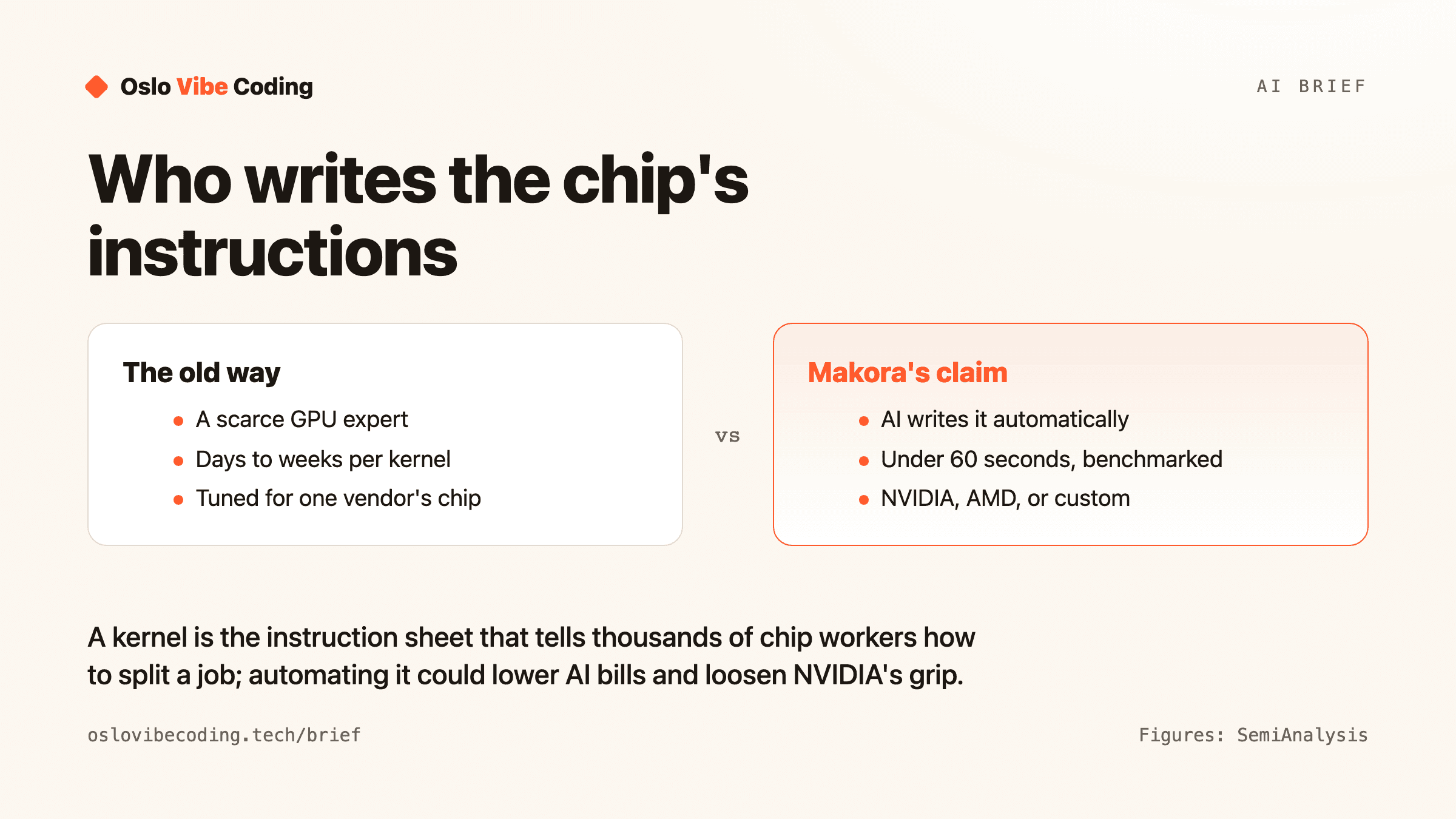
Automating the hand-tuned code that makes AI chips fast could lower everyone's AI bill and loosen NVIDIA's grip, but the speed claims still need independent proof.
What happened
A startup called Makora (an AI infrastructure company that came out of Cornell Tech) has raised an 8.5 million dollar seed round, according to SemiAnalysis's figures. The round was led by M13 (a venture capital firm), and one of the people putting money in was Jeff Dean, the chief scientist at Google DeepMind and one of the more respected engineers in the field. When someone like Dean joins a seed round personally, it is worth paying attention to what the company actually does.
What Makora does is narrow and technical, but the consequence is not. Its main product, MakoraGenerate, claims to produce a verified, benchmarked GPU kernel in under 60 seconds. To see why that sentence matters, you have to know what a kernel is.
The simple version
A GPU (the chip that runs AI, originally built for video-game graphics) does its work by splitting one big job across thousands of tiny workers running at the same time. A kernel is the instruction sheet that tells those workers exactly how to divide the task: who does what, in what order, and how they hand results to each other without tripping over one another.
Think of it like turn-by-turn directions for thousands of drivers crossing the same city at once. A rough set of directions gets everyone there eventually. A brilliant set of directions means nobody idles at a red light and nobody collides, and the whole fleet arrives far sooner. Same road, same cars, very different time.
Writing those brilliant directions is a rare and slow skill. A specialist can spend days or weeks hand-tuning a single kernel for one specific chip. Makora's pitch is that an AI can now write and check that instruction sheet automatically, in the time it takes to make coffee.
Is this new?
The problem Makora is attacking is old, and that is exactly why the timing is interesting. For years, the standard way to write these kernels has been CUDA, NVIDIA's own software toolkit. CUDA is very good, but it only runs on NVIDIA hardware, and the deep pool of engineers who know it is one of the main reasons NVIDIA is so hard to leave. There is a newer, more open option called Triton (a language, backed by OpenAI, for writing kernels without hand-writing CUDA), but the underlying skill is still scarce.
Automated kernel generation is not a brand-new dream. What is new is a company claiming production-grade, verified output at this speed, and pairing it with headline numbers. SemiAnalysis cites a technique Makora uses called Sequential Monte Carlo speculative decoding (a method for letting a model guess ahead and check its guesses in parallel) that it reports as roughly 5 times faster than SGLang, a widely used serving system, and about twice as fast as experimental overlap schedulers.
The engineers who know CUDA are one of the main reasons NVIDIA is so hard to leave.
What it means
If a kernel that used to cost weeks of expert time can be generated in under a minute, two things follow. First, the cost of running AI could fall for everyone, because faster kernels mean the same answer uses less chip time, and chip time is most of the bill. Second, Makora's stated goal is to be hardware-agnostic, generating optimized kernels for NVIDIA, AMD, or custom accelerators alike. If your code no longer has to be lovingly hand-written for one vendor, switching chips gets easier, and NVIDIA's lock-in gets a little weaker.
The honest caveat: these are the company's own benchmark figures, reported by SemiAnalysis, not yet independent results reproduced across the messy variety of real workloads. A 5x speedup on one setup is not a promise of 5x on yours, and "verified in 60 seconds" is a claim to test, not a settled fact. Automated tools have narrowed skill gaps before without fully erasing the experts.
Still, the direction is the one to watch. AI is increasingly being pointed at the plumbing that makes AI itself run. When the tools start optimizing their own foundations, the cost curve tends to bend, and that is the part worth following even before the benchmarks are independently confirmed.
AI is increasingly being pointed at the plumbing that makes AI itself run.
Curious about AI? Come build with us.
Oslo Vibe Coding runs free, beginner-friendly drop-ins where we build real things with AI. No one codes alone.