The AI race is turning into an electricity-and-infrastructure race, and on the raw power measure Google is quietly out in front.
What actually happened
SemiAnalysis, a research firm that tracks the semiconductor and datacenter industry, published a ranking of the world's largest AI computing sites. Its headline: the industry has crossed from what it calls the "megawatt era" into the "gigawatt era" (a gigawatt, or GW, is 1,000 megawatts, roughly the electrical output of a large nuclear reactor).
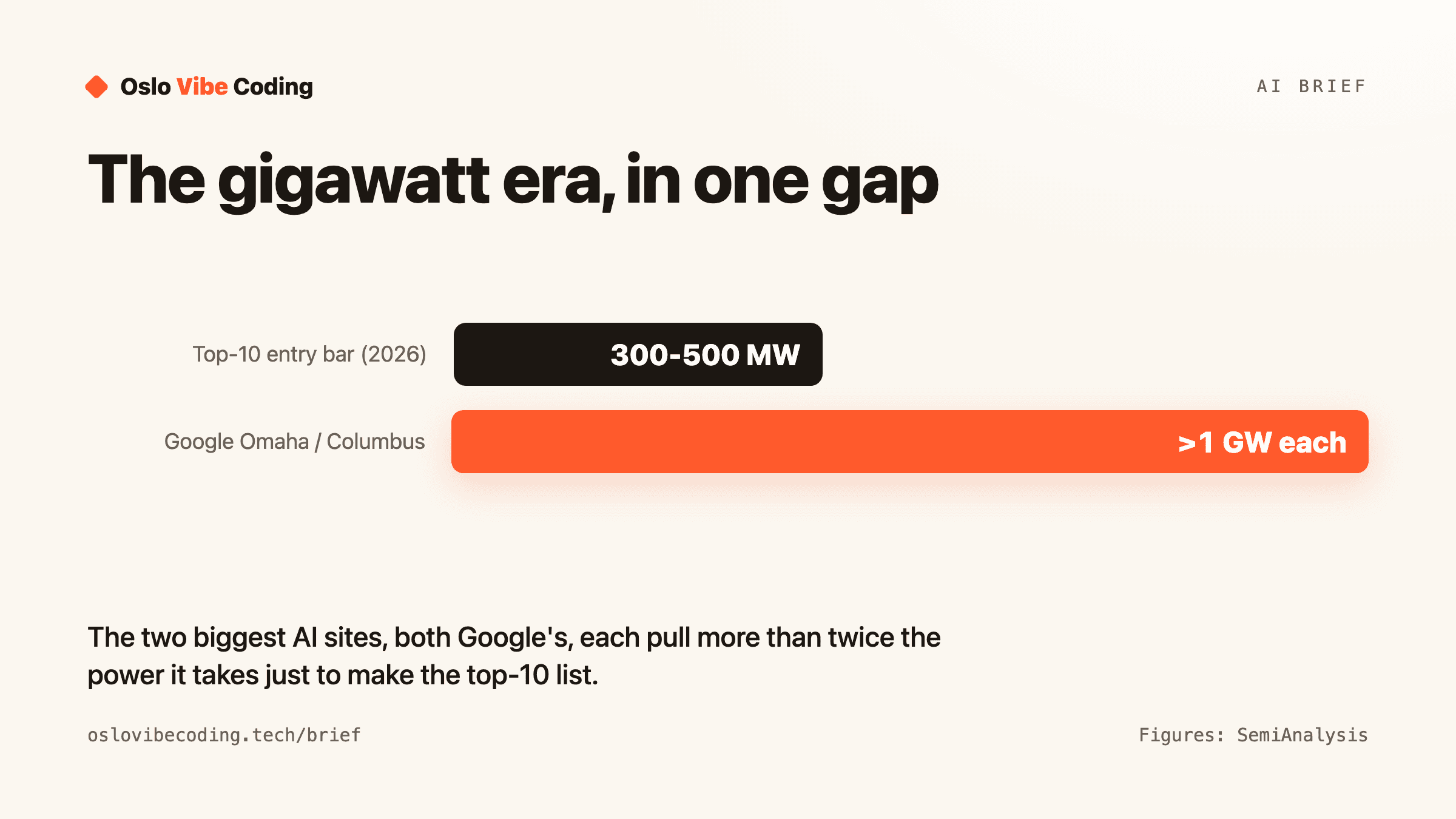
The top sites on the list now draw electricity comparable to a whole metropolitan area. According to SemiAnalysis, the two largest are both clusters run by Google, one in Omaha, Nebraska and one in Columbus, Ohio, each exceeding 1 GW of total power. Not a building's worth of power. A city's worth.
The simple version
Picture the electricity meter on the side of a house. A single home ticks over slowly. A megawatt datacenter, the kind that seemed enormous a few years ago, was like wiring up a large office block: a fast-spinning meter, but still one building.
A gigawatt site is a different category. It is as if one company plugged a single computing campus into the same wire that feeds an entire town, and the meter now spins as fast as everyone in that town combined. The jump from megawatts to gigawatts is a jump of a thousandfold in scale, and that is the line SemiAnalysis says the industry has now stepped over.
Here is the tell for how crowded this has become. SemiAnalysis reckons that for 2026, roughly 300 to 500 MW of AI power is the entry bar just to make the top-10 list. Half a decade ago that figure would have described one of the biggest datacenters on Earth. Now it barely gets you in the door.
Not a building's worth of power. A city's worth.
How you measure a datacenter that nobody announces
Companies do not publish these numbers, so the obvious question is how anyone knows. SemiAnalysis runs what it calls its Datacenter Industry Model, tracking more than 5,000 datacenters worldwide. It does not rely on press releases. It pieces the picture together from construction permits, utility power filings, and satellite imagery of the sites themselves.
That is closer to detective work than to reading an annual report. It also means the figures are careful outside estimates rather than audited disclosures, a caveat worth keeping in mind before treating any single number as gospel.
Is this genuinely new?
Datacenters have been power-hungry for decades, and the cloud has always run on very large electricity bills. So the growth itself is not new. What is new is a hard physical wall.
SemiAnalysis notes that Google, OpenAI, and Anthropic are all now doing multi-datacenter training, splitting the work of training one model across several sites at once. The reason is blunt: a single location can no longer supply enough power to train a frontier model on its own. When you have to wire together multiple campuses because no one plot of land on the grid can feed your ambitions, the constraint has stopped being about chips and started being about electricity.
The constraint has stopped being about chips and started being about electricity.
Why it matters
The quiet story in the ranking is that the AI race is increasingly an electricity-and-infrastructure race, and by this measure Google is out in front, holding the two largest sites. That is a different leaderboard from the one most people watch, which is about who has the smartest model this month.
The two are not the same, and this is the honest caveat. More power does not automatically mean better AI. A gigawatt site is an input, not an outcome, and raw draw says nothing about whether the models trained there are any good. What the numbers do show is where the real bottleneck is moving. The next phase of AI will be shaped less by clever code and more by who can get a small city's worth of electricity onto a plot of land, and then connect it to the grid.
Curious about AI? Come build with us.
Oslo Vibe Coding runs free, beginner-friendly drop-ins where we build real things with AI. No one codes alone.