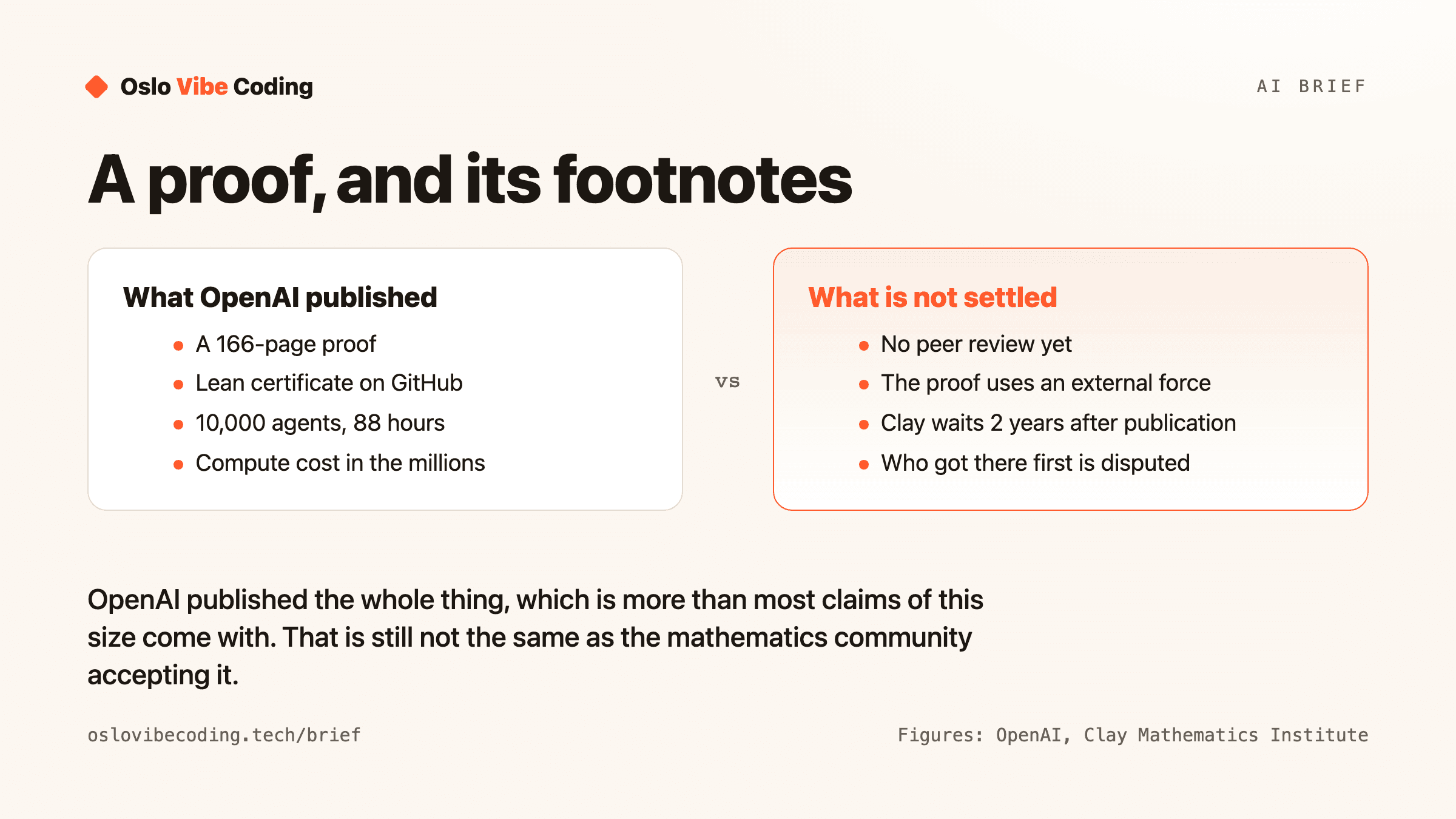
On 8 September OpenAI announced that an internal model, running as roughly 10,000 agents working in parallel for about 88 hours, produced a proof about the Navier-Stokes equations, the equations used to model how fluids move. It is one of the seven Millennium Prize Problems, each carrying a one million dollar award, and none had been solved before. The result is a negative one: OpenAI says it constructed a fluid flow that starts at rest and reaches infinite speed in finite time, which means the equations break down. The proof is public, runs to 166 pages, and comes with a Lean certificate on GitHub, meaning a computer has checked every logical step. What is not settled is larger than what is. The proof uses an external force, which the prize rules permit but many mathematicians regard as the easier version of the question. Clay's rules require publication in a refereed journal and two further years of general acceptance before any prize is considered, and OpenAI says it will not seek the money. Separately, mathematician Tristan Buckmaster has accused OpenAI of pressuring him over authorship on related work, which OpenAI denies.
What was announced
On Tuesday 8 September, OpenAI said one of its internal models had produced a proof of the Navier-Stokes existence and smoothness problem. The company describes running roughly 10,000 agents, meaning 10,000 copies of the model working on pieces of the problem at the same time, for about 88 hours. The model is not one you can buy. OpenAI says it is more capable than GPT-6 Astra, which it released a week earlier.
The Navier-Stokes problem is one of seven Millennium Prize Problems set by the Clay Mathematics Institute in 2000. Each carries a one million dollar award. One has been solved in twenty-six years, by Grigori Perelman, who declined the money.
So the claim is large, and the first instinct with a claim this large is to look for the part that is missing. In this case an unusual amount of it is present. OpenAI published the proof: 166 pages, plus a separate result on the related Euler equations. It also published a Lean certificate on GitHub, under an open licence. We checked the repository directly. It exists, it is written in Lean, and it went up on 8 September.
OpenAI also says it will not claim the prize money.
What the problem actually asks
The Navier-Stokes equations were written in the 19th century and are still what we use to model moving fluids. Weather forecasts use them. So does aircraft design, so does the modelling of blood in arteries, so does the simulation of water in an animated film.
Here is the awkward part. We use these equations constantly and we have never been able to prove they always work.
The specific question is whether a fluid that starts off smooth can stay smooth forever. Smooth here has a precise meaning: no point in the fluid ever reaches infinite speed. If a solution to the equations sends some speck of water to infinite velocity in a finite amount of time, mathematicians call that a singularity, or a blow-up. Real water does not do this. If the equations do, then the equations are not a faithful description of the thing they are supposed to describe.
The prize statement, written by Charles Fefferman, does not only reward proving the equations behave. It offers four routes. Two ask you to prove smoothness always holds. The other two ask you to produce a counterexample, a case where the flow does break down. Either direction resolves the problem.
OpenAI took the second direction. It says it constructed a three-dimensional flow that begins at rest and reaches unbounded velocity in finite time, while its total energy stays bounded. If that holds up, the equations we have been trusting for two hundred years have a hole in them.
We use these equations constantly and we have never been able to prove they always work.
The footnote that matters
The counterexample uses an external force. In the equations, that is a term representing something pushing on the fluid from outside, rather than the fluid simply being left to itself.
This is allowed. Fefferman's statement explicitly permits a smooth external force in the two breakdown routes, as long as that force obeys strict conditions and does not itself become infinite. Sneaking in an infinite force would be cheating, and nobody is alleging that.
But permitted and satisfying are different things. Most working mathematicians treat the unforced case, water left alone in a box, as the real question. You can think of the difference between proving a bridge collapses on its own and proving it collapses when you drive an approved but very heavy lorry across it. The second is a legitimate result, and the prize rules count it. It is not the thing most people picture when they hear the bridge fell down.
Terence Tao, the mathematician who has done more than anyone alive to map this problem, has raised exactly this point about the removal of forcing, and has been publicly uneasy about the whole episode for separate reasons we come back to below.
What a machine-checked proof does and does not tell you
The Lean certificate is the strongest thing OpenAI has here and it is worth understanding what it is.
Lean is a language in which mathematics can be written so precisely that a computer can verify every logical step. If a Lean proof compiles, the argument contains no gaps and no hand-waving. That is a real guarantee and it is not a small one. OpenAI says formalising the proof took a further 17 hours on top of the 88.
Think of it as a machine checking every line of arithmetic on a tax return. It will tell you, with total confidence, that the sums add up. It will not tell you that you filed the right form, or that the income was yours, or that the whole return answers the question the tax office actually asked. Lean certifies that the proof proves what it says it proves. Whether what it proves is the thing the prize was asking for is a judgement human mathematicians still have to make, and that is precisely where the argument about forcing sits.
Diego Córdoba, who helped develop the approach the proof uses, told Scientific American: "We're a little bit in shock. If it's done, that will be a big surprise for us." Luis Silvestre of the University of Chicago said simply that everyone is still discussing what it means.
Nobody in that community is saying it is wrong. They are saying they have not finished reading it. On 8 September the paper was two days old and 166 pages long.
Why nobody official will call it solved
The Clay Mathematics Institute has a procedure, and the procedure is deliberately slow. A proposed solution has to be published in a refereed mathematics journal of worldwide repute. Then it has to survive two further years of general acceptance in the mathematics community. Only after that does Clay's scientific advisory board decide whether to look at it properly.
The two-year wait exists for one reason: to give everyone time to find the mistake. Large claims in mathematics have collapsed on inspection before, sometimes years later.
Martin Bridson, the institute's president, said this week that the evaluation process "is deliberately unhurried, and we shall ensure that it is absolutely rigorous." That is an institution declining to be rushed by a press release, which is its job.
So the honest status is this. A proof exists, in public, machine-checked. It has not been peer reviewed. It answers one of the four permitted versions of the question, the version most mathematicians consider the more approachable one. And the earliest date anyone could formally be awarded the prize is somewhere in 2029.
The fight over who got there first
Running underneath the mathematics is a dispute about conduct, and it is the reason this story has stayed in the news.
In August, Tristan Buckmaster, an Australian mathematician at New York University, and Levent Alpöge, a researcher at Anthropic, used AI assistance to make progress on the Euler equations, a closely related problem. They worked through OpenAI's Codex tool. Buckmaster says they verified their result between 15 and 22 August.
Buckmaster alleges that on 6 September he received calls from Sébastien Bubeck of OpenAI offering him a choice. Either the pair publish their partial result and OpenAI announces its full solution the next day, crediting them as the closest humans to the problem. Or Buckmaster publishes and claims the prize himself, on condition that he state OpenAI's model had also solved it, and on condition that he remove Alpöge's name from the paper because of his Anthropic affiliation.
Buckmaster has also said he does not know whether his and Alpöge's private work reached OpenAI, adding: "I do not know what their model did, or how. I do not know whether our data was used."
Bubeck denies it. He says the model "independently solved the Euler problem by totally different means" and that "we did not use their prompts or proofs to prompt our models." He has called the allegation of a threat false and inflammatory, and has since said publicly that OpenAI recognises the priority of Alpöge and Buckmaster's work.
We cannot resolve this from the outside and neither can anyone else at this stage. What is worth noting is the shape of the problem. Two researchers used a company's own product to do private research, and that company then announced a result in the same area within weeks. Whether or not anything improper happened, that arrangement is going to keep producing this argument.
Is this actually new?
Computers have been part of mathematical proof for fifty years. The four colour theorem was settled in 1976 with a computer checking thousands of cases, and mathematicians argued for years about whether a proof no human could read in full counted as a proof. The Kepler conjecture, about stacking spheres, was proved in 1998 and then fully formalised by machine in 2014 precisely because the referees could not certify it by hand.
AI systems doing research-level mathematics is also not brand new. Google DeepMind's systems reached medal standard at the International Mathematical Olympiad in 2024. In August we covered a model that produced ten results nobody else had. Last week's GPT-6 Astra release included improvements to bounds on prime numbers.
Three things do look different. The scale, which is 10,000 agents and a compute bill OpenAI describes as emphatically in the millions of dollars, for one problem. The target, which is not a competition question but a named open problem with a prize on it. And the fact that a machine-checked certificate arrived on the same day as the announcement, which changes what sceptics have to argue about. They can no longer say the steps might not follow. They have to argue about whether it is the right problem.
Terence Tao's objection is about none of the above. He has said that AI companies are treating long-standing open problems as marketing proof points, and warned that "the indiscriminate strip-mining of open problems for solutions may destroy the ecosystem" that produces mathematicians in the first place. Zsuzsanna Dancso of the University of Sydney put the ethics more bluntly: mathematics has two basic principles, acknowledging your sources and acknowledging your collaborators, and in her view OpenAI "fail on both counts."
What to take from it
If you want one sentence: an AI system produced a long, public, machine-verified proof of a real open problem, in a version of that problem the prize rules allow but mathematicians consider the easier one, and it will be years before anyone official says whether it counts.
That is genuinely remarkable and it is also not the headline you will see. The headline is that AI solved a million dollar problem. The million dollars is not being claimed, and the solving is provisional.
The part worth watching is not the proof. It is what happens over the next few months as mathematicians read it. If it holds, the interesting question becomes whether the unforced case falls next, and how quickly. If it does not hold, we will have learned something about how far a machine-checked certificate can carry a claim that is still contested at the level of what was being asked.
And the credit dispute is not a sideshow. Research runs on the assumption that what you type into a tool stays yours. A large number of mathematicians now use these tools daily. This week they all had a reason to think about that.
Curious about AI? Come build with us.
Oslo Vibe Coding runs free, beginner-friendly drop-ins where we build real things with AI. No one codes alone.