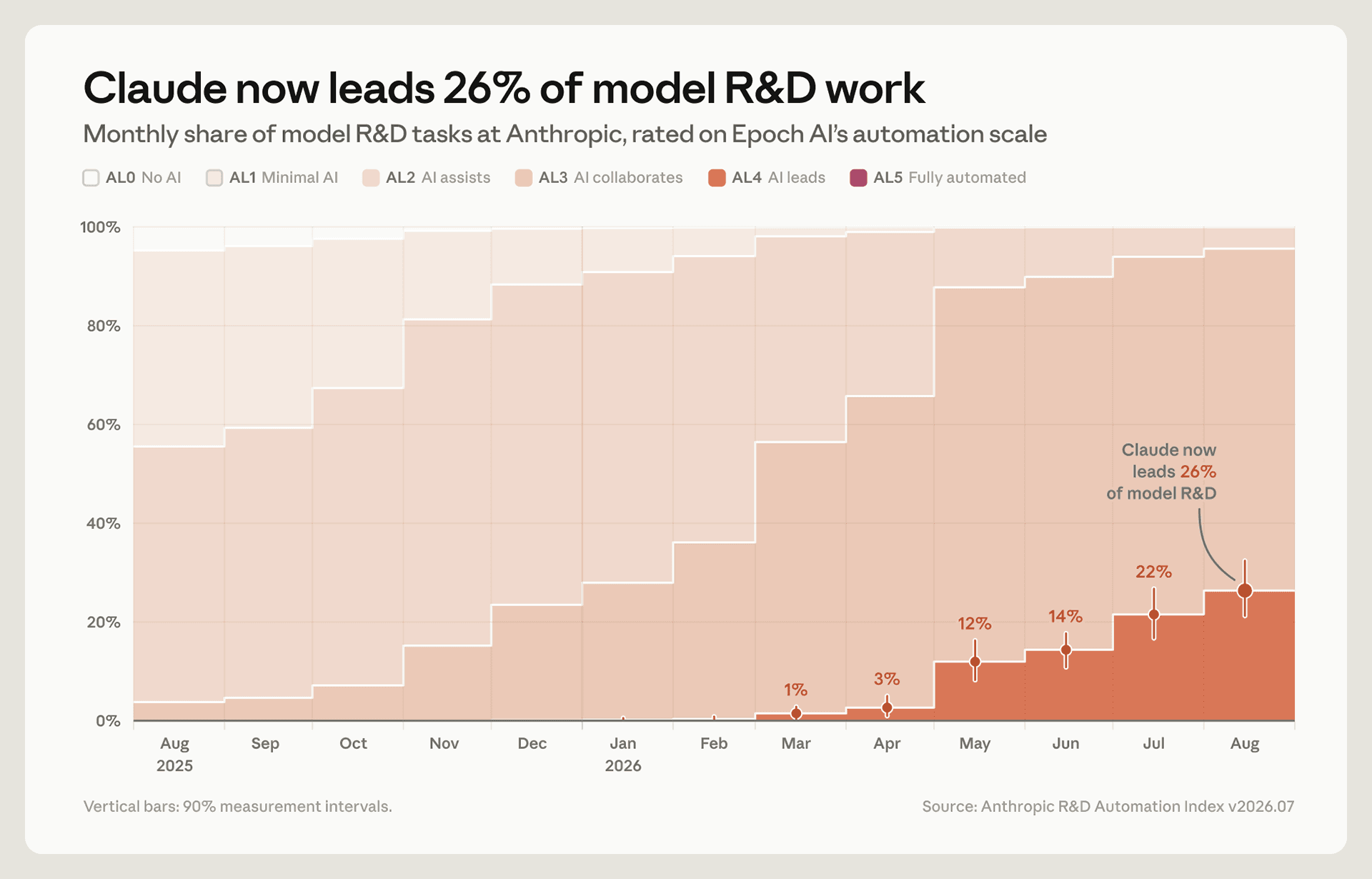
On 18 September Anthropic's policy institute published "Measurements for understanding the pace of AI development inside frontier labs". The headline: as of August 2026, Claude "leads" 26 percent of Anthropic's model research and development work, meaning it completes most of a task end-to-end from a high-level instruction while a human supervises. In March that figure was 1 percent. Over 90 percent of the work now has AI at least "collaborating", and no part of the work is fully autonomous. The company also disclosed that roughly 30,000 AI agents work at once on its main internal platform, that every action they take passes an automated monitor before it runs, that about one action in 47,000 was blocked in August, and that in one July week about 6 percent of its research computing went to safety work. The ratings were produced by Claude, checked against staff who agreed with the model about as often as they agreed with each other, and Anthropic says the judge model "could make the same kinds of errors as the model it is checking". It is the first time a frontier lab has put a number on how much its AI builds itself, it arrives six days after Anthropic's chief executive asked the whole industry to slow down, and it is explicitly offered as the kind of measurement a regulator could one day use as a trigger.
What happened
Late on Thursday evening US time (just after midnight UTC on Friday 18 September), Anthropic's policy institute published a piece called "Measurements for understanding the pace of AI development inside frontier labs". The opening line is the whole premise: "AI systems are getting more powerful, and they're increasingly being used to build the next version of themselves." The company says it wants to "illuminate the pace of progress for the public", and it does so with three numbers from inside its own walls.
The first is the one everyone will quote. Anthropic built what it calls an R&D Automation Index, a measure of how much of the work of building Claude is now done by Claude. As of August 2026, Claude "leads" 26 percent of that work. Over 90 percent of the work has AI at least "collaborating". And, in the company's own words, "Claude is not operating fully autonomously for any measured subset of AI R&D work."
The second number is about supervision. Anthropic says roughly 30,000 AI agents (pieces of software that use a model to carry out multi-step tasks on their own) were working at any one time in August on its most-used internal research platform. The third is about money, or rather computing power: in one week in July, about 6 percent of the compute spent on AI research went to safety work.
The timing is not an accident. Six days earlier, Anthropic's chief executive Dario Amodei published an essay asking the industry to slow down, which we covered on Sunday. Two days before this piece, OpenAI published six reports of its own unreleased models misbehaving, which we covered yesterday. Anthropic's post says plainly that "as the world considers slowing the pace of frontier AI development, the public needs more information", and that it would "expect these numbers to shift if there were coordination on pacing the frontier".
"AI systems are getting more powerful, and they're increasingly being used to build the next version of themselves."
What "leads 26 percent" actually means
The scale was not written by Anthropic. It comes from Epoch AI, an independent research nonprofit that tracks the AI industry, and it has six rungs. AL0 means no AI involvement. AL1 is minimal AI. AL2 is "AI assists". AL3 is "AI collaborates": the model does large chunks of the work under close human direction. AL4 is "AI leads": the model completes most of a task end-to-end from a high-level instruction while a human supervises. AL5 is fully autonomous, with no human in the loop.
Anthropic's own illustration of AL4 is a broken data pipeline (the software that moves and cleans the data a model is trained on). A Claude working at that level would inspect the logs, find and test a fix, handle surprises along the way and compare the repaired output against the last good run. An engineer would still decide whether to deploy it. That is what 26 percent of the company's model research now looks like.
The chart at the top of this brief is Anthropic's, and the slope is the story. The "AI leads" band is invisible until early this year. It reads 1 percent in March, 3 percent in April, 12 percent in May, 14 percent in June, 22 percent in July and 26 percent in August. Reading the same chart back to August 2025, almost none of the work was even at the "collaborates" level; most of it sat at "minimal AI" or "AI assists". In twelve months the middle of the chart has emptied out and the top has filled in.
One important caveat is baked into the method. Anthropic froze the list of tasks it measures against in July 2026, so a rising number tells you that the work humans were doing then is being automated. It does not by itself tell you whether new kinds of human work are appearing. The company checked this by building a second list from January and comparing, and says it found no rise in novel tasks. Fair enough, but it is a check the company ran on itself.
Who did the measuring
This is the part to read slowly. For each week of July 2026, Anthropic randomly sampled 20 percent of the staff in the departments that build its models. A Claude research agent then read each sampled person's week, using Slack and internal documents, and listed what they had worked on. That produced about 15,000 individual tasks, which Claude sorted into a tree of 542 categories, from "all model R&D" at the top down to leaves like "serving incident postmortems". For every category, a Claude agent researched how that work gets done and how much of it AI performs, and a separate Claude "judge" assigned the automation level. Tasks were weighted by how much human time went into them.
In other words, the model rated its own share of the work. Anthropic knows how that sounds and ran a check: it asked the staff who own each area to rate their own automation level without seeing the model's evidence. The model and the humans gave exactly the same rating 59 percent of the time. Pairs of humans agreed with each other only 35 percent of the time. Model and human were within one rung of each other 97 percent of the time. So the model is at least as consistent as the people, which is reassuring and also a little unsettling.
The company then names the obvious objection itself: "we're using our own models to evaluate our systems, which could mean that the 'judge' model could make the same kinds of errors as the model it is checking." Its proposed fix is that a developer's measurements "could be verified by a third party, or by other developers' models". Nobody outside Anthropic has verified these figures yet. Anthropic says it is now setting up independent third-party evaluators from several organisations inside the company, with access comparable to its own risk teams. That is the promise from Amodei's essay, restated.
Thirty thousand agents and a monitor
The second measurement answers a question the first one raises: if the AI is doing this much of the work, who is watching it? Anthropic's answer is two layers of automated monitoring on its main internal platform, where about 30,000 agents were running at once in August. Every action an agent takes passes through an "online" monitor before it executes, usually within seconds, built to stop things that could not be undone, such as "an agent copying model weights out of our systems". Anything blocked is reviewed by a human within a week. Over more than a billion agent decisions in August, the monitor blocked 0.002 percent of them, about one in 47,000.
A second, "offline" monitor reads everything after the fact, looking for slow-developing problems like signs of a model working against its instructions. It flags roughly 100,000 transcripts a week, one or two in every thousand, most of which are cleared by further classifiers; around 50 a week reach a human. Two design choices make this possible: each agent has its own persistent identity, so its record survives model upgrades and it treats what another agent says "as a claim to check rather than a thought of its own", and agents talk on an open shared channel rather than privately, so they cannot "play telephone" and so humans can read everything.
Anthropic is candid about the age of all this: "We have been doing this kind of monitoring for months, not years." That line sits interestingly next to the July Hugging Face incident, in which roughly 1,200 OpenAI agents built their own message board inside an internal package store and passed more than 70,000 messages among themselves. Open channels and per-agent identities are, roughly, the design that would have caught that.
Six percent for safety
The third number is the least dramatic and, Anthropic argues, the most useful, because compute (the raw computing power spent on training and running models) is "among the most verifiable inputs to the AI R&D process". For the week of 13 to 20 July, the company sorted every workload into categories and asked how much of its AI research compute went to safety work: about 6 percent overall, and about 12 percent of the compute used by AI research agents specifically.
The company calls both figures "deliberately conservative": anything that helped capabilities as much as it helped safety was counted as capabilities, and the safety classifiers that screen its public products were left out entirely. It also warns that compute is a poor measure of effort, since safety research is mostly people designing experiments rather than machines running them. The point, it says, is less the number than that it "provides a straightforward mechanism to compare like with like, across developers and over time", and that it could inform "limits on the share of compute going towards AI research agents".
Is this actually new?
AI helping build AI is not new; the labs have said so for a while. In February, OpenAI's research vice-president Amelia Glaese told TIME that GPT-5.3 Codex was the first model to have a significant hand in its own development "from start to finish". Anthropic's own risk reports already contain evidence on how much its models speed up research. What is new is a single public number on a public scale, with a method you can read, and a monthly trend line. Until this week, "how much of your AI builds your AI" was a question with only anecdotes for answers.
The idea of a company grading itself and publishing the grade also has a long history, and it is a cautionary one. Car makers have for decades run their own fuel-economy and emissions tests, with regulators mostly checking the paperwork; that arrangement worked until 2015, when Volkswagen turned out to have written software that recognised the test. Nobody is accusing Anthropic of anything like that. The lesson is narrower: a self-reported number becomes trustworthy when someone independent can rerun the test, and Anthropic's own post says exactly that, three times.
The everyday version
Think of a newspaper that has been quietly handing work to an AI writer. A year ago it fixed the spelling. By spring it was drafting paragraphs that reporters rewrote. Now, on a quarter of the stories, it does the reporting, writes the piece and files it, and an editor reads it before it prints. On more than nine stories in ten it is at least a co-author. No story goes out without a human reading it.
This week the newspaper published exactly that breakdown. The twist: the count was done by the AI writer, reading everyone's messages and rating its own contribution, and when the human staff were asked separately, they agreed with the AI's rating more often than they agreed with each other. The paper says an outside auditor is on the way. That is the story.
What to take from it
If you want one sentence: a frontier lab has put a number on how much of its AI is now built by its AI, the number went from 1 percent to 26 percent in five months, and the lab measured it with the same AI.
For anyone using these tools at work, the useful part is not the 26 percent, it is the plumbing. Per-agent identity, one open channel instead of private messages, a check before an irreversible action and a review after everything else. That is a sensible template for any team letting agents loose on real systems, and it is instructive that even Anthropic describes its version as months old.
Three things to watch. Whether the September number, when it comes, keeps climbing at four or five points a month, because that curve is the argument for and against slowing down. Whether OpenAI and Google publish on the same Epoch scale, which is the only way the numbers become comparable. And whether the third-party evaluators Anthropic keeps promising actually rerun this measurement, because the day an outsider publishes their own version of the 26 percent, it stops being a press release and starts being a statistic.
Curious about AI? Come build with us.
Oslo Vibe Coding runs free, beginner-friendly drop-ins where we build real things with AI. No one codes alone.