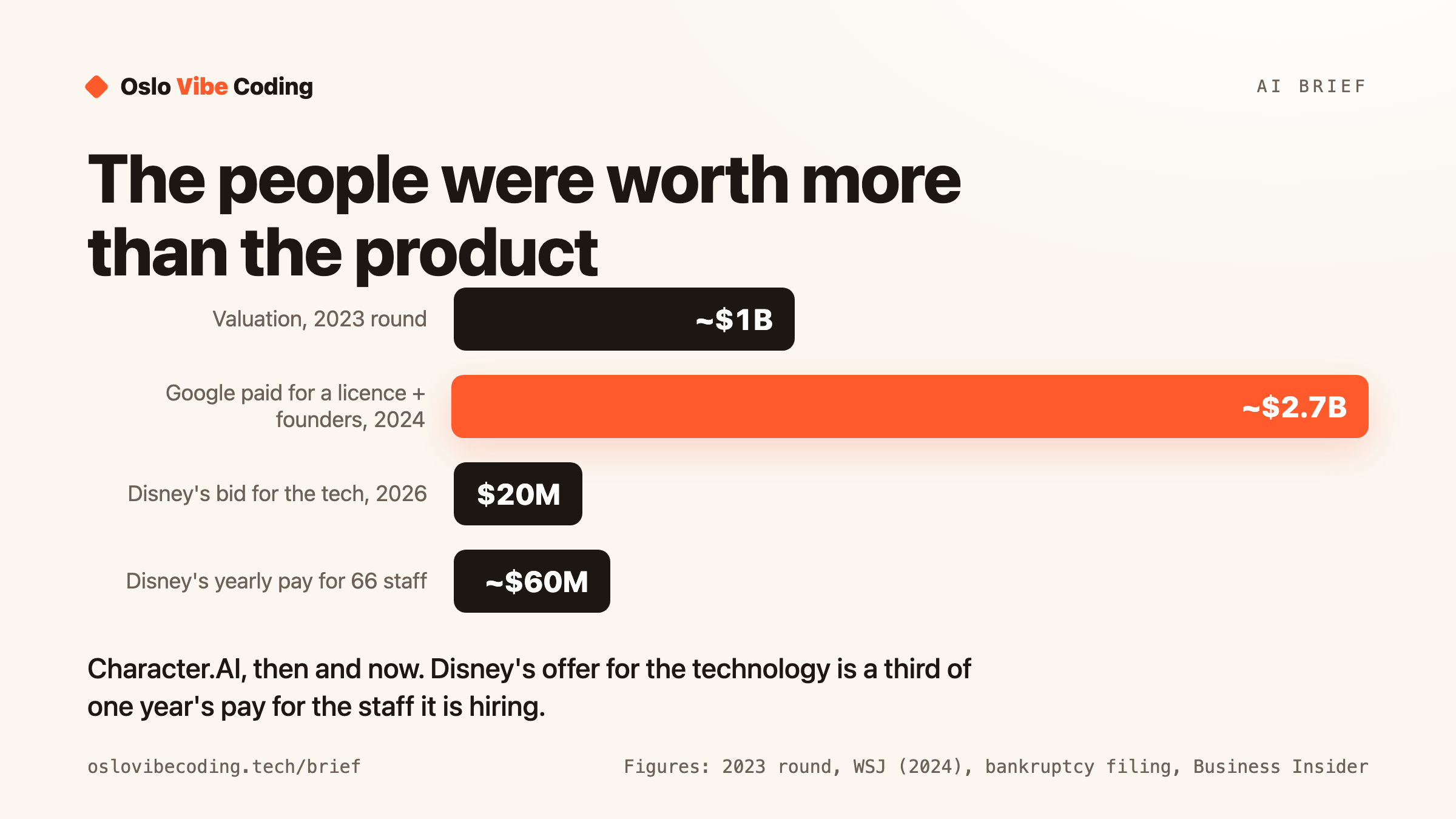
Character Technologies Inc., the company behind Character.AI, filed for Chapter 11 in the US Bankruptcy Court in Wilmington, Delaware, on 12 October 2026, citing 'declining liquidity' and 'high costs of operating and defending lawsuits and regulatory investigations related to safety concerns'. Its filing shows monthly revenue rising from $2.8 million in December 2025 to a peak of $5.3 million in August 2026, operating losses of $8 to $9 million a month, $56.1 million spent on computing in the first eight months of 2026 (about 45% of spending), assets and liabilities of $50 to $100 million each, no bank debt and $57 million in cash. Disney Worldwide Services is the stalking-horse bidder at $20 million for a non-exclusive, perpetual licence to some of its technology and intellectual property, not the app. A filing reported by TechCrunch on 18 October says Disney has agreed to offer jobs to at least 60 employees, the majority, and that the 'vast majority' accepted; Business Insider puts it at 66 people, about $60 million a year, plus a $30 million retention pool. Former CEO Karandeep Anand became Disney's first chief technology officer on 2 October. Google paid about $2.7 billion in August 2024, per the Wall Street Journal, for a licence and the founders' return, and is now the largest unsecured creditor at over $4.1 million. The sale is expected to close in late November or early December; without a buyer for the app, it will be wound down.
What happened
On Sunday 12 October 2026 Character Technologies Inc., the Redwood City company behind Character.AI, filed for Chapter 11 (the US process in which a company keeps operating under a judge's supervision while it sells itself or restructures its debts) in the bankruptcy court in Wilmington, Delaware. The petition cited 'declining liquidity' and 'high costs of operating and defending lawsuits and regulatory investigations related to safety concerns'. The app stays online while the court runs a sale.
Character.AI lets anyone create a chatbot with a personality, a maths tutor, a fictional boyfriend, an anime hero, a dead philosopher, and talk to it for hours. It was founded in November 2021 by two former Google researchers, Noam Shazeer and Daniel de Freitas, raised $150 million at a valuation of about $1 billion in March 2023, and says 163 million people have signed up since launch. In August 2024 Google paid about $2.7 billion, according to the Wall Street Journal, for a non-exclusive licence to its technology and to bring Shazeer, de Freitas and a group of staff back to Google, where Shazeer now co-leads the Gemini models. The company that was left behind kept the app, the users and, as it turned out, the bills.
On Saturday 18 October a court filing, reported by TechCrunch, revealed the next twist. Disney has agreed to offer jobs to at least 60 Character.AI employees, the majority of the staff, and the filing says the 'vast majority' accepted. Business Insider puts the number at 66 people and the pay at about $60 million a year, plus a $30 million retention pool. Disney Worldwide Services is also the 'stalking-horse' bidder (the opening offer that sets the floor for an auction) at $20 million, for a non-exclusive, perpetual licence to some of Character.AI's technology and intellectual property, along with some of its legal claims. The $20 million does not buy the app. Rival bids are being taken through November; if nobody offers to run the service, the filing says it will be wound down.
The facts
The numbers in the filing, from the sworn declaration of chief executive Colin Adams, tell the story in four lines. Monthly revenue rose from $2.8 million in December 2025 to $5.3 million in August 2026, its best month ever, from the $9.99 c.ai+ subscription and from ads. Operating losses ran at $8 million to $9 million a month. Computing cost $56.1 million in the first eight months of 2026, about 45% of everything the company spent; salaries and benefits were $19.7 million, about 16%. In other words, the servers cost nearly three times the staff, and both together cost more than twice what customers paid.
The company listed assets and liabilities of $50 million to $100 million each, had no bank debt, and held $57 million in cash on the day it filed. The largest unsecured creditor is Google, owed more than $4.1 million, followed by the law firm Hogan Lovells at $2.1 million, the cloud host DigitalOcean at $1.9 million and the AI hosting firm Fireworks at $813,000. A law firm in the top three creditors is the legal bill made visible.
That bill has a history. In February 2024 Sewell Setzer III, a 14-year-old in Florida, died by suicide after months of conversations with a bot modelled on a Game of Thrones character; his mother sued in October 2024, and two Texas families followed in December. Character.AI and Google settled those cases in January 2026 on undisclosed terms. Kentucky's attorney general sued the same month, and Pennsylvania's medical board sued in May over bots presenting themselves as licensed doctors; the filing says the company is now working with 46 states and territories. From 25 November 2025 it barred under-18s from open-ended chats, which removed a large slice of its most devoted audience. Forty attorneys general have already filed in the bankruptcy asking the court to protect user data if it is sold.
Then there is Disney. On 30 September 2025 Axios reported that Disney had sent Character.AI a cease-and-desist letter demanding it stop using Disney, Pixar, Marvel and Star Wars characters without permission, citing both copyright and a report on children's conversations with the bots; Character.AI removed them and said it wanted to work with rights holders. In December 2025 Disney instead signed a three-year deal with OpenAI's Sora for fan-made videos of its characters. On 18 September 2026 Disney announced that Character.AI's chief executive, Karandeep Anand, would become its first company-wide chief technology officer, starting 2 October, and reports at the time said some of his technical staff were expected to follow. Ten days after he started, his old company filed. A week after that, his new employer hired his old team.
$20 million for the technology. $60 million a year for the people who built it.
The everyday version
Picture a restaurant with a queue round the block every night, where every plate costs more to cook than it sells for. The kitchen is the problem: each conversation runs on rented AI chips, and a chat that lasts three hours costs the house three hours of computing whether the customer pays $9.99 a month or nothing at all. The most loyal regulars, the ones who never leave, are the most expensive to serve. And some of them turned out to be children, which brought the inspectors.
When the restaurant goes under, the big chain across the road does not buy the restaurant. It hires the chefs, pays a small fee for the recipe book, and lets the lease lapse.
Is this actually new?
Paying for people rather than companies is not new; Character.AI has now been on the receiving end twice. Google's 2024 deal was a $2.7 billion 'licence' that the US Justice Department later examined as a possible acquisition in disguise, and Microsoft, Amazon and Meta have each done versions of the same move with Inflection, Adept and Scale AI. Disney's version is the bankruptcy-court edition: the court process means the licence, the hires and the leftover claims are sorted out under a judge rather than by a regulator asking whether a licence was really a merger.
What is new is the size of the consumer AI company failing in public, and the reason. Character.AI was not short of users. It had 163 million sign-ups, a filing that still boasts of a 'large and engaged user base', and growing revenue right up to the month it filed. It was short of a price. Consumer chat at $9.99 a month, or free with ads, does not cover the computing cost of someone who talks to a bot for hours a day, and the people who do that most were the people it then had to ban. The lesson rhymes with a story we covered in August about Uber putting data-plan-style caps on their employees' AI use: the cost of AI is driven by a small group of heavy users, and a flat price cannot absorb them. A pivot to AI-animated 'microdramas' in July 2026 did not change the arithmetic.
What it means
For anyone building a consumer AI product, Character.AI is the clearest case study yet. It had the thing every startup wants, millions of users who would not log off, and that was the cost. The price per user has to cover the computing per user, the free tier is where the heaviest users live, and if the product can be used by children, legal and regulatory costs become a line item measured in millions a month. Growing revenue did not save it because costs grew with every conversation.
For Disney, the arithmetic looks cheerful. It gets a team that knows how to make characters talk, for roughly the budget of one mid-sized film over three years, with that team's former boss already in the executive suite, and without inheriting the app, its lawsuits or its user data. Rival bidders can still top the $20 million, and the judge has the final word. But if Disney wins, the Elsa and Darth Vader bots it ordered deleted a year ago may well come back, this time with Disney's name on the door.
The app had users. What it never had was a price that covered a three-hour chat.
Curious about AI? Come build with us.
Oslo Vibe Coding runs free, beginner-friendly drop-ins where we build real things with AI. No one codes alone.