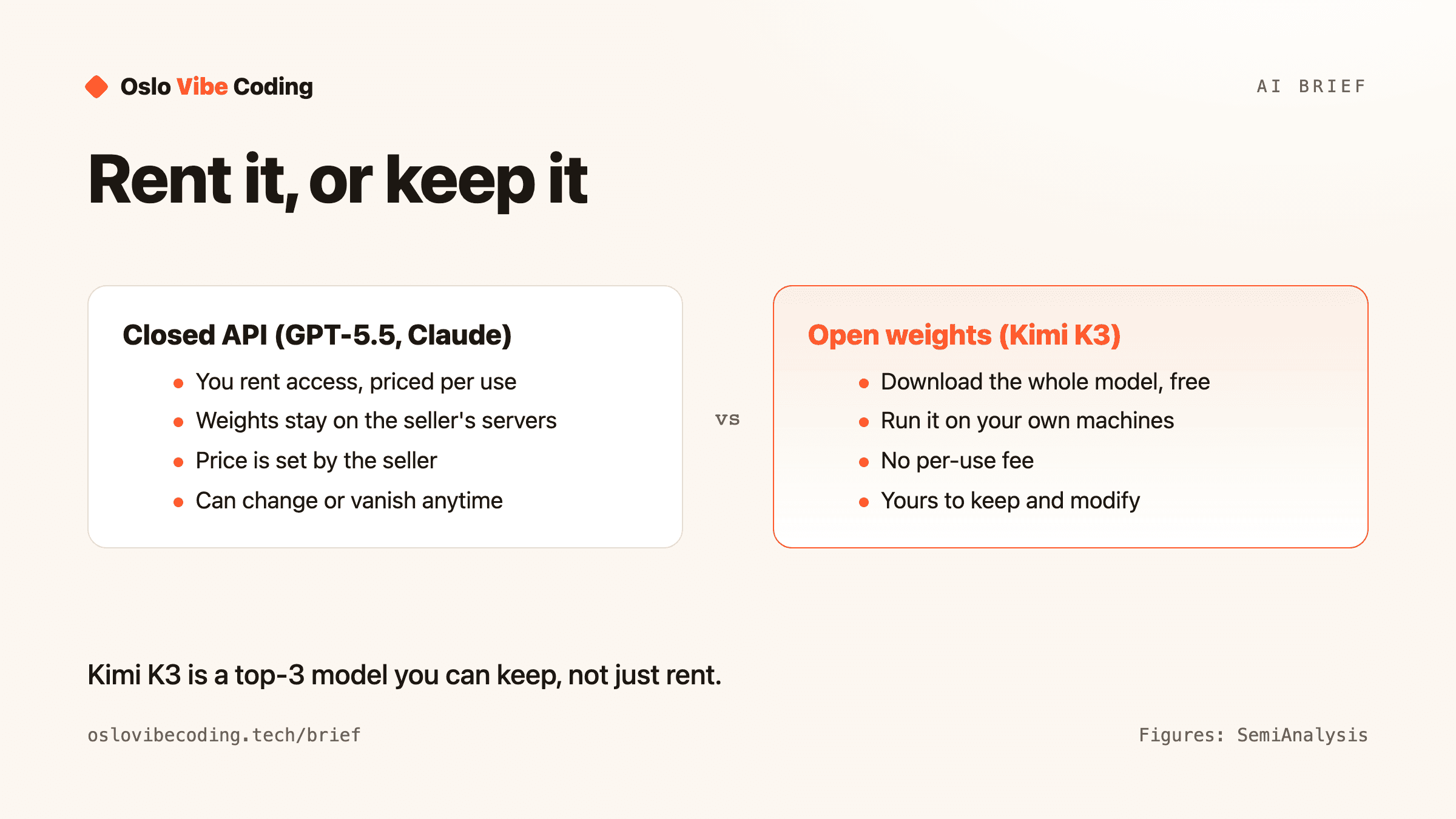
When a top-tier AI model becomes free to download, value shifts away from selling access and premium chips toward what people actually build with it.
China just released a top-3 AI model for free
On July 17 2026, a Chinese lab released Kimi K3, and by the numbers it is one of the strongest AI models in the world. SemiAnalysis, a semiconductor and AI research firm, places it above Google's Gemini on composite benchmarks (averaged test scores across many different tasks) and says it beats Anthropic's Claude Opus 4.8 and OpenAI's GPT-5.5 on many agentic suites (tests where the model has to plan and use tools, not just chat).
The headline is not only the scores. The team promised to publish the model's open weights about 10 days after launch, under a Modified MIT license (a permissive legal license that lets almost anyone use, change, and even sell versions of it). In plain terms, a model that trades blows with the best American systems is becoming free to download.
Rent the kitchen, or take the recipe home
To see why that matters, it helps to separate two ways of using an AI model. Most Western frontier models are closed APIs. An API (application programming interface) means you send your request to the company's servers and get an answer back; the model itself, its weights (the billions of learned numbers that make it work), never leaves their data centre. Think of a restaurant with a kitchen you cannot enter: you order, they cook, you pay per plate.
Open weights are the opposite. The lab hands you the recipe and the ingredients so you can cook at home. You download the whole model and run it on your own machines, with no per-use fee and nobody able to switch it off. Kimi K3 is a top-3 model you can keep, not just rent.
A model that trades blows with the best American systems is becoming free to download.
How a giant model stays cheap, and whether this is new
A fair question: does a model this large not cost a fortune to run? Kimi K3 has 2.8 trillion parameters in total, but it is a Mixture-of-Experts (a design that splits the model into many specialist sub-networks and wakes only the relevant ones for each word). So only about 32 billion parameters activate per token (per chunk of text it processes), keeping the running cost closer to a much smaller model. It also ships with a 1-million-token context window (how much text it can hold in mind at once, here roughly a long book), native vision, and an always-on reasoning mode.
Is any of this new? Open models catching up to closed ones is a trend, not a first. Meta's Llama models and earlier Chinese releases like DeepSeek already showed the gap closing. What is new is the position. This is not a good-enough free option sitting a step behind the leaders. By SemiAnalysis's benchmarks, it is at the front.
Why chip stocks flinched
There is a hardware twist. Kimi K3 uses MXFP4, a 4-bit number format (a way of storing the model's numbers in far less memory) supported by Nvidia's Blackwell and AMD's MI400 chips. SemiAnalysis frames the model as designed to run well on Chinese accelerators (the specialised chips that run AI), a way to work around US limits on exporting the most advanced hardware to China. When it launched, chip stocks sold off on the Nasdaq (the tech-heavy US exchange) and Tokyo's Nikkei. The worry is simple: if a free model this capable can run on cheaper, non-US chips, the premium on frontier hardware and paid access looks less certain.
Two cautions are worth holding. Benchmark leadership is narrow and shifts monthly, so "top-3 on these tests" is not the same as best for your task, and the weights were promised at launch, not yet fully public. And a market dip on launch day is a mood, not a verdict. Still, the direction is worth watching. For anyone learning to build with AI, the practical takeaway is good news: the best tools are getting cheaper and more open, not less.
A market dip on launch day is a mood, not a verdict.
Curious about AI? Come build with us.
Oslo Vibe Coding runs free, beginner-friendly drop-ins where we build real things with AI. No one codes alone.