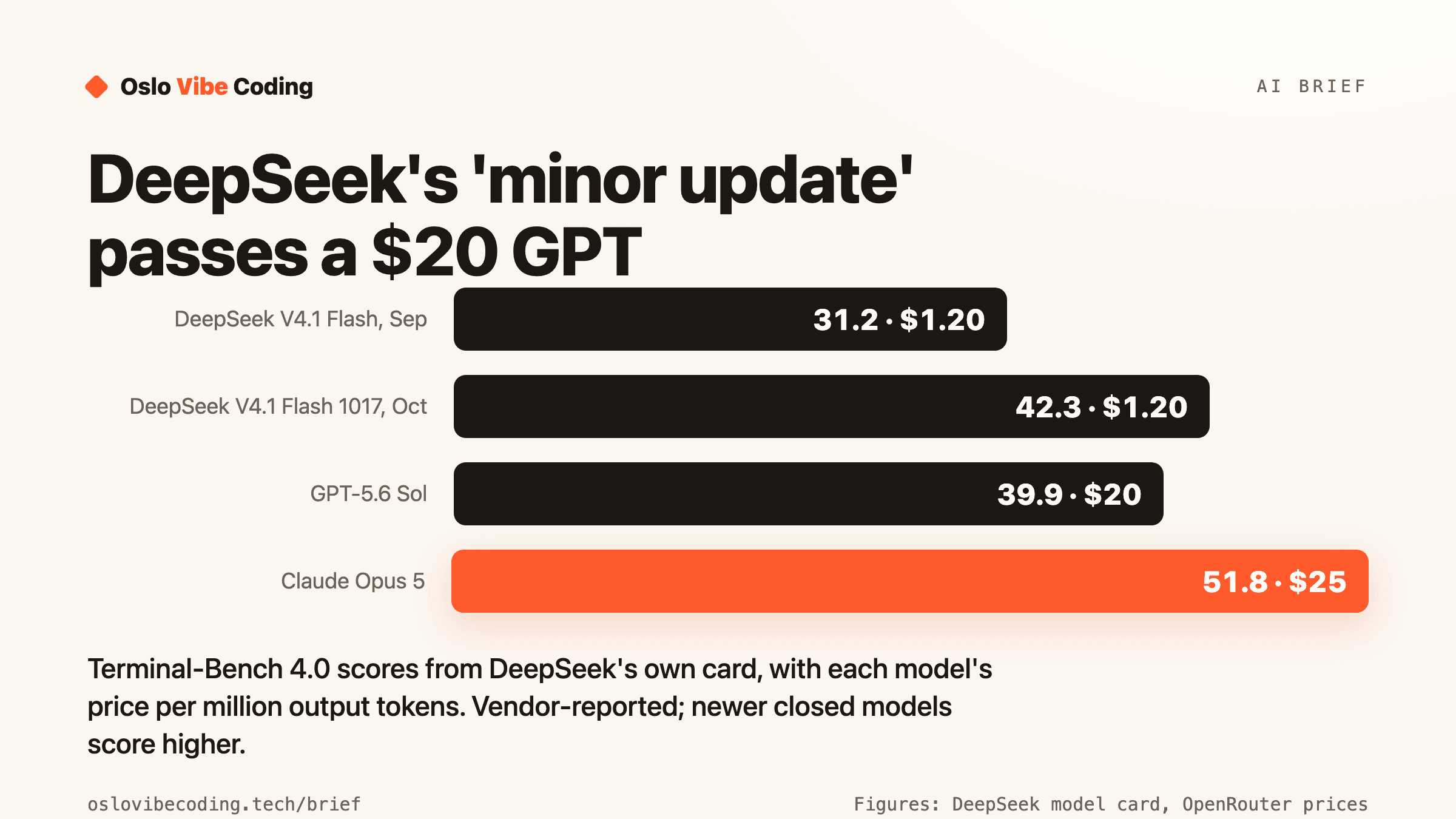
On 17 October 2026 DeepSeek released DeepSeek-V4.1-Flash-1017, an updated version of its cheap Flash model, with weights downloadable under the MIT licence and the price unchanged at $0.30 per million input tokens and $1.20 per million output tokens at peak hours (half that off-peak). Its model card calls it 'a minor update' with 'substantial improvements' and reports Terminal-Bench 4.0 rising from 31.2 to 42.3, above GPT-5.6 Sol at 39.9 and below Claude Opus 5 at 51.8; across the card's eleven rows it beats GPT-5.6 Sol on nine and Opus 5 on four. Those are vendor numbers against summer-vintage closed models; Google's Gemini 4 Argon card puts Opus 5.5 at 66.4 on the same test. Artificial Analysis independently scored the model 45 on its Intelligence Index, tied with GLM-5.3 and one point behind MiMo V2.6 Pro among open models, 13 points behind Claude Opus 5.5 at 58, at 216 tokens per second. GPT-5.6 Sol and Claude Opus 5 cost $20 and $25 per million output tokens on OpenRouter. Per task at maximum effort the cost advantage narrows because the model thinks at length. MiniMax launched M3.1 Flash at the same $0.15 and $0.60 prices two days later.
What happened
On Friday 17 October 2026 DeepSeek (the Hangzhou AI lab whose cheap R1 model knocked about a trillion dollars off tech stocks in January 2025) published DeepSeek-V4.1-Flash-1017. The number is the date. The model card on Hugging Face (the site where open AI models are shared) describes it as 'a minor update to DeepSeek-V4.1-Flash, delivering substantial improvements across reasoning, coding, agentic tasks, and visual benchmarks'. Hacker News, the developers' news board, put the release at number one with more than 950 points and 700 comments, and a good share of those comments were about that sentence. One: ''a minor update' they say before showing off benchmarks that display a substantial improvement.'
Flash is DeepSeek's cheap, fast tier; Pro is the big one. The 1017 version is already live on DeepSeek's website, app and API (the paid connection developers use), and the weights (the model file itself) can be downloaded under the MIT licence, which means anyone can run it, modify it and sell services on it with no fee and no permission. DeepSeek's announcement promises 'stronger benchmark performance, faster task completion, and shorter outputs than the previous version' and calls the result 'a Pareto improvement in performance and cost', economist-speak for better on one axis without getting worse on the other.
The price did not move. DeepSeek charges $0.30 per million input tokens and $1.20 per million output tokens at peak hours, and half that off-peak (a token is roughly three-quarters of a word; output is what the model writes, and it is the expensive part when an AI agent writes code for hours). For comparison, on OpenRouter (a marketplace that resells access to most models at list price) OpenAI's GPT-5.6 Sol costs $4 and $20, and Anthropic's Claude Opus 5 costs $5 and $25. On output, DeepSeek is about seventeen times cheaper than the GPT it claims to beat.
The facts
The claims come from DeepSeek's own table, so treat them as vendor figures until someone else repeats them. On Terminal-Bench 4.0 (a test where the AI must finish real tasks in a computer terminal with no human help) the new model scores 42.3, up from 31.2 for the September version, against 39.9 for GPT-5.6 Sol and 51.8 for Claude Opus 5. On DeepSWE v1.1 (fixing real bugs in real code repositories) it reports 77.0, ahead of both Opus 5 at 74.0 and Sol at 73.0. Counting across the card's eleven rows, 1017 beats GPT-5.6 Sol on nine and Claude Opus 5 on four. It also beats the two other big Chinese open models, Kimi K3 and GLM-5.3, on every row where all three are scored.
Two caveats are printed in the card's own footnotes. DeepSeek ran Terminal-Bench 4.0 inside Anthropic's Claude Code harness (the software wrapper that lets a model use a terminal), and harnesses move scores a lot. And the rivals in the table are not the newest ones: OpenAI has since shipped GPT-6 Astra and GPT-6.1 Sol, and Anthropic has shipped Claude Opus 5.5. Google's model card for Gemini 4 Argon, published last week, lists Terminal-Bench 4.0 at 57.4 for Argon, 58.2 for GPT-6 Astra and 66.4 for Opus 5.5, all well above DeepSeek's 42.3, though those runs used different settings and are not directly comparable either.
The independent check arrived on Monday. Artificial Analysis, a firm that re-runs its own battery of tests on every major model, scored the 1017 model at its maximum reasoning setting 45 on its Intelligence Index. That ties it with GLM-5.3 and Qwen3.8 Max near the top of the Chinese open-weight group, one point behind MiMo V2.6 Pro at 46, and 13 points behind Claude Opus 5.5 at 58, the current number one; it sits around 30th on the full table once every variant of the closed models is counted. The same page measured 216 output tokens per second, roughly twice the speed of most frontier models. Meta's Muse Spark Open, the 'most capable US open-weight model' we covered last week, scores 39 on the same index.
One more number from that page matters to anyone paying by the task rather than by the token. A Hacker News commenter noticed that GPT-6.1 Sol at medium effort worked out cheaper per task than DeepSeek 1017 at maximum effort, $0.21 against $0.26, and finished in 2.9 minutes against 4.9, because the DeepSeek model thinks at length before it answers. Per token it is the cheapest frontier-class model there is. Per task, at full effort, the gap narrows a lot.
Per token it is seventeen times cheaper than the GPT it beats. Per task, at full effort, the gap with OpenAI's newer GPT-6.1 Sol nearly closes.
The everyday version
Think of a supermarket own-brand that keeps its price and quietly changes the recipe. Last autumn's version was fine for everyday use. This month's beats the big-name brand's product from the summer in a blind tasting, at a seventeenth of the price. The big-name brand has a newer recipe on the shelf that still wins the tasting, but it costs seventeen times as much, and the gap in quality is now smaller than the gap in price.
That is the trade developers are making this week. The question is no longer 'which model is best' but 'which one is good enough for this job, and what am I paying for the difference'.
Is this actually new?
The pattern is not new; the pace is. DeepSeek's V3 in December 2024 and R1 in January 2025 set the playbook: match last season's closed models, release the weights, charge a tenth of the price. What has changed in 2026 is that the catch-up interval has shrunk to months and the Chinese labs now race each other as hard as they race the Americans. Two days after this release, on Monday 19 October, MiniMax (a Shanghai lab) launched M3.1 Flash at $0.15 and $0.60 per million tokens, the same as DeepSeek's off-peak price, claiming nearly three times faster inference, though its weights are 'to be released later' and its blog names no rival for comparison. DeepSeek's V4.1 Flash also arrived in September with a research paper on compressing the model's working memory, which is part of why it is fast.
The Hacker News mood was mostly delight with a few sharp edges. One user reported 'around 3 hours' of heavy development on the model for about $0.40. Another said that this month they had 'more tokens and more capabilities on OpenCode at $8/month via DS 4.1 flash, than I had on a $200 account in June with the American providers'. A more measured voice: 'DS isn't better than Sol and Gemini in the benchmarks, but after working with them all for a while now I'm beginning to understand why people find DS feels so much better', citing speed and being able to see the model's reasoning. The complaints were about the name ('Why didn't they name it 4.2 Flash?'), about censorship of Chinese political topics, and about size: a model this large cannot run on a home PC, so in practice you rent it from a cloud.
What it means
For a community building apps with AI, the practical rule this week is the split several Hacker News users described: a cheap open model for the bulk of the agent's typing, and a top closed model for planning and review. At a seventeenth of the price, a wrong answer from DeepSeek costs less than a right one from Opus, provided something checks the work. Watch effort settings, because at maximum effort the cheap model can take twice as long and lose its per-task edge. And, as Saturday's OpenCode breach showed, whichever model you pick, put a spending cap on the key.
For the industry, two things to watch. Whether independent scores keep tracking DeepSeek's own table (so far roughly yes, with the usual vendor shine on top). And whether the price gap holds: OpenAI and Anthropic charge $20 to $25 per million output tokens for their flagships because enough customers pay it. Every 'minor update' from Hangzhou that lands within reach of those flagships makes the premium harder to defend. The frontier is still American, by 13 points on the independent index. The frontier of what most people can afford is increasingly Chinese.
The best model is still American. The best model most people can afford is increasingly Chinese.
Curious about AI? Come build with us.
Oslo Vibe Coding runs free, beginner-friendly drop-ins where we build real things with AI. No one codes alone.