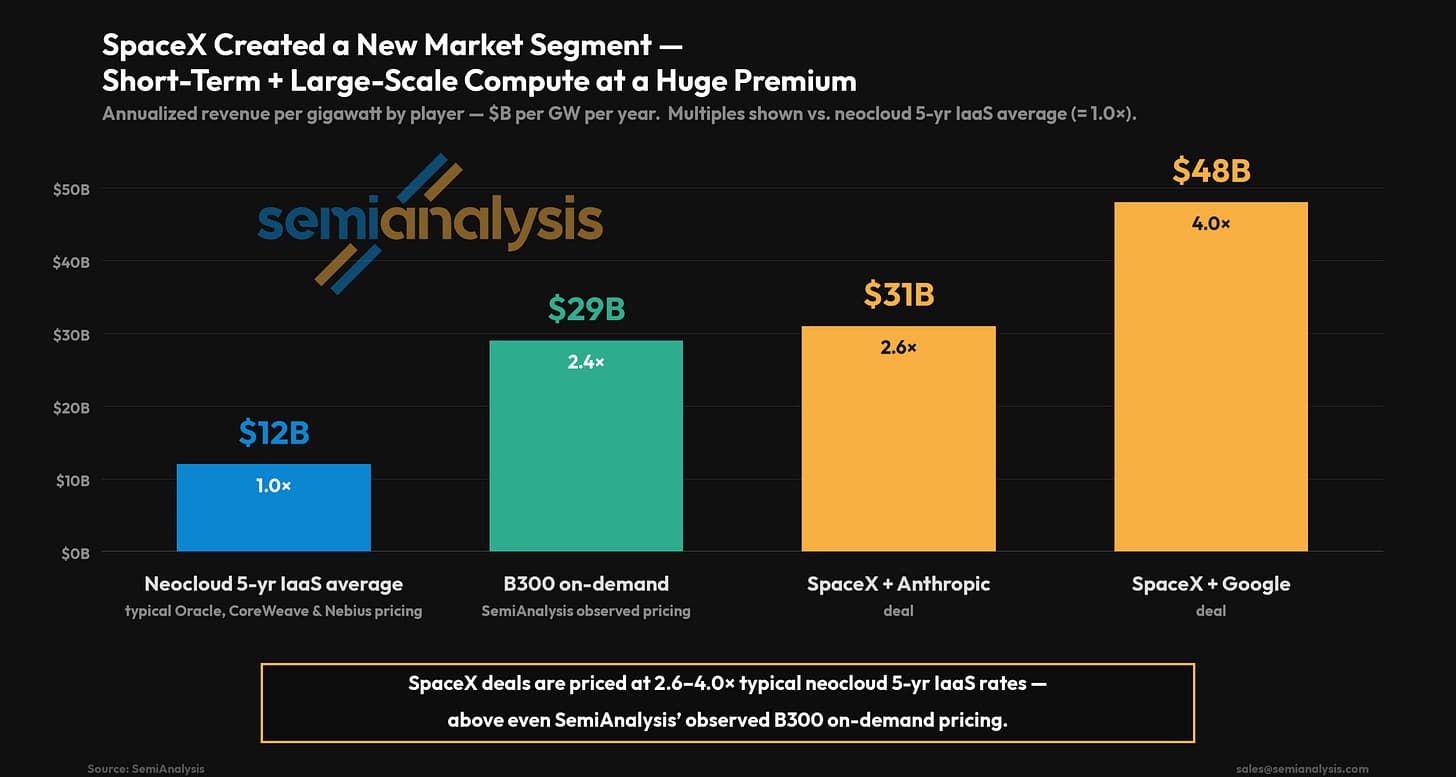
The same chips drawing the same electricity sell at four very different prices, and the difference is almost entirely in how the contract is written. Customers pay a large premium for the right to walk away at short notice, and only landlords with enormous balance sheets can offer those terms. That gap is why the buildout keeps accelerating even when the market looks oversupplied.
The short version
In an analysis published on 2 July, the research firm SemiAnalysis made a claim that sounds like a typo. If Meta set aside just 200 megawatts of its computing capacity for outside customers, at the prices SpaceX has been getting for similar deals, that would be roughly $10B a year of revenue, at very high margin.
To see why that is strange, you need the units. A megawatt is a measure of electricity draw, and the AI industry now sizes its datacenters in power rather than in machines, because power is the thing actually in short supply. A gigawatt is a thousand megawatts. In the first six months of 2026 alone, Meta contracted over 5 gigawatts of capacity. So 200 megawatts is about four per cent of half a year's shopping, and it would be a top-thirty business in its own right.
What a compute landlord is
Training and running AI happens on racks of specialised chips inside large buildings. Somebody owns the building, the chips and the power contract. Somebody else needs to use them and would rather not build their own. So the owner rents access, by the hour or by the year.
The industry nickname for a company that does only this is a neocloud, a newer, AI-focused rival to the established clouds run by Amazon, Microsoft and Google. CoreWeave and Nebius are the best known. They are landlords, and what they own is expensive, depreciating and useless if it sits empty.
Which means this behaves like any other rental market. The rent depends far less on the flat than on the lease.
Why the same electricity sells at four prices
The chart above is SemiAnalysis's, and it puts annualised revenue per gigawatt per year side by side. A typical neocloud five-year contract earns about $12B per gigawatt per year. That is the baseline. On-demand pricing for a current NVIDIA B300 chip runs about $29B, roughly 2.4 times the baseline. SpaceX's compute deal with Anthropic works out around $31B, about 2.6 times. SpaceX's deal with Google reaches roughly $48B, four times the baseline rate.
Same class of chip. Same electricity. Four times the money.
The everyday version of this is your own housing costs. A five-year lease on an unfurnished flat gets you the cheap monthly rate, because the landlord knows the place is full until 2031. A furnished serviced apartment you can leave on 90 days' notice costs several times more per month, and nobody thinks that is a scandal. Both sides know exactly what the premium buys. SemiAnalysis reports that the SpaceX deal with Google carries 90-day cancellation options, which is precisely the serviced-apartment arrangement, at gigawatt scale.
So the premium is not really for the chips. It is for the right to change your mind. In a field where the next model, the next chip generation and the next demand surge are all genuinely unknown, being able to walk away in three months is worth paying several times over for.
The premium is not for the chips. It is for the right to change your mind.
Why the small landlords cannot charge it
Only a landlord who can absorb an empty building can offer 90-day terms. This is where the neoclouds are stuck. To finance a large cluster they generally have to borrow against a signed tenant first, which means securing a multi-year commitment before the thing gets built. SemiAnalysis puts it bluntly: the financing burden excludes the neoclouds from that market entirely. The flexible, expensive end is structurally closed to them, no matter how well they run their operations.
That was the actual point of the analysis. On 1 July, after Bloomberg reported that Meta was considering renting out spare capacity, shares in CoreWeave and Nebius fell more than six per cent on fears of a flood of new supply. SemiAnalysis called that reaction erroneous. Meta showing up is not a company about to undercut them on five-year leases. It is a company with the balance sheet to chase a premium tier the neoclouds cannot reach at any price.
A Norwegian price check
A month later there was a clean way to test the numbers, and it happened here. On 4 August, Bloomberg reported that Anthropic had signed a six-year, $10B deal for computing capacity with Volta Infra, a cloud startup founded in January by former Brookfield Asset Management executives and backed by NVIDIA, Andreessen Horowitz, Altimeter and Azora. The capacity is 133 megawatts at a site in Norway, operated with Bitdeer, a bitcoin miner that runs datacenters, running NVIDIA's Vera Rubin chips.
Run the arithmetic against the chart. $10B spread over six years is about $1.67B a year. 133 megawatts is 0.133 of a gigawatt. That comes out at roughly $12.5B per gigawatt per year, which lands almost exactly on the cheapest bar in the chart: the standard five-year neocloud rate. A long commitment gets the baseline price, about a quarter of what SpaceX reportedly charged Google for flexibility.
Two honest caveats. These are reported figures, and Anthropic declined to comment on them. And a six-year contract is rarely paid in six equal instalments, because capacity ramps up, so the early years usually cost less than the average. This is an order-of-magnitude check, not an audited rate card. But the order of magnitude is the whole point, and it holds.
It is also worth noticing where that capacity is. Cheap power, a cool climate and a six-year tenant with a very large balance sheet. Norway is now in this market.
A long commitment gets the baseline price. Roughly a quarter of what flexibility costs.
Is this new?
Renting out computing is the oldest idea in the cloud. Amazon turned its own internal infrastructure into a product and built a giant business out of it, and Microsoft and Google followed. What has changed is which part of the stack is scarce. For twenty years the hard parts were software and operations, and that is where the margin sat. Now the hard parts are power and chips, and the money is decided in the contract terms.
It is also worth being clear about what has not happened. Meta Compute, the internal name for this effort, has not launched. Reports say Meta is weighing two shapes for it: hosting its own closed-weights Muse Spark model for developers, similar to Amazon's Bedrock, or selling raw capacity the way a neocloud does. The effort is reportedly led by Santosh Janardhan on infrastructure, Daniel Gross of Meta Superintelligence Labs, and president Dina Powell McCormick. In July, Meta was reported to be in early talks with Anthropic about a lease worth up to $10B over two years. Those talks were reported as early stage, and the deal Anthropic actually signed a few weeks later was with Volta, not Meta.
What it means
This is the missing piece in the argument about whether AI is overbuilt. If the only use for a datacenter were training a frontier model, then betting five gigawatts on that being worth it would be reckless. But the same capacity can be pointed at ads recommendation systems, at hosting models for developers, or rented at a premium to whoever needs 200 megawatts next quarter. SemiAnalysis's argument is that this optionality is what justifies contracting so aggressively. The building does not need one plan to work. It needs any of four.
Keep the stakes measured, though. These are outside estimates of private contracts, and $48B per gigawatt is a rate observed in a small number of unusual deals, not a market-wide price anyone can go and get. If the flexible tier stops commanding its premium, or if enough capacity arrives that tenants stop paying for optionality, the arithmetic that makes all this look sensible changes quickly.
For now, though, the price of being able to change your mind is around four times the price of committing. That gap is quietly doing an enormous amount of work in the AI economy, and it is why so many companies that have nothing to do with renting out computers have suddenly decided they would like to be landlords.
The building does not need one plan to work. It needs any of four.
Curious about AI? Come build with us.
Oslo Vibe Coding runs free, beginner-friendly drop-ins where we build real things with AI. No one codes alone.