Reshuffles at the top rarely change what a model can do next month. What this one signals is that Google is treating its AI unit as an operating business rather than a research institute, and that the people who built the foundations are now willing to leave.
The short version
On Wednesday 5 August, Sundar Pichai published a post called "The next chapter of our AI momentum". It announced three things at once, and the third is the one that made people sit up.
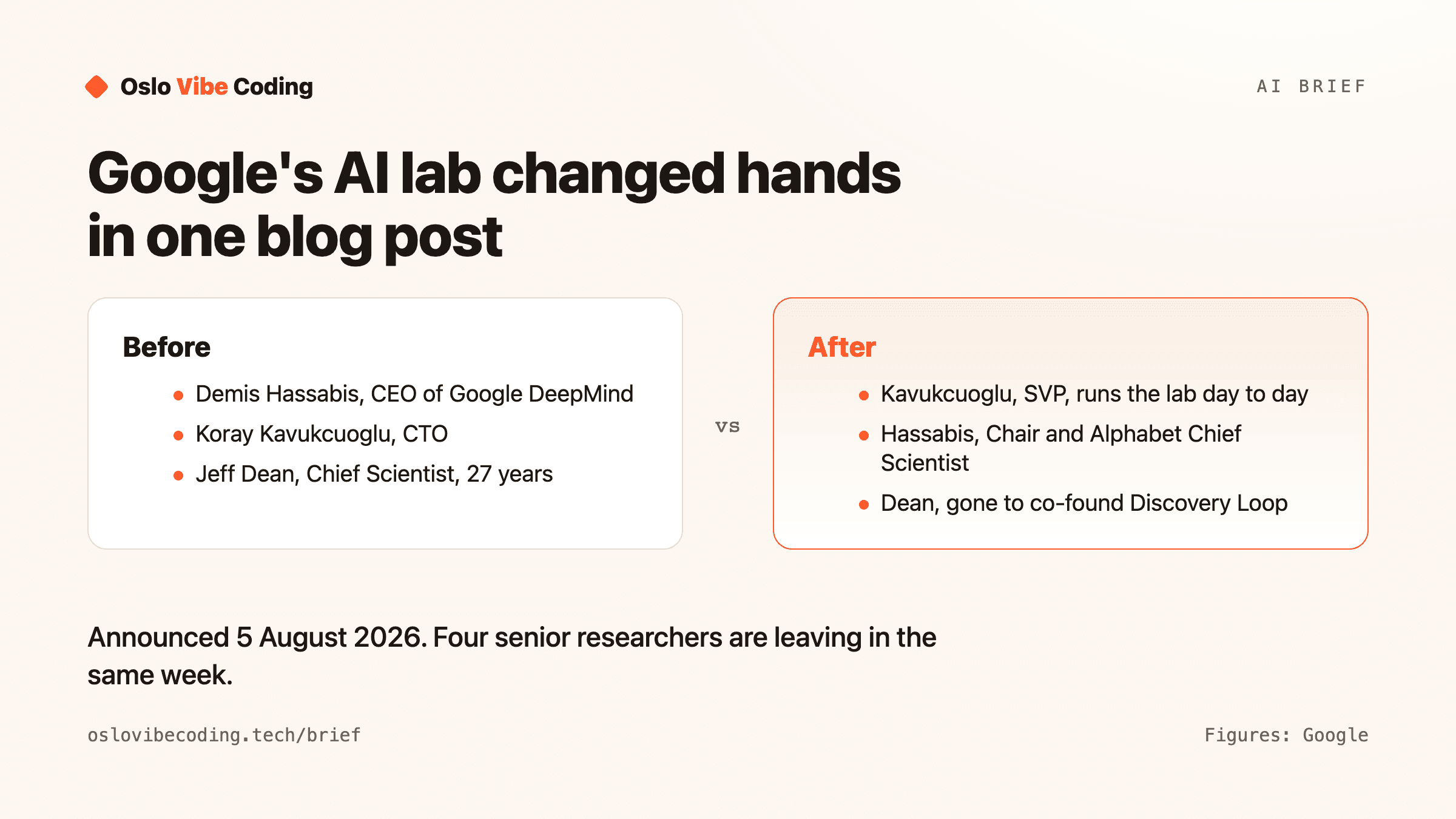
Demis Hassabis, who co-founded DeepMind in 2010 and has run Google's AI research ever since, steps out of the day-to-day job. He becomes Chair of Google DeepMind and Chief Scientist of Alphabet, Google's parent company, while continuing to run Isomorphic Labs, the drug discovery company spun out of DeepMind. He said he wanted room to focus on the bigger picture.
Koray Kavukcuoglu, DeepMind's chief technology officer and a 13-year veteran of the lab, takes over the operational job as senior vice president, reporting directly to Pichai. Gemini model development, frontier research, and the Gemini app and developer teams all now run through him.
And Jeff Dean is leaving Google after 27 years.
Why the third one matters most
If you have not heard of Jeff Dean, here is the short reason to care. Alongside Sanjay Ghemawat, who is leaving with him after his own 27 years, Dean built much of the machinery that made Google possible at scale, and then made it public. MapReduce, a way of splitting an enormous computation across thousands of ordinary machines. Bigtable and Spanner, the databases that hold Google's data across the planet. TensorFlow, the software that a generation of researchers used to train neural networks.
Those ideas did not stay at Google. They were published, copied, and rebuilt in the open, and they underpin a large share of how the modern internet stores and processes anything. If you have used a service that handles data at scale, you have used a descendant of this work.
Dean and Ghemawat are leaving to co-found Discovery Loop, structured as a public benefit corporation, aimed at using AI to speed up scientific research. Reporting says two more senior Google researchers, Quoc Le and Oriol Vinyals, are going with them. Vinyals was one of the leads on Gemini.
He is also not the first out of the door this year. John Jumper, who shared the 2024 Nobel Prize in Chemistry for AlphaFold, DeepMind's protein structure work, left earlier in 2026 for Anthropic.
Two people with 27 years each, and two senior researchers, leaving in the same week as the reorganisation.
An analogy for what actually changed
Picture a football club where the long-serving manager moves upstairs to become director of football. He keeps the title, the respect and a say in the long-term direction, and he stops picking the team on a Saturday. His assistant of thirteen years takes the touchline and now reports straight to the owner.
In the same week, two players who have been at the club since before anyone can remember announce they are leaving to start their own club.
None of that changes the result of next weekend's match. All of it tells you something about where the club thinks it is.
Is this actually new?
Partly. Google has restructured its AI operation before, and recently.
Until 2023 the company ran two separate AI groups: Google Brain, in Mountain View, which Jeff Dean led, and DeepMind, in London, which Hassabis ran. They had different cultures, different priorities and a certain amount of rivalry. That year Google merged them into a single unit called Google DeepMind, and Dean moved into the role of chief scientist.
What happened last week finishes that job. The centre of gravity moves to Mountain View, the reporting line runs to Pichai, and the communications, legal and marketing teams fold back into Google proper. Lila Ibrahim, the chief AI readiness officer, now reports to James Manyika. This is a research lab being absorbed into an operating company.
So the structural direction is not a surprise. The departures are.
The context nobody at Google will say out loud
Google invented the transformer, the architecture underneath essentially every large language model in use today, in a 2017 paper. It then watched OpenAI turn that idea into the product that defined the category.
Since then Google has been in a long catch-up, and by most external accounts Gemini has closed a lot of the gap. But the two labs setting the pace commercially are OpenAI and Anthropic, and the reorganisation is widely read as Google deciding that shipping is now the constraint rather than research.
That reading is reasonable, and it is still a reading. Pichai's post frames it as momentum, not repair, and a company with Google's resources reorganising is not evidence of trouble on its own.
What to watch
Two things, and neither is the next model release.
The first is whether more people leave. A reorganisation that costs you four senior researchers in a week is one story. If the number keeps climbing through the autumn, it becomes a different one, and Google's ability to hold onto the people who can build frontier systems becomes the actual news.
The second is what Discovery Loop turns out to be. A public benefit corporation aimed at scientific discovery, founded by four people of this calibre, will have no trouble raising money. Whether it produces something is a question for 2027, but it is now the third serious attempt in as many years at pointing AI at science rather than at chat.
For everyone else, the practical effect this month is close to zero. Gemini keeps shipping, the apps keep working, and the people who decide what gets built next have new titles.
Curious about AI? Come build with us.
Oslo Vibe Coding runs free, beginner-friendly drop-ins where we build real things with AI. No one codes alone.