You no longer need a mega-lab budget to ship a competitive open model, but $20M "cheap" is still a rich person's kind of cheap.
What actually happened
Arcee, a small US startup, has released Trinity, a family of AI models it trained itself from scratch. The flagship, Trinity Large, is a roughly 400-billion-parameter model (parameters are the internal numbers a model learns during training; more of them usually means more capacity). It uses a Mixture-of-Experts design (MoE, where only a slice of the model switches on for any given word), so only about 13 billion of those parameters are active per token (a token is a chunk of text, roughly a word-piece). That keeps it fast to run despite its size.
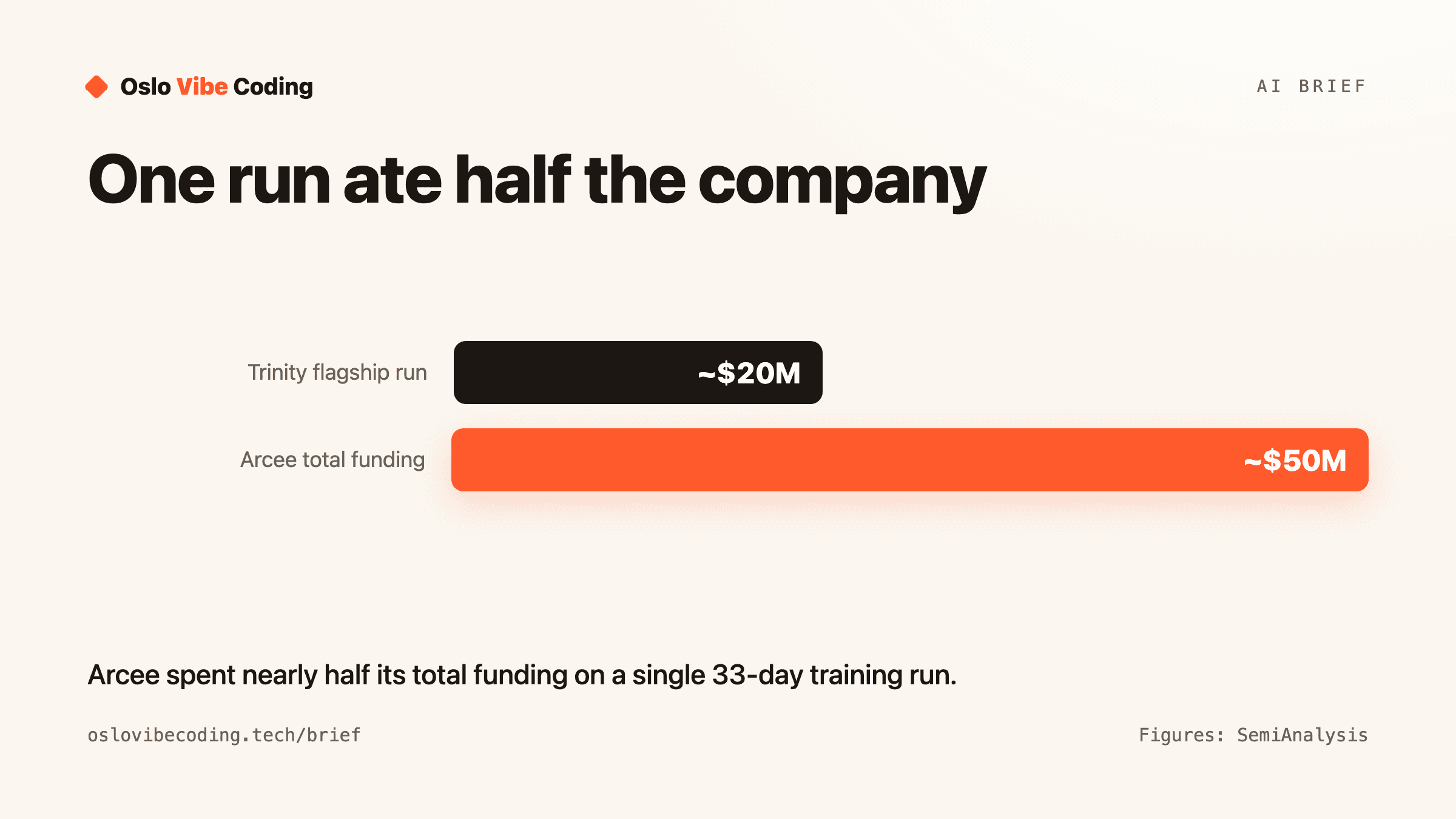
According to figures from SemiAnalysis (a well-regarded chip and AI-infrastructure research firm), the whole Trinity family was trained in about six months for roughly $20M. The headline flagship came from a single training run of about 33 days on 2,048 Nvidia B300 Blackwell GPUs (Blackwell is Nvidia's current top-end AI chip generation; a GPU is the processor that does the heavy math). That one run cost close to $20M on its own, which is nearly half of Arcee's roughly $50M in total funding.
Every Trinity model is released free under the Apache 2.0 license, one of the most permissive open-source licenses there is. That means anyone can download the weights, run them, and build products on top without paying Arcee a cent.
The simple version
Think of it like building a car. The biggest AI labs behave like a luxury automaker that designs a hand-built flagship over years, with a budget most companies could never touch. Arcee did something closer to renting a fully-equipped factory for one month, running the line flat out for 33 days, and driving out a car that gets most people where they need to go.
The 2,048 rented Nvidia chips are that factory floor. The 33-day run is the month of production. And because Arcee gave the finished blueprints away under Apache 2.0, anyone can now copy the car in their own garage.
That is the real story in the number. Not that AI got cheap in the everyday sense, but that the price of reaching the front of the pack fell far enough for a startup to spend half its money on a single run and still be standing.
Arcee rented the factory for 33 days, ran the line flat out, and gave the blueprints away.
Is this new?
The idea of open weights is not new. Meta's Llama models and France's Mistral have handed out capable open models for a couple of years, and China's DeepSeek startled the industry in early 2025 by matching strong results at a fraction of the usual reported cost. Trinity sits firmly in that lineage rather than inventing it.
What is worth noticing is the direction. Arcee is not trying to beat the frontier labs at their own game or catch up to the very best closed models. It is aiming just below the top and undercutting hard on price. One third-party review claimed Trinity is around 96 percent cheaper than Anthropic's Claude for comparable work. Treat that as a single reviewer's estimate rather than a settled fact, because such comparisons depend heavily on the exact task and how you measure it.
The pattern is the point. A well-run team with a clear target and a few thousand rented chips can now put out a genuinely competitive open model without a nine-figure war chest.
What it means, and the catch
For anyone building with AI, more strong open models under a permissive license is straightforwardly good. It means more choice, more price pressure on the closed labs, and the freedom to run a capable model on your own terms instead of renting access to someone else's.
But keep the honest caveat in view. $20M is cheap only next to the frontier labs. It is still roughly half of a funded startup's entire treasury, spent on one 33-day run that could have gone wrong. This is not a garage project, and it does not mean small teams can now train frontier models for pocket change.
The more useful takeaway for a community like ours is not the training bill at all. It is that the outputs keep landing in the open. You do not need $20M to build something real with Trinity. You need the download link, which is free, and an idea worth pointing it at.
You do not need $20M to build with Trinity. You need the download link, and it is free.
Curious about AI? Come build with us.
Oslo Vibe Coding runs free, beginner-friendly drop-ins where we build real things with AI. No one codes alone.