The money bought Meta a real frontier model, an enormous compute position and a credible path back into the race, which is more than the sceptics expected. It did not buy loyalty, and it cost Meta the open-weights identity that made it matter to ordinary developers in the first place.
The short version
In mid-2025 Meta built a new unit called Meta Superintelligence Labs, run by Alexandr Wang, the founder of the data-labelling company Scale AI, alongside Nat Friedman, the former chief executive of GitHub. Getting those two in place was itself expensive. Meta put $14.3 billion into Scale AI to bring Wang across, and more than a billion more to buy out the venture fund Friedman ran with Daniel Gross.
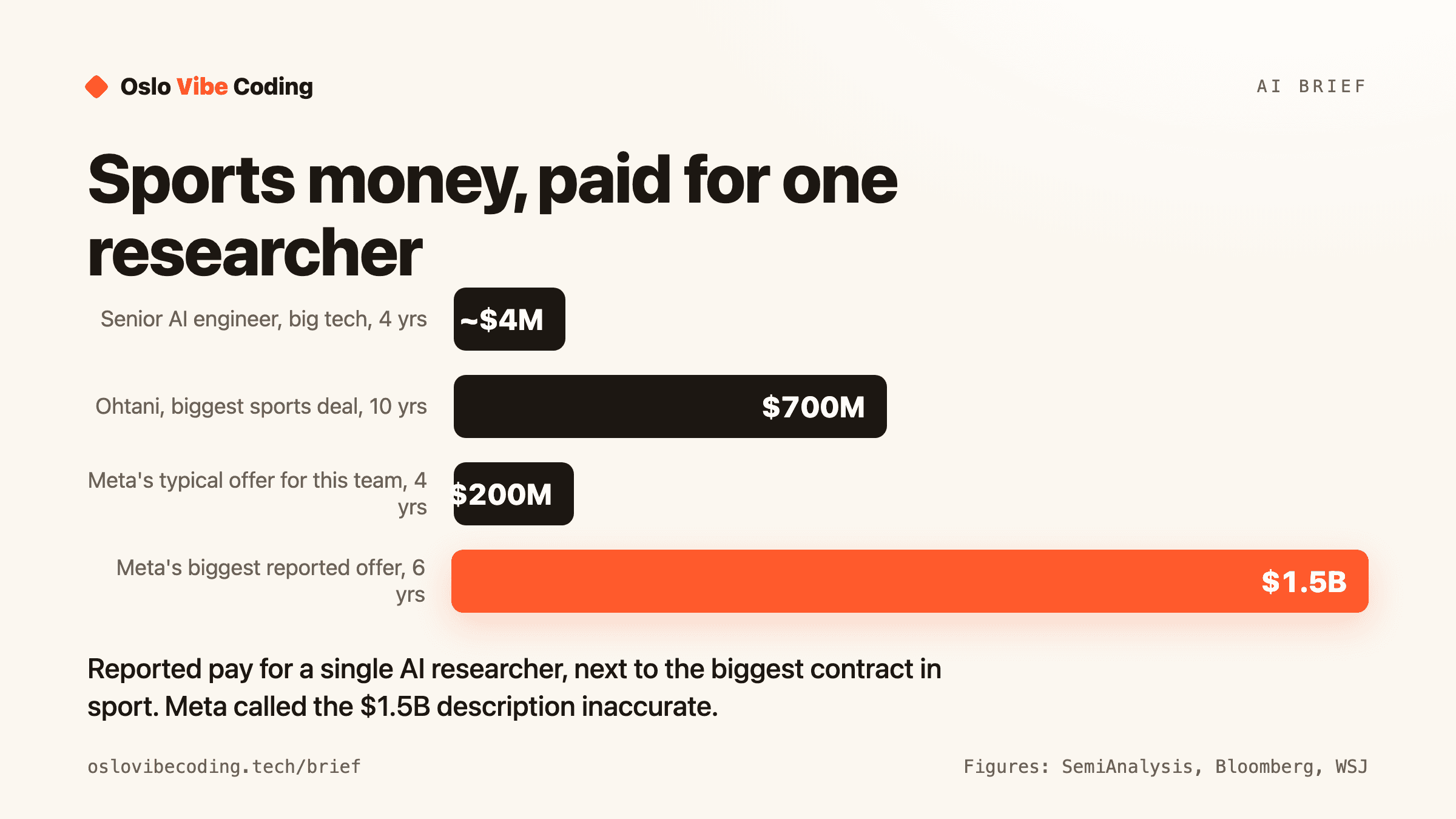
Then came the staffing, and this is the part that broke people's sense of scale. According to the research firm SemiAnalysis, the typical offer to the researchers being recruited onto this team was around $200 million over four years, which it put at roughly a hundred times what their peers were earning.
Individual reports went further. Bloomberg reported a package worth about $200 million for Ruoming Pang, who had been running Apple's foundation models team. Wired reported offers of up to $300 million over four years, with more than $100 million landing in the first year, extended on more than ten separate occasions. The Wall Street Journal reported a package worth up to $1.5 billion over at least six years for Andrew Tulloch, a co-founder of Thinking Machines Lab. Meta called that description "inaccurate and ridiculous". Tulloch turned the offer down, and then joined Meta anyway a couple of months later, on terms reported to be considerably smaller.
By the end of June 2025, Meta had reportedly poached at least fourteen researchers, mostly from OpenAI, with others from Anthropic and Google.
Why a rational person would do this
It looks unhinged until you look at what the year before had been like for Meta.
Meta had spent years as the champion of open weights, meaning models anyone can download and run on their own machines rather than renting through somebody's API. Llama was that model, and it worked: by early 2026 it had passed 1.2 billion downloads. Being the free option made Meta the default foundation for an entire generation of developers.
Then two things went wrong at once. Llama 4 arrived in April 2025 to a reception that cooled fast. And the people who had built the original had already gone. Of the fourteen authors on the 2023 Llama paper, eleven had left by May 2025, five of them to the French lab Mistral, which two former Meta researchers co-founded. Meanwhile Chinese labs were shipping models that matched or beat Meta's while reportedly costing a fraction as much to train.
So Meta was losing on capability, losing the people who knew how to fix that, and watching its one clear advantage stop being an advantage. Zuckerberg's answer was to go into what Silicon Valley calls founder mode: skip the org chart, do the recruiting personally, and remove money as a reason for anyone to say no.
The numbers really are sports numbers
When Shohei Ohtani signed with the Los Angeles Dodgers in December 2023 for $700 million over ten years, it was the largest contract in the history of professional sport, and it was news everywhere for a week.
Meta's reported typical offer for this team was $200 million over four years. Run over the same ten years, that pace outruns the Ohtani deal. The single largest reported offer, the one Meta disputes, was larger outright.
There is one difference worth sitting with, and it is not flattering to either side. A baseball club can point at ticket sales, shirts and broadcast rights, and show you the revenue that a superstar generates. Meta was paying these sums for people whose historical output is research: ideas that, until very recently, the field expected to be published and given away. The bet is that the next generation of those ideas stays inside the building for long enough to matter.
A club can show you the shirts a superstar sells. Meta was buying people whose output the field expected to be published for free.
Is this actually new?
The idea of hoarding scarce brains is old. Bell Labs and IBM did it with physicists for decades. Investment banks have paid nine figures to lift an entire trading desk. Google and Facebook spent the 2010s buying small companies mainly for their engineers, at prices that worked out to a few million per head.
Two things are genuinely different. The first is the unit: this is money paid to a single individual contributor, not a founder selling a company and not a fund manager with a book of business. The second is the size relative to everything around it. These packages are large enough that a public company has to think about them at the level of reported earnings.
It is worth knowing that most of the reported figures are stock that vests over years rather than cash in a suitcase. If Meta's share price falls, the number falls with it. That is standard for senior technology pay, and it is why the headline totals should be read as an intention rather than a receipt.
What the money bought
On 8 April 2026, Meta Superintelligence Labs released its first model, Muse Spark. It handles text, images and audio natively, does step-by-step reasoning, uses tools and coordinates multiple agents. It now runs Meta AI across Facebook, Instagram, WhatsApp, Messenger and the Ray-Ban glasses, which puts it in front of more than three billion people.
On the Artificial Intelligence Index v4.0 it scored 52, fourth behind Gemini 3.1 Pro, GPT-5.4 and Claude Opus 4.6. It was well ahead of everyone on HealthBench Hard, a set of difficult health questions, at 42.8. Wang said the team had rebuilt Meta's AI stack from scratch in nine months and reached roughly Llama 4 level capability for about a tenth of the computing power. Meta's stock rose more than 9% on the announcement.
SemiAnalysis published a one-year progress update on 9 July 2026 and its assessment is neither a victory lap nor a write-off. It rates the follow-up model, Muse Spark 1.1, as roughly on par with Claude Opus 4.6 or GLM 5.2, priced just under the latter. It argues Meta is the only hyperscaler on track to be world class at all three of the things that matter, data, talent and compute, and that Meta expects to have more AI computing power than OpenAI or Anthropic by the end of 2026, with five separate gigawatt-scale sites going up in Ohio, Louisiana, El Paso, Iowa and Indiana.
Then it adds the sentence that keeps the whole thing honest. Meta is, in its words, basically at step one, success is far from guaranteed, and it does not expect Meta to match OpenAI or Anthropic on capability before the end of this year.
What the money did not buy
Loyalty, for a start. At least eight people connected to the effort left within months of the launch. Avi Verma lasted less than a month before going back to OpenAI. Ethan Knight also went back to OpenAI. Rishabh Agarwal left after about five months for Periodic Labs. Long-serving Meta people went too: Bert Maher after twelve years, to Anthropic, and Chaya Nayak after more than eight, to OpenAI.
The reason given by the people who talked about it was not money. Chi-Hao Wu, five years in, said the AI team felt too dynamic, and that his own manager had changed several times. SemiAnalysis notes a compute specialist who had just been hired quitting over the same culture problem. That is a specific and slightly deflating finding: past a certain number, more money stops being the variable, and what people want is a team that is not being reorganised around them every quarter.
The second thing it cost is harder to price. Muse Spark has no open weights and no free download. It is available in private preview through an API to selected partners, which makes it more closed than several paid competitors. Wang has said future versions may be opened up, without committing to a timeline. For the developers who built on Llama precisely because they could download it, run it on their own hardware and not ask anyone's permission, that is the change that actually affects them, and no amount of benchmark position replaces it.
What to watch
Whether the gap closes on schedule. SemiAnalysis has effectively set the test by putting it at the end of 2026. That is close enough to check.
Whether Meta reopens the weights. This is the one that decides whether Meta remains a company that matters to individual developers or becomes simply another API you rent from.
And the market-wide question. If rivals matched these packages, then the cost of doing frontier research changed permanently and every lab now carries it. If they did not, then this was one unusually wealthy company panic-buying at the bottom of its confidence, and the most expensive lesson of 2025 will turn out to be that talent has a price, retention does not respond to the same lever, and the two are not the same purchase.
Curious about AI? Come build with us.
Oslo Vibe Coding runs free, beginner-friendly drop-ins where we build real things with AI. No one codes alone.