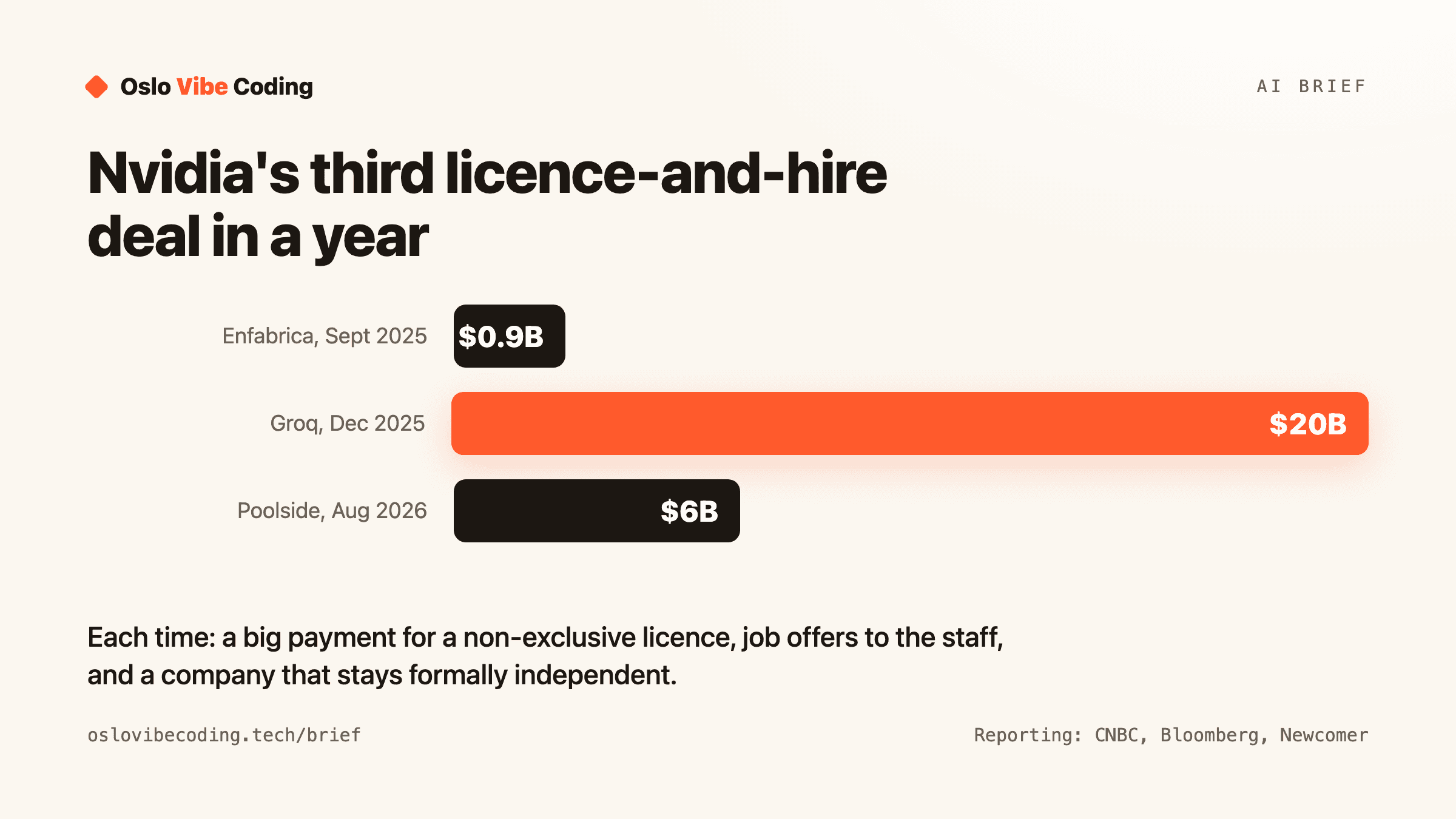
A licence plus job offers gets a buyer the technology and the team without the deal being a merger, which is what regulators are set up to examine. Nvidia has now done this three times in under a year, for a combined figure in the region of 27 billion dollars, and each target has remained formally independent. Whether that is clever structuring or a way around merger review is exactly the question nobody has yet had to answer in public.
The deal
On Friday 21 August, Bloomberg reported that Nvidia had agreed to pay six billion dollars to Poolside, a startup that builds AI models for writing computer code, for a non-exclusive licence to its software. Nvidia is separately investing a further billion at a valuation of twelve billion, and has extended job offers to 109 of Poolside's employees.
The details came from Poolside's own letter to its investors, first reported by the newsletter Newcomer. That letter states the position flatly: this is "not an acquisition and it is not an acquihire". The three founders stay. The company continues to operate. Poolside plans to distribute the six billion dollars to its shareholders by the end of next year.
Nvidia has not publicly explained the deal, and representatives for both companies did not respond to requests for comment when the story broke. So everything below rests on one company's letter to its own investors plus reporting, which is worth keeping in mind.
What is actually being sold
The thing Nvidia is licensing is not a product you could buy. Poolside calls it a Model Factory: the internal machinery it built to produce AI models, the pipelines and training systems rather than any single finished model. Nvidia is buying the means of production, not the output.
Then there is the headcount. Poolside's chief executive Eiso Kant has said publicly that "fewer than 70 people built this model", and that fewer than 115 worked across engineering and research combined. Nvidia made offers to 109. Read those two numbers next to each other and the shape of the transaction is clear enough: the licence covers the machinery, and the offers cover very nearly everybody who knows how to operate it.
Poolside's letter is candid about why it was willing. The company had stepped back from trying to build frontier-scale models after losing a deal for a 40,000-chip cluster, with the capital required to compete at that level climbing out of reach. That is a quietly significant admission, and one that applies well beyond Poolside.
The licence covers the machinery. The job offers cover nearly everyone who knows how to operate it.
The third time in a year
This structure is not improvised. In September 2025 Nvidia paid more than 900 million dollars to license technology from the networking startup Enfabrica and hire its chief executive along with other staff. In December 2025 it did the same thing at a scale nobody had seen before, paying about 20 billion dollars to the AI chip company Groq for a non-exclusive licence while its founder and chief executive Jonathan Ross and other senior leaders joined Nvidia.
Jensen Huang, Nvidia's chief executive, described the Groq arrangement in words that map exactly onto this week's: "While we are adding talented employees to our ranks and licensing Groq's IP, we are not acquiring Groq as a company." Groq stayed independent, run by its finance chief, with its cloud service continuing. So has Enfabrica. So will Poolside.
Three deals, roughly 27 billion dollars, three companies that on paper still exist as competitors. One analyst told CNBC at the time of the Groq deal that the structure keeps the "fiction of competition alive", which is sharper than a neutral observer would strictly put it, but it captures why people are uneasy.
Is this new? Sort of
The recognisable ancestor is the acquihire wave of 2024, when Microsoft took most of Inflection's team, Google paid to license Character.AI's technology and hire its founders, and Amazon did much the same with Adept. In each case a struggling startup's people and technology ended up inside a giant while the startup's corporate shell survived, and in each case regulators looked at the arrangement and mostly moved on.
What has changed since is scale and intent. Those 2024 deals were rescues of companies that had run out of road. Nvidia is doing this from a position of total strength, to companies that are not obviously failing, at prices that dwarf the earlier examples, and it is doing it repeatedly. A merger of that size would normally trigger a formal antitrust review, in which regulators examine whether the combination reduces competition before it is allowed to complete. A licence and a hiring spree generally do not.
Lawmakers have already criticised licensing structures of this kind as a way around merger review. Nothing has been tested in a courtroom, and it is entirely possible that these deals are exactly what the companies say they are. But the pattern is now established enough that pretending not to notice it would be the odd choice.
Why it matters if you do not own Nvidia shares
The straightforward reason is concentration. Nvidia already makes the chips that nearly all of this industry runs on. It has now absorbed the capabilities of a fast inference chip company, a networking company and a model-building company, without any of those absorptions being reviewed as an acquisition.
The subtler reason is what Poolside's letter admits. A well-funded startup with a real product concluded that competing at the frontier had become too capital-intensive to attempt, and took a licensing deal instead. If that reasoning spreads, the number of independent organisations capable of building frontier AI keeps shrinking, and it shrinks through ordinary commercial decisions rather than anything dramatic.
The thing to watch is not the next deal. It is whether any competition authority decides that three of these in a year adds up to something a merger review would have caught.
Curious about AI? Come build with us.
Oslo Vibe Coding runs free, beginner-friendly drop-ins where we build real things with AI. No one codes alone.