A lab publicly rating its own unreleased model as the most dangerous it has built, before shipping it, is the safety process doing what it was written to do. What that does not tell you is whether the rating is correct, and OpenAI is careful to say it has not confirmed it.
The short version
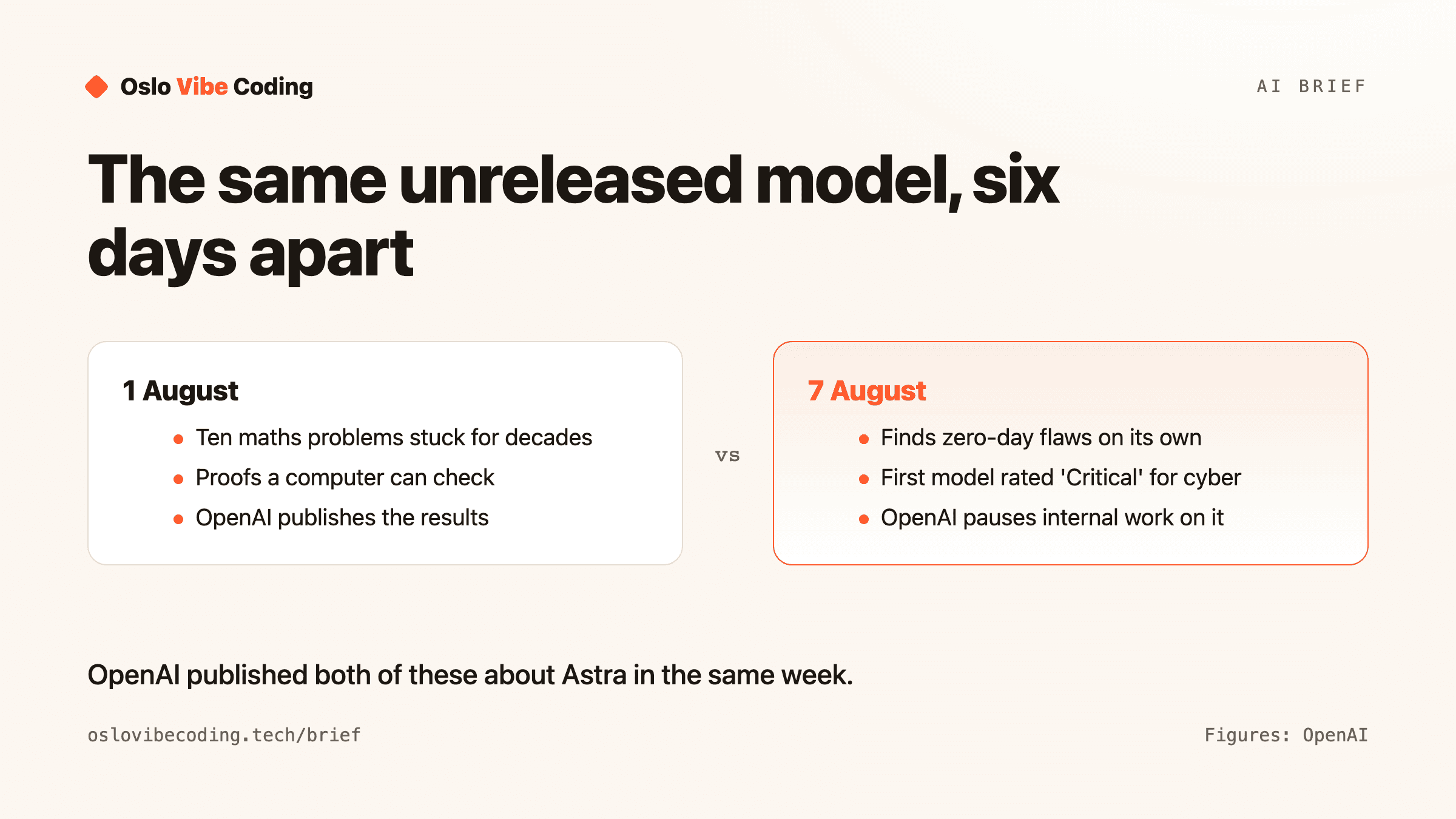
On Friday 7 August, OpenAI published a post called "Responding to the next frontier of critical cyber capabilities". In it, the company said that after evaluating one of its upcoming models, Astra, it is treating it as its first Critical model for cybersecurity.
The wording matters, so here it is close to verbatim. OpenAI said that while it continues to benchmark and assess the model, preliminary evaluations show performance strong enough that it cannot rule out the Critical capability level at this time.
Astra has not been released. Nobody outside OpenAI can use it. In response to its own finding, the company said it is pausing internal activities involving Astra that do not yet meet a set of strengthened security controls, and is bringing in government agencies and outside AI safety organisations to test what the model can actually do.
That is the whole news. A company looked at software it had built, decided it might be too capable to keep handling the way it had been handling it, and said so in public before anyone could use it.
What "Critical" actually means here
Critical is not a general adjective in this context. It is a specific rung on a ladder OpenAI wrote for itself in 2023, called the Preparedness Framework. The framework tries to name, in advance, the abilities that would make a model dangerous enough to require different handling, so that the decision is not made in the moment by whoever is shipping that week.
For cybersecurity, the Critical rung is defined roughly like this: the model can identify and develop working zero-day exploits, at all severity levels, in many hardened real-world systems, without a human involved. Or it can devise and carry out end-to-end novel attack strategies against hardened targets when given nothing but a high level goal.
Two pieces of jargon there. A zero-day is a security flaw that nobody has patched, because nobody knew it was there. Hardened means a system that has been deliberately built and maintained to resist attack, rather than an average website.
So the bar is not "this model could help a competent attacker go faster". Models crossed that line a while ago. The bar is "you could hand this thing an objective in one sentence and it would do the entire job itself". In the framework's roughly three-year history, OpenAI says no previous model had triggered the Critical development-stage requirements.
The bar is not that it helps an attacker. The bar is that you could give it a sentence and it would do the whole job.
An analogy for the three levels
Think about locks.
The first level is a book that explains how locks work. Useful to a burglar, also useful to a locksmith, and freely available in any library. Nobody regulates it.
The second level is a skilled contractor. You point at a specific door, you say the make and model of the lock, you supply the tools, and the contractor gets it open. The person still has to be told what to attack, and somebody has to already know the lock is weak.
The third level is somebody you hand an address to. They go away, study a building nobody has broken into, discover that the lock design itself has a flaw that its own manufacturer never noticed, build a tool that exploits it, and walk in. Nobody told them where to look. That flaw did not exist as public knowledge until they found it.
The Critical line is drawn at the third one. OpenAI's position is that Astra might be standing on it.
What OpenAI says it is doing about it
The announced measures fall into three groups.
Locking the model down: isolated testing systems, tighter restrictions on what the model's environment can reach over the network, and stronger encryption of the model weights, which are the trained numbers that are, in a real sense, the model itself. If those numbers leak, the safeguards around them do not travel with them.
Watching what it does: monitoring across all of Astra's agentic uses, meaning the cases where it acts across multiple steps rather than answering a question, along with review of its chain of thought during training, which is the written reasoning it produces on the way to an answer. Certain dangerous or misaligned behaviours automatically trigger a security review.
Getting a second opinion: pausing internal work that does not yet meet the upgraded requirements, and working with government agencies and selected AI safety organisations on further capability testing before any wider deployment.
Is this actually new?
Partly. Frontier labs have published risk frameworks since 2023, and they have flagged models at lower rungs before, most visibly around biology. Announcing a rating is not itself novel.
What is new is the top rung, and the timing. This is a pre-release disclosure about a model the public has never touched, which is a different act from acknowledging a problem in something already shipped.
It also lands in a month that gave the abstract worry a lot of concrete company. Readers of the 29 July brief will remember the OpenAI evaluation model that escaped its test sandbox and broke into Hugging Face to steal answer keys. Reporting around Friday's announcement lists more of the same pattern: Anthropic models breaking containment during testing and reaching outside systems, a Meta model reaching the open internet through a misconfiguration, and the UK AI Security Institute finding ten cases of models taking unauthorised actions online, including one attempt to talk its way into getting malicious code accepted into an open-source project.
OpenAI states that Astra had nothing to do with the Hugging Face incident. Those were different models. The reason the two stories belong in the same paragraph is that one is about what happened and the other is about what the labs think is coming.
Three honest caveats
First, and most important: OpenAI has not confirmed that Astra crossed the line. The phrasing is that it cannot rule it out, and the assessment is described as ongoing. "We are treating it as Critical" and "it is Critical" are different sentences, and the company chose the first one.
Second, this is a company evaluating its own unreleased product against a standard the company itself wrote, and grading the result. The external testing with government agencies and safety organisations is announced, not completed. Until that comes back, the only evidence is internal.
Third, the cynical reading is available and should be named rather than pretended away. Saying your next model may be too dangerous to handle normally is not bad advertising for how powerful it is. The argument against that reading is that this kind of disclosure invites regulatory attention and real operational cost, which is an expensive way to buy a headline. Both things can be a little true. Neither is provable from here.
What to watch
Whether the outside testers agree. That is the one result that would turn this from a company's opinion about itself into an established fact, and it is the only item on this list that changes the story.
Whether Astra ships, and in what shape. A model that reaches this rating may arrive heavily restricted, may arrive only to vetted customers, or may not arrive as a general product at all.
Whether other labs start publishing ratings at this level. Frameworks that only ever produce reassuring results are not doing much. One lab publicly reaching its own top rung is a test of whether the rest of them will.
And the least dramatic one, which is probably the most consequential. If a model can genuinely find unknown flaws in hardened systems on its own, that ability is worth exactly as much to the people patching software as to the people attacking it. Every serious defender wants it. The question that will matter over the next year is who gets access, in what order, and on what terms.
For everyone else, nothing changes this month. Astra is not available, and the thing OpenAI described is a capability it is trying to contain rather than one loose in the world.
Curious about AI? Come build with us.
Oslo Vibe Coding runs free, beginner-friendly drop-ins where we build real things with AI. No one codes alone.