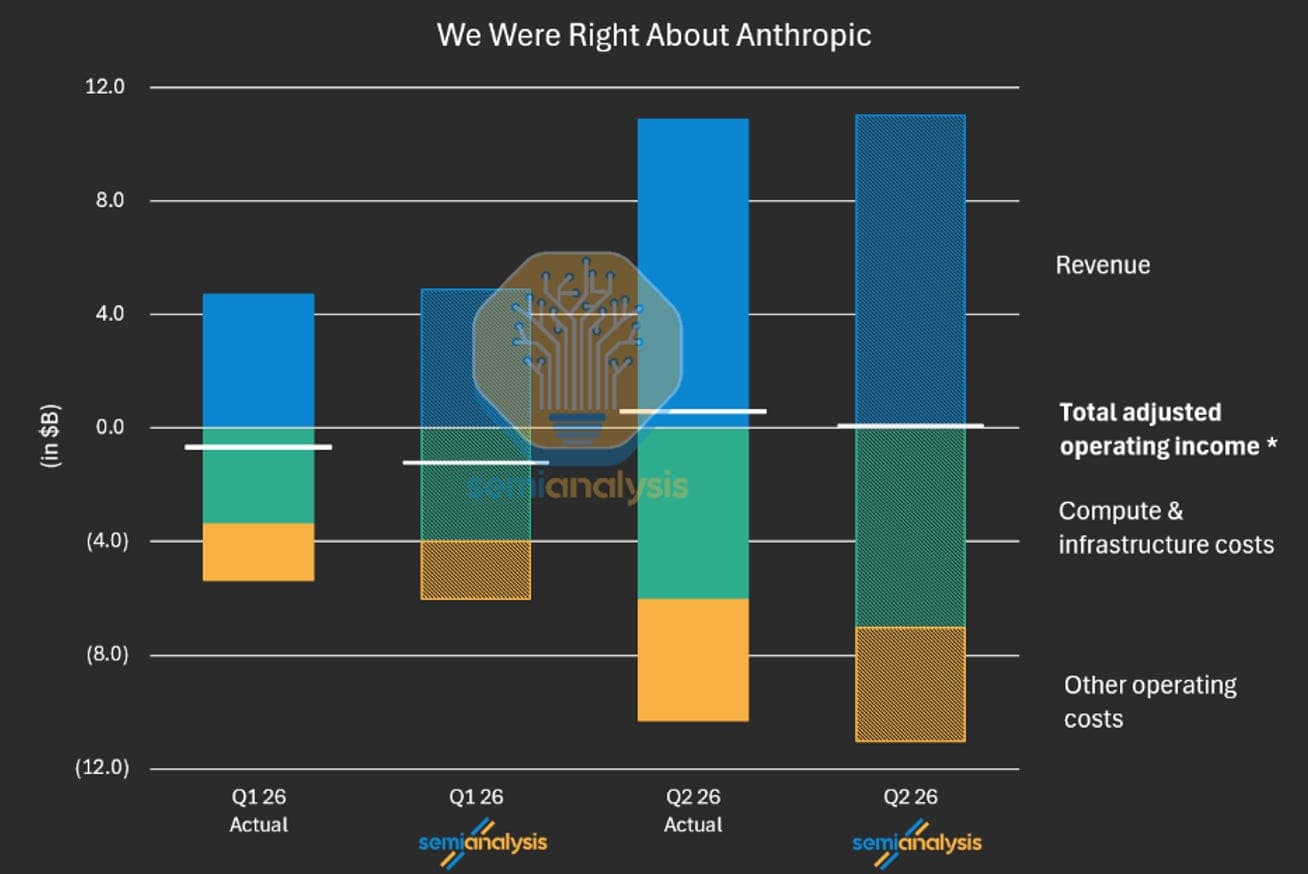
A frontier AI lab turning an operating profit is genuinely new, and it happened because the cost of answering a question fell faster than the price did. It is one quarter, on outside estimates, with a large asterisk about a discounted compute deal. Watch whether it repeats.
The short version
The standing assumption about AI companies is that all of them lose enormous amounts of money, and that the only question is who can keep raising enough to stay in the game. For most of the last three years that assumption was correct.
It has stopped being correct for one of them. According to SemiAnalysis, a research firm that spends its time picking apart the economics of chips and AI, Anthropic turned an operating profit of roughly $559 million in the second quarter of 2026, on revenue of about $10.9 billion. Three months earlier the same company took in $4.8 billion and lost money. SemiAnalysis expects the third quarter to clear a billion dollars of profit, at a margin of around six percent.
For comparison, OpenAI's own internal forecast, as reported earlier this year, has it losing something like $14 billion in 2026 on roughly $25 billion of run-rate revenue.
Two companies in the same business, at a similar scale, on opposite sides of the line. That is the thing worth understanding.
What "profit" means here, exactly
Worth being precise, because this word gets stretched.
The figure being discussed is operating profit: what is left of revenue after the cost of running the business. For an AI lab that means the computers that answer your questions, the electricity to run them, the salaries, the offices, and the enormous cost of training new models. It does not include interest, tax, or the paper gains and losses that show up further down a company's accounts.
It is also an estimate. Anthropic is a private company. It does not publish quarterly accounts, and nothing here has been audited. SemiAnalysis is reconstructing the numbers from supplier data, deal terms, and conversations, which is what it is good at, and which is still not the same as a filing.
Why the numbers moved
The interesting part is not that revenue grew. Everyone's revenue is growing. The interesting part is that the cost of delivering it fell at the same time.
When you ask an AI model a question, that is called inference: the model doing work, as opposed to the model being trained. Every answer costs the company real money in electricity and rented computing time. The gross margin on inference is simply what is left of the price after paying that bill.
SemiAnalysis puts Anthropic's inference gross margin at roughly 38 percent a year ago and above 70 percent now. Across the whole company it lands in the mid-60s, and the business of selling access to the models directly to developers, the API, is above 80 percent.
Think of a restaurant that has not raised its prices, has not changed the menu, and is suddenly making money on every plate because the kitchen learned to cook the same dish in a third of the time, on a third of the gas. Nothing the customer sees has changed. Everything behind the door has.
Where the money comes from
It comes overwhelmingly from software developers. SemiAnalysis has estimated that more than 70 percent of the recurring revenue at both Anthropic and OpenAI is now attributable to coding. Not chatbots, not image generation, not search.
This is the part most coverage still gets wrong. The public face of AI is a chat box, and the paying customer is an engineering department. Anthropic's coding tool, Claude Code, reportedly passed a billion dollars of annualised revenue within six months of launch.
That concentration is a strength and a risk in the same sentence. It is a strength because businesses pay real money for work that used to require hiring. It is a risk because it means one product category is carrying the whole thing.
Revenue went from about $4.8 billion in the first quarter to about $10.9 billion in the second, and the loss turned into a profit.
The asterisks
Three of them, and they are not small.
The first is that Anthropic has said itself that it does not expect to stay profitable. Training the next model is a cost that lands in lumps, not in a smooth line, and a quarter without a big training run looks very different from a quarter with one.
The second is the compute deal. Anthropic reportedly pays on the order of $1.25 billion a month to rent computing power from SpaceX, and critics of the profit figure argue that the early months of a contract like that come at a ramp-up discount. If the effective price rises as the deal matures, some of this margin is borrowed from later quarters.
The third is that a quarter is a quarter. One profitable three-month stretch tells you the shape of the business is capable of working. It does not tell you the business works. That is a claim two or three more quarters can support and one cannot.
Is this actually new?
Yes, and it is worth saying why rather than taking it on faith.
Plenty of profitable companies do AI. Google, Microsoft and Meta all make money, and all of them spend heavily on AI, but their AI divisions sit inside businesses that were already printing cash from search, software licences and advertising. The frontier labs, the companies whose entire existence is building and selling models, have been the opposite: enormous revenue growth funded by enormous fundraising, with the profit question pushed into the future.
So a lab covering its own costs from its own product, at this scale, has not happened before. That is a real milestone regardless of what happens next.
The stock market context matters too. Anthropic filed confidentially for an IPO on 1 June, meaning it has started the process of listing publicly without disclosing numbers yet. OpenAI's listing has reportedly slipped to 2027. A company about to ask public investors for money has an obvious interest in the market seeing a profitable quarter, which is not an accusation, just a reason to read the timing with your eyes open.
The number to be careful with
SemiAnalysis also floats the possibility of Anthropic becoming a six trillion dollar company as a base case if it keeps executing. That figure travelled widely, and it deserves a label.
It is an analyst's projection built on a growth rate continuing, which is the single most fragile assumption in finance. Roughly three companies in history have been worth more than four trillion dollars. Treating six trillion as a base case is a statement about a spreadsheet, not about the world.
The same caution applies to the annual run-rate figures now being quoted, which range from around $44 billion, the simple annualisation of the second quarter, to over $60 billion in more recent estimates. When numbers this large move this fast, the spread between sources is itself information: nobody outside the company knows precisely.
What to watch
One thing, really. Whether the third quarter lands where SemiAnalysis says it will, and whether the fourth does too, with a large training run inside it.
If it does, the argument that frontier AI is structurally unprofitable is finished, and the conversation shifts to why one lab managed it and the other did not. If it does not, this will read as a quarter where the accounting and the compute contract happened to line up nicely.
The honest position today is that something real changed in the cost of running these models, and that one quarter of profit is early evidence rather than proof.
Curious about AI? Come build with us.
Oslo Vibe Coding runs free, beginner-friendly drop-ins where we build real things with AI. No one codes alone.