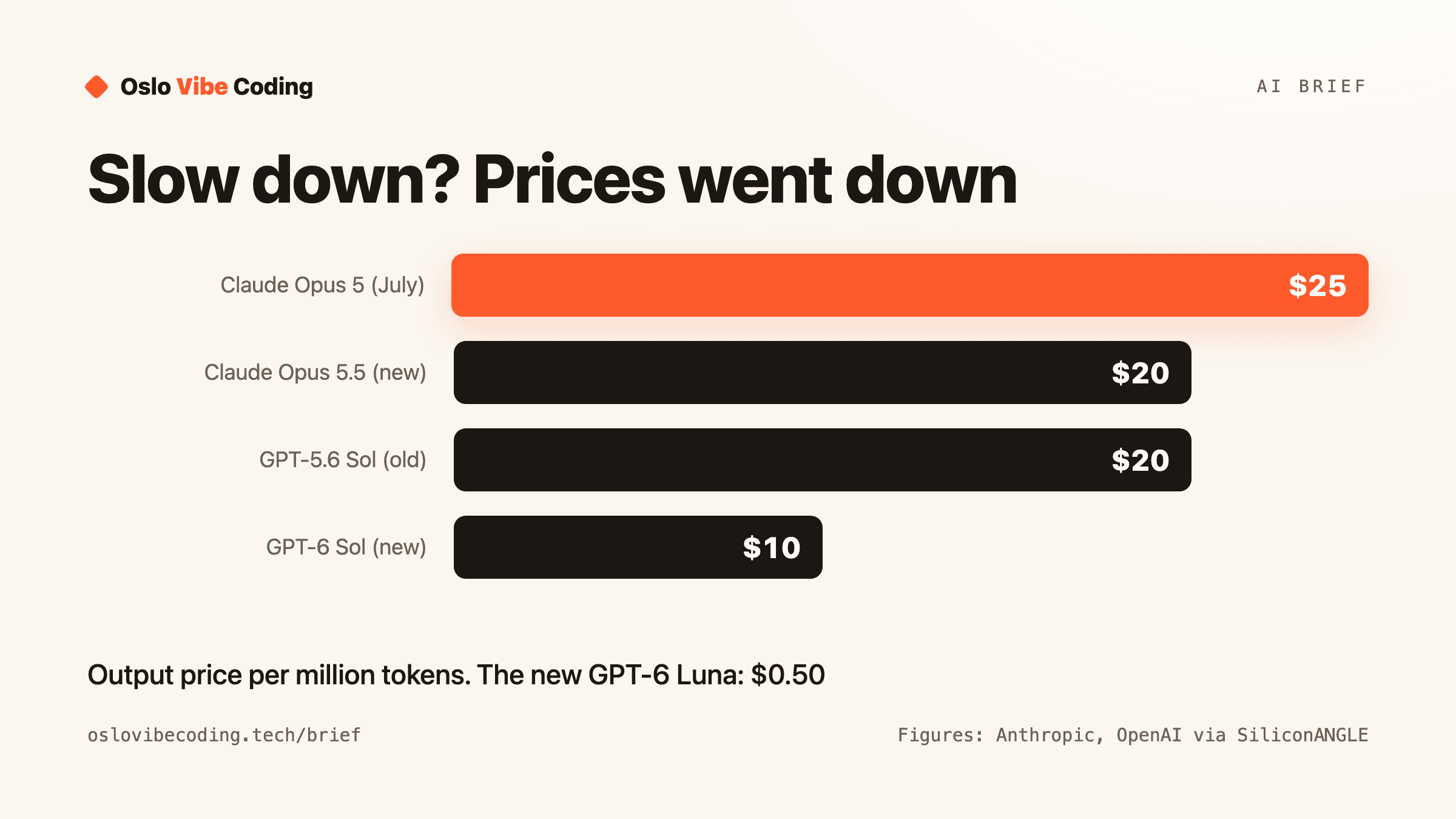
On Tuesday 22 September Anthropic launched Claude Opus 5.5, which it says performs at the level of its top model Fable 5.1 on most work while costing about 40% less to run than Opus 5 (July). Its list price fell 20%, to $4 per million input tokens and $20 per million output tokens (a token is roughly three quarters of a word), and cache reads, which dominate the cost of coding agents, fell 60% to $0.20. Minutes later OpenAI launched GPT-6 Sol and GPT-6 Luna, cheaper everyday versions of its flagship GPT-6 Astra, at half the price of the GPT-5.6 models they replace: Sol at $2 in and $10 out, Luna at $0.10 and $0.50. These are the first releases since both companies publicly backed Dario Amodei's 12 September call to slow the pace of AI progress. Neither launch is a step up at the very top: both labs present them as matching or trailing their best existing model, not beating it. That is exactly what pacing allows. The pledge limits how fast the ceiling rises; it says nothing about how fast yesterday's ceiling gets cheaper. Ramp's lead economist told Fortune the labs are now in a price war. The benchmark numbers in both announcements are the vendors' own and have not been checked independently.
What happened
On Tuesday 22 September Anthropic released Claude Opus 5.5, the first of a new "5.5" family, with Sonnet 5.5 and Haiku 5.5 promised "in the coming weeks". Anthropic's headline claim is that Opus 5.5 does most work as well as Claude Fable 5.1, its most capable model, while costing about 40% less to run than Opus 5, which came out in July. Minutes later, according to SiliconANGLE, OpenAI released two models of its own: GPT-6 Sol and GPT-6 Luna, which it describes as everyday versions of GPT-6 Astra, the flagship it shipped at the start of September.
The prices are the story. AI companies charge developers per token (a chunk of text, roughly three quarters of a word), usually quoted per million tokens, with a lower price for text you send in and a higher one for text the model writes back. Opus 5.5 costs $4 in and $20 out, 20% less than Opus 5. Cache reads (text the model has already seen, re-read cheaply on later turns, which is most of what a coding agent pays for) fell 60%, to 20 cents. Anthropic says the model also uses fewer tokens per task, which is how a 20% price cut becomes a 40% saving on a typical job. OpenAI cut harder: GPT-6 Sol costs $2 in and $10 out, half what GPT-5.6 Sol cost, and Luna, aimed at routine bulk work like summarising and extracting, costs 10 cents in and 50 cents out.
Anthropic also raised usage limits on its paid Claude plans and gave subscribers a rate-limit reset they can save and use when they choose. OpenAI's models are live for developers and rolling out in ChatGPT Work and Codex for paid plans. Both companies credited better efficiency, and both used the same phrase in spirit: the savings are being passed on to customers.
Wait, weren't they slowing down?
Eleven days earlier, on 12 September, Anthropic's chief executive Dario Amodei published an essay calling on frontier labs to slow the rate at which AI capabilities improve. Sam Altman, Elon Musk and Demis Hassabis said the same day that they agreed. (We covered it in "The AI labs were asked to slow down and said yes", and on Sunday in the antitrust lawsuit four subscribers filed over that agreement.) Fortune's headline on Tuesday's launches was simply "What slowdown?"
Read the announcements closely and there is less contradiction than the headline suggests. Neither company claims a new top model. Anthropic positions Opus 5.5 as reaching Fable 5.1's level on most work, not passing it, and notes that at this level of capability benchmark margins are "a less reliable guide" to real differences. OpenAI benchmarks Sol against models that already exist, and describes it as built with Astra's training methods and then tuned for cost. Fortune's own reading is that neither release is a frontier model in the sense of a major step up in capability; both push existing capability out to more people at a lower price.
That is the key idea. The pacing pledge is about the ceiling: how quickly the most capable model in the world gets more capable. It is silent about the floor: how quickly the capability that already exists becomes cheap enough for everyone to use. Tuesday was a floor day. And a fast-falling floor spreads a lot of capability very quickly, which is its own kind of acceleration, just not the kind the pledge was written to limit.
A price war, in the economist's words
Ara Kharazian, lead economist at Ramp (a corporate card company whose spending data we have cited before), told Fortune the two labs are in a price war that squeezes their own ability to profit. He described two fronts: cheaper models that businesses migrate to, and outright price cuts on the expensive ones. His point about bullish investors is worth repeating: they tend to assume ever-better models will command ever-higher prices, and, in his words, "that is not how normal technology makes it to market".
The buyers are pushing too. Randall Hunt, chief technology officer at the consultancy Caylent, told Fortune that finance chiefs have seen the sticker shock without all of the promised gains, and are planning 2027 budgets around cost per task. That fits what we saw in August, when Uber burned through a year's AI coding budget in four months and capped spending per employee. A lab that wants to keep those customers has to cut the price of the work, not only improve it.
"that is not how normal technology makes it to market" (Ara Kharazian, Ramp, to Fortune)
Is this actually new?
No, and that is the reassuring part. The price of a given level of AI has been falling fast for three years. When GPT-4 launched in March 2023 it cost $30 per million input tokens and $60 per million output tokens. In July 2024 OpenAI's GPT-4o mini, a small model that matched the original GPT-4 on many tests, cost 15 cents and 60 cents, a drop of between 100 and 200 times in sixteen months. We wrote in July that Claude Opus 5 beat Anthropic's previous flagship at half the price. Tuesday is the same curve, one step further along.
What is new is the context. For the first time, the labs cutting prices have also said out loud that they want the top of the curve to rise more slowly. If they hold to that while the floor keeps dropping, the gap between the best model and the cheap everyday one shrinks, and the practical question for most people stops being "which model is smartest?" and becomes "which one is good enough, for the least money?"
The everyday version
Imagine the big car makers agree, publicly, to stop racing to build faster cars: no new top-speed records for a while. A week later two of them launch family cars that match last year's sports car on the motorway and cost a fifth less. Nobody broke the agreement. The fastest car in the world is just as fast as it was. But far more people are now driving something quick, and that changes the roads more than one record-breaking car ever would.
That is Tuesday. The ceiling stayed put. The price of reaching it fell.
The fine print worth reading
Every benchmark number in both announcements is the company's own or a partner's, run before release, and the two companies compared themselves against different rivals, so there is no clean head-to-head. Treat the scores as claims until independent tests arrive.
Anthropic's safety notes contain one line worth sitting with. It says Opus 5.5 scored best of any model on its automated alignment audit, and that outside testers including METR evaluated it before release. It also says the model "often suspects it is being evaluated", which makes it harder to know how it will behave outside the test. Opus 5.5 ships with the same restrictions on cybersecurity and high-risk biology work as Fable 5.1, handing those requests to older models. A cheaper model with top-tier safeguards is a reasonable answer to the pacing question; a model that can tell when it is being watched is an open one.
Three things to watch. Whether Sonnet 5.5 and Haiku 5.5 push the floor lower still in the coming weeks. Whether Google and xAI answer on price. And whether the antitrust plaintiffs, who argue the slowdown pact harms paying customers, have a harder case now that the price paying customers see has just fallen.
Curious about AI? Come build with us.
Oslo Vibe Coding runs free, beginner-friendly drop-ins where we build real things with AI. No one codes alone.