Meta's revenue grew 28 percent year over year in the second quarter of 2026, to 60.80 billion dollars. The engine is not Meta AI or any chatbot. It is RecSys, the recommendation systems that choose which ad and which video you see. This quarter Meta introduced Meta Generative Recommender, which it describes as a change in how the ads system works: instead of scoring every candidate ad separately, a large language model reasons about the ad and the person together. Meta reports that this and related work produced an 8.3 percent increase in ad clicks and a 15.7 percent uplift in conversions on Facebook. Ad impressions rose 14 percent and the average price per ad rose 12 percent, which is the clearest evidence that advertisers think the matching improved. The bill is enormous: 31.08 billion dollars of capital spending in the quarter, full-year guidance of 130 to 145 billion, and free cash flow down to 784 million dollars from 8.5 billion a year earlier. All performance figures are Meta reporting on itself.
The wrong AI story
When people talk about Meta and artificial intelligence, they usually mean one of two things: the assistant inside WhatsApp and Instagram, or the very expensive team of researchers the company hired last year to chase superintelligence.
Neither is currently making money. The thing that is making money has a dull name and no public face. Meta calls it RecSys, short for recommendation systems, and it is the software that decides which video appears next in your feed and which advertisement is placed beside it.
In the second quarter of 2026, Meta's revenue was 60.80 billion dollars, up 28 percent from a year earlier. Advertising was 59.36 billion of that. For a company that investors had written off in 2022 as a mature business entering a slow decline, growth accelerating past 25 percent is the whole story, and the recommendation engine is the reason.
The research firm SemiAnalysis, which tracks this industry closely, puts it plainly in its report on Meta's compute buildout: the company has "dramatically re-accelerated revenue growth, in large part due to GPU investments," and it believes Meta thinks it can scale its ads recommendation systems by more than ten times in complexity to push that further.
What changed inside the machine
For most of the past decade, an ad system worked roughly like an auction with a scoring step. When a page loads, thousands of candidate ads are eligible. The system scores each one for how likely you are to act on it, then shows the winner. Every candidate is evaluated separately, which is why the cost grows with the size of the catalogue.
This quarter Meta introduced something different, called Meta Generative Recommender. Its chief financial officer described it to investors as a change in how the ads system works: "Rather than scoring every possible ad individually, we are now using LLMs to reason about ad content and user preferences together, and predict the best ad for each person." LLM here means large language model, the same family of system that powers a chatbot, pointed at a completely different job.
Picture a shop with a thousand assistants, each holding one product and shouting a number for how likely you are to buy it, while a manager listens for the loudest. Replace all of them with one assistant who has read the entire catalogue and has watched you shop for years, and who simply says: this one. That is the shift, and it is why it needs the kind of computer that used to be reserved for training chatbots.
The engineering is real and documented. Meta published the design of what it calls the Adaptive Ranking Model in March. It runs models with around a trillion parameters, the internal numbers a model learns during training, and it has to return an answer in well under a second because a feed cannot wait. Meta got there by computing what it knows about you once per page load instead of once per candidate ad, which turns the cost from linear to sub-linear. Since launching on Instagram at the end of 2025, that system alone delivered a 3 percent increase in ad conversions and a 5 percent increase in click-through rate for the users it covered.
The numbers Meta puts on it
Meta's own reported figures for the quarter are specific enough to be worth listing, with the caveat that every one of them is the company measuring itself.
The user understanding models combined with the generative recommender produced an 8.3 percent increase in ad clicks and a 15.7 percent uplift in conversions on Facebook. Early pilots using language models to understand user preferences drove a 1 percent increase in app event conversions on Instagram. Advantage+, the bundle of automated campaign tools sold to advertisers, reached an annual revenue run rate of over 75 billion dollars.
The same machinery works on the unpaid side of the feed, which is what creates the space to sell. Every public Reels and Feed post on Instagram is now automatically read by a language model and tagged for topic and tone. Meta shipped what it calls its largest single-release ranking improvement to date on Reels. More than half of the content recommended in the Instagram feed is now less than a day old, roughly double a year ago. Facebook video time spent rose 9 percent globally.
There is also a small, genuinely interesting counter-move. Instagram now has a page called Your Algo where you can write a plain sentence to steer your own recommendations, and Facebook has an equivalent called Shape Your Feed. Meta says over 80 percent of the people who use it come back to it.
The price of an ad is the scoreboard
Company claims about their own models are easy to make. There is one number in Meta's results that is much harder to fake, because it is other people's money voting.
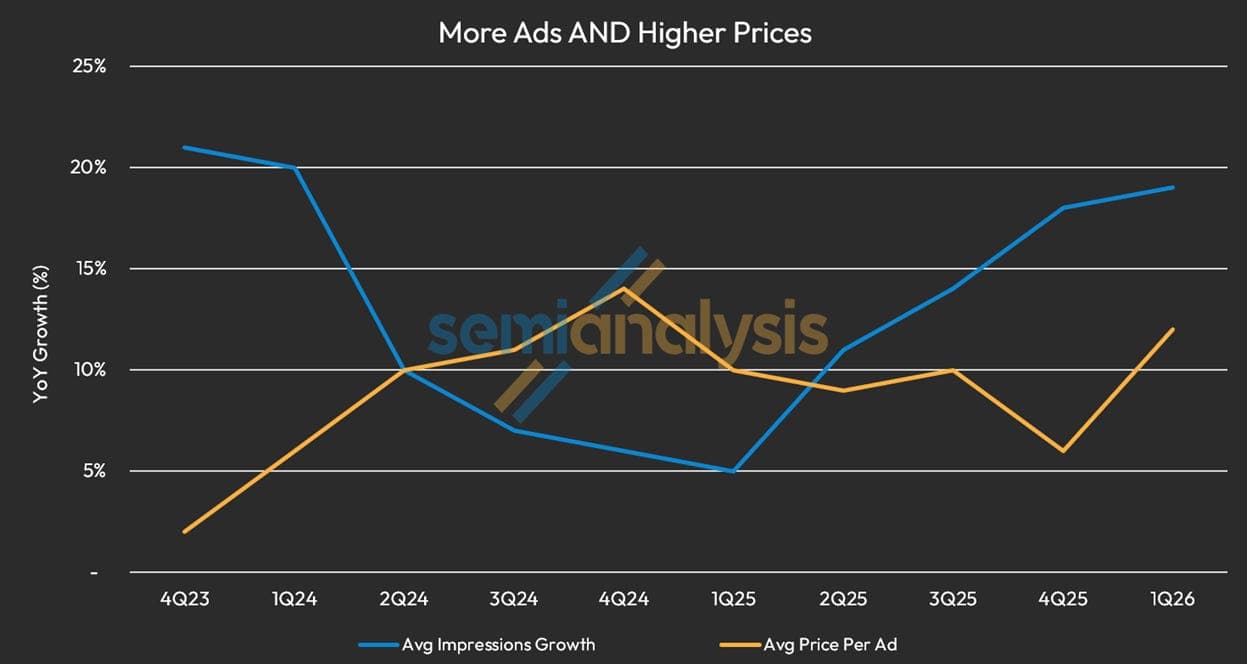
In the second quarter, the number of ads Meta delivered rose 14 percent year over year, and the average price of each one rose 12 percent. Advertisers are buying more ads and paying more for each of them at the same time.
Normally those two lines move in opposite directions. Flood the market with more advertising slots and the price per slot should fall. When both rise together for several quarters, the straightforward reading is that each ad is worth more to the buyer than it used to be, which is exactly what better matching should produce. The chart above, from SemiAnalysis, tracks those two lines from late 2023 onward, and the crossover in 2025 is the moment the story changed.
One honest note about that chart: it ends in the first quarter of 2026, when impression growth was running near 19 percent. The second quarter came in at 14 percent, so the volume line has eased even as the price line held at 12 percent. The re-acceleration is real, and it is not a straight line upward.
Is this actually new?
Recommendation systems are one of the oldest commercial applications of machine learning. Amazon shipped item-to-item recommendations in the late 1990s. Netflix ran a famous public competition to improve its own between 2006 and 2009. Meta has been ranking feeds with neural networks for a decade, and published earlier generations of this work under names like Lattice and Andromeda.
So the category is old. Two things about the current moment are not.
The first is the technique crossing over. The architecture behind chatbots is now being used to make the advertising decision itself, at a scale of about a trillion parameters, inside a budget of a few hundred milliseconds. That was not practical two years ago.
The second is what it pays for. Every large technology company is currently spending enormous sums on computing hardware, and most of that spending is justified by a future product. Meta's recommendation work is the rare case where the spending has a measured, near-term return in the current quarter's revenue. SemiAnalysis makes this point about Meta's position: the non-superintelligence part of its chip fleet is producing, in their words, outstanding return on investment. That is why the company finds it easy to keep buying.
What it costs, and who pays
The bill is not small. Meta spent 31.08 billion dollars on capital expenditure in the quarter and has guided to between 130 and 145 billion for the full year, narrowed upward from its earlier range. Free cash flow, the money left after that spending, fell to 784 million dollars for the quarter, from 8.55 billion a year earlier. Total costs rose 55 percent. Headcount is down about 1 percent year over year and includes roughly 8,000 people cut in May.
That is the shape of the trade: a company converting almost all of its cash generation, and some of its workforce, into computing capacity, on the strength of a return it can currently measure in the ads system.
For everyone else, there are two consequences worth naming without alarm. The first is commercial. If the average price per ad keeps rising 12 percent a year, the cost of reaching customers through the largest advertising platform in the world is rising with it, and small businesses feel that before large ones do. Better targeting is sold as efficiency, and for the advertiser who converts, it is. It is also inflation in a channel many businesses cannot leave.
The second is quieter. A system that reasons about you and the catalogue together, using a model that has read every public post on the platform, knows more about you than one that scored ads in isolation. Nothing about that is secret, and Meta is now shipping controls that let you talk back to it. But the direction of travel is more inference about you, funded by the fact that it works.
What to take from it
If you want to know whether AI spending is producing anything, the honest answer today is that one clear case exists at scale, and it is not the one in the headlines. It is advertising recommendation, it is measured in click and conversion rates, and it shows up in a price per ad that buyers accept.
Keep the sourcing straight. The revenue, impression and price figures are audited financial disclosures. The 8.3 percent and 15.7 percent improvements are Meta describing its own systems to investors, with no outside verification, and companies do not publish the experiments that failed.
And notice the reframing this suggests. The question worth asking about any large AI budget is not how impressive the demonstration is. It is whether there is a boring, unglamorous system somewhere in the business whose output can be counted in money. At Meta there is. At most companies buying AI right now, there is not one yet.
Curious about AI? Come build with us.
Oslo Vibe Coding runs free, beginner-friendly drop-ins where we build real things with AI. No one codes alone.