Most AI features you use are served by a company whose name is nowhere on them. That layer is now a multi-billion-dollar business growing several times a year, and it is also the part of AI with the least public information attached. Not one of these companies has published what it actually earns on a token after paying for the chips, and that single missing number decides whether this is a durable industry or a very fast way to resell someone else's costs.
What just happened
On 19 August, Stripe said it had agreed to buy a company called OpenRouter. Stripe is the payments company that handles card checkouts for a large share of the internet. OpenRouter is not a name most people outside software development would recognise, and neither company disclosed a price.
Bloomberg had reported three days earlier that the deal was worth more than seven billion dollars, which would make it the largest purchase Stripe has ever made. For scale, OpenRouter's own funding round earlier this year valued it at about 1.3 billion. Neither company has confirmed a figure, so treat the number as reporting rather than fact.
What OpenRouter sells is a switchboard. Instead of a company wiring its software separately into each AI provider, it connects once to OpenRouter, which then decides which model should answer each individual request based on price, speed and quality. In its own announcement the company said it now processes "10+ trillion tokens per day from 400+ AI models for a community of over 10 million developers and companies", and that its volume has grown at least tenfold every year since it started.
A token is the unit AI is sold in. It is roughly a fragment of a word, and every model charges per million of them, both for what you send in and what it sends back. Stripe's chief executive Patrick Collison put the strategic logic plainly: "Tokens are the central currency for companies building with AI."
Here is the part worth stopping on. OpenRouter runs almost none of those ten trillion tokens itself. It owns no data centres and trains no models. It is a switchboard sitting on top of an industry, and that industry is the actual subject of this piece.
The layer under the switchboard
Two things happen to an AI model in its life. It gets trained, which is the enormously expensive one-off process of building it. Then it gets used, which the industry calls inference: the model actually answering a question, every time, for everyone, forever. Training is the headline. Inference is the electricity bill, and it never stops.
Some AI labs publish their finished models openly. Meta, DeepSeek, Alibaba and the Chinese lab Moonshot all release what are called open-weight models, meaning the model file itself is downloadable and anyone is allowed to run it. That sounds like it should make the model free. It does not, because running one properly is a serious industrial problem. You need thousands of graphics chips, you need them busy rather than idle, and you need the answer back in under a second while a thousand other people are also asking.
So a category of company grew up to do exactly that job and nothing else. They take models they did not build, run them at scale on hardware they rent or own, and charge per million tokens. The industry has a flat, forgettable name for it: Token-as-a-Service.
The closest everyday parallel is bottling. Coca-Cola does not fill most of its own cans. Independent bottling companies do that, at scale, close to where the cans will be sold. The recipe is famous and the bottler is invisible, and the bottler is nonetheless a real and large business. The analogy breaks in one place worth naming: the big AI labs also serve their own models directly, so they are both the recipe and, some of the time, the bottler.
Training is the headline. Inference is the electricity bill, and it never stops.
The numbers, and where they come from
Fireworks AI raised 1.505 billion dollars on 16 July at a valuation of 17.5 billion, led by Atreides Management, Index Ventures and TCV, with Nvidia among the investors. Alongside the round the company said its annualised revenue had passed one billion dollars, about five times where it was a year earlier, and that daily token volume on its platform had climbed above 40 trillion from about 15 trillion over the same stretch. Those are company-stated figures, not audited accounts.
Together AI closed 800 million dollars on 1 July at a valuation of 8.3 billion, saying annual bookings had crossed roughly 1.15 billion. Bookings are contracts signed, which is not the same as money received, and the gap between the two matters when contracts run for years.
Baseten was reported in June to be raising about 1.5 billion at somewhere between 11 and 13 billion. Its revenue figures are the softest of the three: the research firm Sacra estimates the company went from about 200 million annualised in December 2025 to about 600 million in March 2026. That is an outside estimate, not a disclosure.
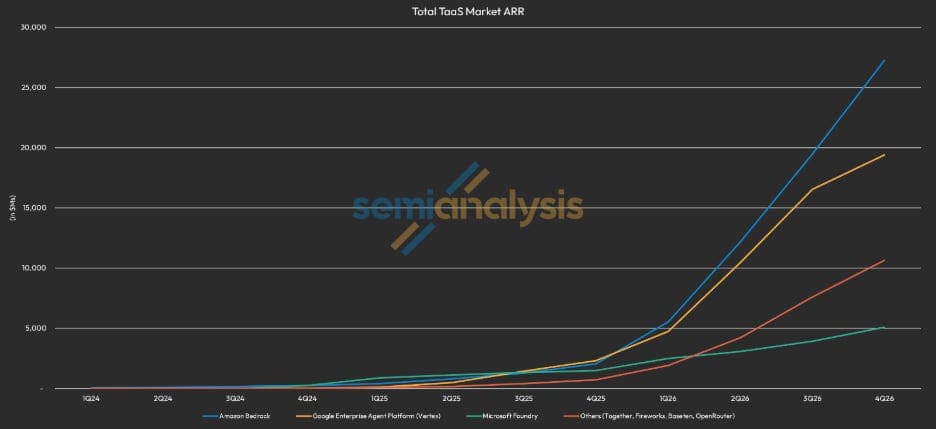
Put together, SemiAnalysis estimated on 30 June that the independent providers, meaning "Together, Fireworks, Baseten, and others", were selling over four billion dollars a year. Given that Fireworks alone said it crossed a billion two weeks after that estimate was published, four billion now looks like a floor rather than a ceiling.
The chart above is that firm's model of the whole category, and it contains a detail people skim past. The largest sellers of tokens are not the startups at all. They are Amazon's Bedrock, Google's enterprise agent platform and Microsoft's Foundry, which resell other companies' models through the cloud accounts that big firms already have. The independents are the fourth line. Note also that everything to the right of the middle of 2026 has not happened yet: it is a forecast, and forecasts of this shape have a habit of being wrong in both directions.
Why anyone buys from a wholesaler
The plain answer is price. Fireworks co-founder Lin Qiao told CNBC that "our cost compared with the equivalent-quality closed model is five to 10 times cheaper". That is a vendor's claim about its own product and should be read as one, but the direction is not seriously disputed, and it is why a company with a large, boring, high-volume AI workload goes looking for an alternative to the famous names.
This only works because open models got good. Two years ago the gap between a downloadable model and the best commercial one was wide enough that price barely entered the conversation. It has narrowed sharply, to the point where Moonshot claimed its Kimi K3 model beat the leading commercial systems on several benchmarks. Once the free-to-download model is close enough for the task in front of you, the question stops being which model is smartest and becomes who can run it most cheaply.
That is the entire commercial basis of this layer. It is a good basis. It is also, on inspection, a narrow one.
Is any of this actually new?
Not really, and that is reassuring rather than dismissive. Contract manufacturers have built other companies' hardware for decades. Web hosting companies ran other people's websites long before anyone said cloud. Content delivery networks quietly carried most of the internet's video while remaining invisible to the people watching it. A layer of unglamorous specialists forming underneath a famous product is one of the most reliable patterns in the history of technology.
What is genuinely unusual here is the speed, and a squeeze that the older examples did not have. Two prices are moving in opposite directions at once. The price these companies charge per token keeps falling, because competition is fierce and every provider is running much the same downloadable models. Meanwhile the price of their main input has started rising: as we covered on 20 August, the rental price of the previous generation of Nvidia chips bottomed out last October and has climbed back roughly 40 per cent since, because new chips are scarce and old ones are not coming off contract.
Revenue up, price per unit down, input cost up. The only thing holding that together is volume, and volume is currently exploding. It works beautifully while that lasts.
Revenue up, price per unit down, input cost up. Only volume holds that together.
What to watch
Watch for a gross margin. Every company in this piece has published a revenue figure and a valuation, and not one has published what it keeps after paying for the chips that served those tokens. For a business whose entire proposition is being cheaper than the alternative, that is the number that decides everything, and its continued absence is the most interesting fact in the category.
Watch the switchboard too. OpenRouter's value came from being neutral, from having no reason to prefer one model over another. Its announcement is explicit that this will not change: "Routing decisions will remain driven by one thing: what's best for you, the user." That is the right commitment to make and the right one to hold them to, now that the neutral party is owned by a company with its own AI billing products to sell.
And keep the scale in proportion. Stripe is reported to have paid more for the switchboard than the entire independent wholesale layer underneath it earns in a year. Either the switchboard is worth an extraordinary amount, or the layer beneath it is still early. Both can be true, and the next few quarters of that chart will tell you which.
Curious about AI? Come build with us.
Oslo Vibe Coding runs free, beginner-friendly drop-ins where we build real things with AI. No one codes alone.