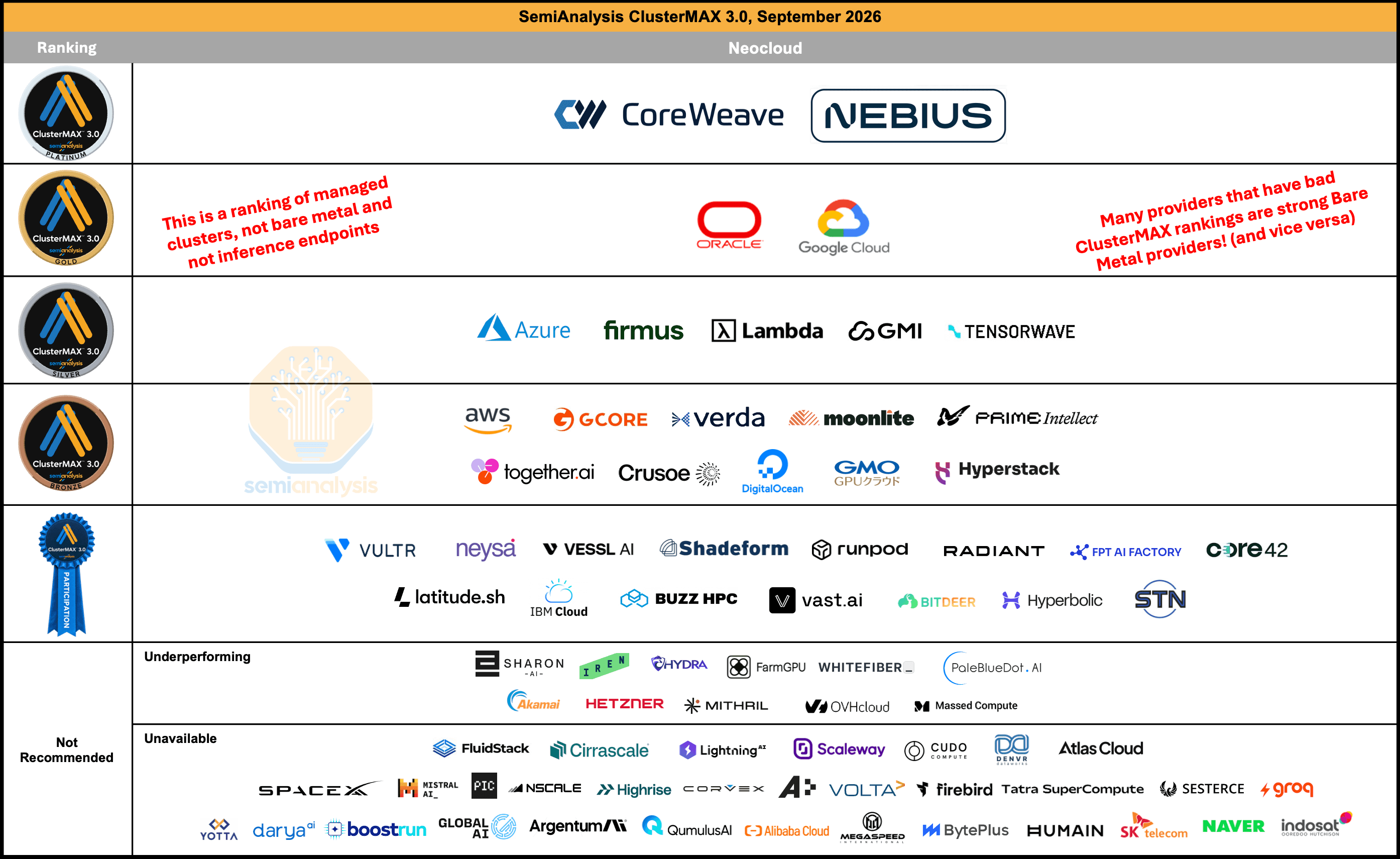
On 23 September 2026 the research firm SemiAnalysis published ClusterMAX 3.0, its third ranking of 'neoclouds' (companies that rent out clusters of AI chips) and the big clouds' AI offerings. It rated 77 providers out of 323 it tracks, after hands-on tests and more than 200 customer interviews. Only 19 earned a medal: CoreWeave and Nebius at Platinum, Oracle and Google Cloud at Gold, Azure, Firmus, Lambda, GMI and TensorWave at Silver, and ten at Bronze, including AWS and Crusoe. A new 'participation ribbon' tier holds 15 providers doing 'the bare minimum', and Hetzner and OVHcloud sit in 'underperforming'. The differences came from reliability and housekeeping, not the chips: storage that slowed by almost 40% under load, model loading taking over two minutes on some clouds versus 10 to 40 seconds on others, a failed network link that kept reporting itself as healthy. The ranking is one firm's method, and it covers managed clusters, not bare servers or AI answer APIs.
What happened
Most companies building with AI never touch a chip. They rent: an hour, a month or three years of time on someone else's GPUs (graphics processors, the chips AI runs on), usually from a cloud. Besides Amazon, Microsoft and Google, there are now hundreds of 'neoclouds', specialist firms whose whole business is renting out AI chips. On paper many sell the identical Nvidia hardware. So does it matter whom you rent from?
SemiAnalysis, a US chip and AI research firm, says yes, loudly. On 23 September 2026 it published ClusterMAX 3.0, the third edition of its ranking of AI clouds. It tracked 323 providers (up from 209 in the previous edition), rated 77 of them after asking each for 32 GPUs, ten terabytes of storage and five days of testing per setup, and interviewed more than 200 customers.
The facts
Only 19 providers earned a medal. Platinum: CoreWeave and Nebius, the latter up from Gold (Nebius is headquartered in Amsterdam). Gold: Oracle, and Google Cloud, new to the tier. Silver: Azure, which slipped, plus Firmus, Lambda, TensorWave and GMI, which climbed from Bronze. Bronze, ten names: AWS, Gcore, Verda, Moonlite, Prime Intellect, Together AI, Crusoe, DigitalOcean, GMO GPU Cloud and Hyperstack. Crusoe dropped, and the report puts it 'towards the bottom' of Bronze for frequent hardware failures, outdated software and slow fixes. Reviewers called AWS 'a headache', citing network delays, storage that failed to provision and buggy health checks.
Below the medals, a new 'participation ribbon' tier holds 15 providers that, in the report's words, do the bare minimum to get by, among them Runpod, Vast.ai, Vultr and IBM Cloud. Then 'not recommended'. Eleven providers are rated 'underperforming', including the European budget favourites Hetzner and OVHcloud and the network giant Akamai. Another long list, from FluidStack to SpaceX, Mistral AI, Nscale, Groq and Scaleway, is marked 'unavailable', which in SemiAnalysis's usage means it could not evaluate them, not that they failed.
What separated the tiers was rarely raw speed. It was what happens when things go wrong. Some clouds' storage slowed by almost 40% under sustained load compared with its first benchmark. Loading a model took over two minutes on some providers and 10 to 40 seconds on others. In one test a network link died while still reporting itself as active, and no alert fired. SemiAnalysis wants failures caught within about two minutes and a broken machine swapped within an hour, and says reliability is the single criterion many large customers care about most.
Two clouds can sell you the identical Nvidia chip. One notices when it breaks. The other keeps billing you.
The everyday version
Think of renting the same model of car from two firms. Both quote the same daily price. One checks the brakes between every hire, has a replacement at your door within the hour if the engine light comes on, and its fuel gauge tells the truth. The other hands you the keys, and when the car dies on the motorway the dashboard still says everything is fine. You pay the same either way, but with the second firm you are paying for a car you are not driving.
AI training runs make that worse, because thousands of chips work in lockstep. One sick machine that nobody notices can stall the whole job, and the meter keeps running on every chip.
Is this actually new?
The idea is not. We have written before about the hidden cost of renting GPUs, where an identical hourly price can hide a much bigger bill once downtime is counted, and about a security test in which renters could see their neighbours' data. What ClusterMAX adds is a public scoreboard, now in its third edition, and providers publicise their medals, so the rankings carry commercial weight.
Two notes for reading it fairly. First, the chart itself warns that it ranks managed clusters, not bare servers or AI answer services, and that many providers with poor rankings are strong if you just want raw machines. Second, SemiAnalysis sells research and consulting to many of the companies it rates. Its methods are published, but it is one firm's judgement, not an industry standard body's. A newer wrinkle for our own community: the report found AI coding agents helpful on well-documented clusters but prone to naive choices on GPU systems, and it calls a fully 'vibecoded' approach to running infrastructure risky.
What it means
If you are a founder or developer renting GPUs, the headline price is the start of the question, not the end. Ask a provider how fast it detects a failed machine, how quickly it replaces one, whether storage holds its speed under load, and what credits you get when it does not. A cheaper hour on a cluster that silently stalls can cost far more than a pricier one that heals itself.
For Europe the picture is mixed. A company headquartered in Amsterdam, Nebius, is at the very top. Two of the continent's best known budget hosts, Hetzner and OVHcloud, are marked down for managed AI clusters, and several European names, including Mistral AI's compute arm and Nscale, which is building AI capacity in northern Norway, were not evaluated at all. As more AI work moves onto rented chips, which cloud you pick is becoming as much a product decision as which model you call.
A cheaper hour on a cluster that silently stalls can cost far more than a pricier one that heals itself.
Curious about AI? Come build with us.
Oslo Vibe Coding runs free, beginner-friendly drop-ins where we build real things with AI. No one codes alone.