The firms getting the most out of AI are not the biggest, they are the ones that give each person a team of AI agents and keep a human VERIFY step at the end.
What actually happened
SemiAnalysis, a semiconductor and AI research firm, published its own AI usage figures, and the comparison is the story. In a 30-day window, Meta employees consumed more than 60 trillion tokens (a token is a fragment of a word, the unit an AI model reads and writes in), which SemiAnalysis estimates cost about $221 million for that single month.
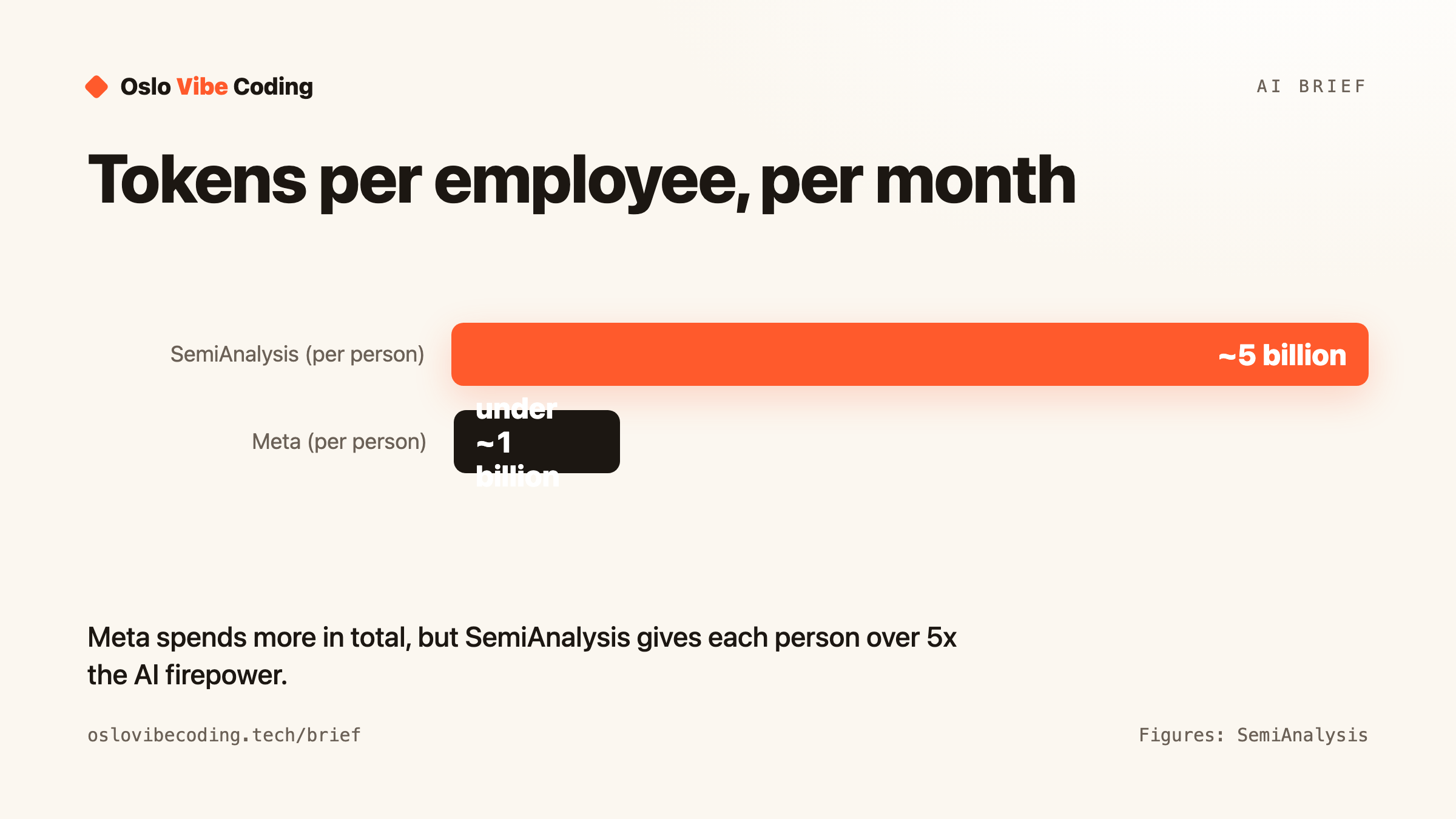
That is a staggering total. But SemiAnalysis, a firm of roughly 20 people, uses just under 5 billion tokens per month for every single employee, which it calculates is more than five times Meta's usage per person. The firm says its annualized spend on tokens already runs at about 30 percent of what it pays its people in salary.
For context, SemiAnalysis notes that a typical corporate AI budget sits at $250 to $500 per employee per month, and that even aggressive companies cap it around $2,000. What SemiAnalysis is doing is a different order of magnitude, and it is deliberate.
A 20-person firm out-uses one of the largest companies on earth, per head, by more than five to one.
The simple version
Forget the raw totals for a moment. The number that matters is per person. Meta's 60 trillion is spread across tens of thousands of employees. SemiAnalysis concentrates its spend on about 20, so each one commands enormous AI throughput.
Think of a restaurant kitchen. The old way to measure it is by counting chefs: more chefs, more dinners. The new way is to ask how many dishes each chef can send out, because each one now runs a brigade of tireless prep cooks who chop, simmer and plate on command. The chef stops cooking every dish by hand and starts directing the line. SemiAnalysis is running that kitchen. Each analyst directs a swarm of AI agents rather than doing every task personally.
Those agents even have named jobs. SemiAnalysis runs a research director, a model builder and an event summarizer, each a separate agent (an AI program that carries out multi-step tasks on its own) pointed at one slice of the work. The human sets the goal and reviews the output. The tokens get burned by the swarm underneath.
Is this new?
Per-employee output has always been a real measure of a company. Investors have compared revenue-per-head for decades, and the classic example is small, highly leveraged teams like early WhatsApp serving hundreds of millions of users with a few dozen engineers. What is new is the mechanism. The leverage no longer comes only from software you wrote once and sell many times. It comes from renting thinking by the token, in real time, at a scale that used to require hiring.
It is worth being sober here. SemiAnalysis is a research shop whose product is analysis, which is exactly the kind of read-and-write work that current AI is strongest at. A firm whose value sits in physical operations, regulated decisions or deep customer relationships will not convert tokens into output at the same rate. High token use is an input, not a result. Burning 5 billion tokens a month per person proves spending, not that the spending paid off.
High token use is an input, not a result. It proves spending, not that the spending paid off.
What it means, and the habit that makes it safe
The reframe is the takeaway. If AI leverage is real, the question for any team stops being how many people do we need and becomes how much can each person now direct. That is a different way to plan a company, and it favors small teams that are fluent at delegating to agents over large teams that are not.
But leverage is only useful if the output is trustworthy, and this is where SemiAnalysis offers the most portable idea. It frames agentic work as four steps: READ, THINK, WRITE, VERIFY. The agents can read the sources, reason over them and draft the answer. The last step, VERIFY, is where a human checks the claims against reality before anything ships. Skip it and the swarm will confidently produce work that is wrong, at speed and at scale.
For anyone starting out with AI, that is the transferable lesson, no billion-token budget required. Let the tools do the reading, thinking and writing. Keep the verifying for yourself. The teams that win with AI are not the ones that trust it the most, they are the ones that check it the best.
Curious about AI? Come build with us.
Oslo Vibe Coding runs free, beginner-friendly drop-ins where we build real things with AI. No one codes alone.