The average tells you nothing. AI spending inside companies is wildly lopsided, and the caps appearing everywhere are a response to a few power users rather than a sign that the bills are out of control.
The short version
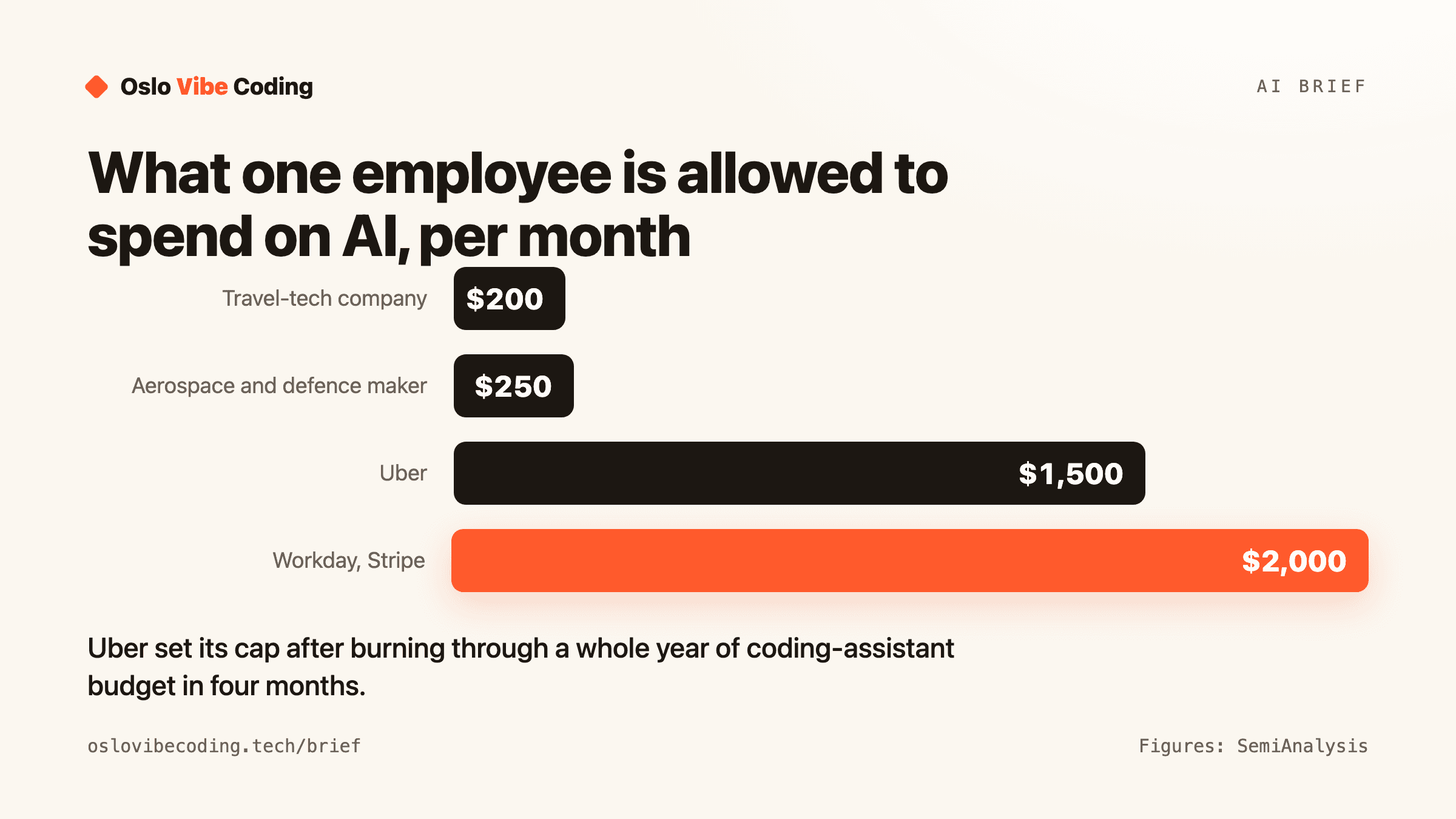
Uber set aside a budget for AI coding assistants for the year. It was gone in four months. The company then put every employee on a limit of $1,500 a month, with anything above that needing to be asked for and approved case by case.
That detail comes from a SemiAnalysis report based on conversations with more than 50 enterprise customers about what they are really spending. Uber is not an outlier in having done this. It is an early example of what is now happening across large companies: the era of telling employees to use as much AI as they possibly can is being replaced by an allowance.
The interesting part is why. It is not that AI got expensive. It is that spending inside a company turns out to be shaped very strangely.
First, what is being bought
When a company buys AI for its staff, it is usually buying tokens. A token is the unit these models read and write in, roughly three quarters of a word. You are billed per million of them, and the meter runs both ways: what you send the model and what it sends back.
For a person typing questions into a chat window, that adds up to very little. For a coding assistant, it adds up fast. Tools like Claude Code and Codex do not answer one question. Given a task, they read through a codebase, try something, run it, read the error, try again, and keep going. Every one of those loops is tokens. One instruction from a developer can turn into hours of machine reading and writing.
So the same subscription that costs nothing when a marketer uses it can cost a serious amount when an engineer points it at a large piece of software and walks away.
The numbers are extremely lopsided
SemiAnalysis pulled spending data from Ramp, the corporate card company, and the spread is the whole story.
The median customer spends about $136 per employee per year on AI. Not per month. Per year. That is roughly a takeaway lunch, once, annually.
At the 90th percentile it is about $7,300 per employee per year. At the 99th percentile it is about $90,000. The heaviest users are spending something like 660 times the typical company, per person.
Meta gives you the same shape inside a single organisation. In a 30-day window in February, its employees ran through more than 60 trillion tokens. One individual employee accounted for roughly 280 billion of them on their own.
The median company spends $136 per employee per year. The 99th percentile spends $90,000.
Which is why everyone is inventing the mobile phone contract
If you have ever had a mobile plan go from unlimited to capped, you already know this story. Unlimited works fine until a small number of people start streaming video all day, and then everybody gets a data allowance, because it is far easier to give everyone a number than to police the few.
That is exactly what is happening. The monthly per-employee caps SemiAnalysis found have no industry consensus at all:
There is no agreed answer here because nobody has had time to work out what a reasonable number is. These are first guesses being made by finance teams, and they will move.
- A travel-tech company: $200 a month by default
- An aerospace and defence manufacturer: $250
- A pharmaceutical company: $500
- A cybersecurity company: about $800 for juniors, and $1,600 to $4,000 for senior staff
- Workday and Stripe: around $2,000
The part that cuts against the panic
The obvious way to read all this is that AI costs are spiralling and companies are slamming on the brakes. SemiAnalysis, having actually asked the companies, argues the opposite.
Their conclusion is that the alarming stories are overstated and that there is no material risk to second-half 2026 AI budgets. The caps are not distress. They are ordinary cost management arriving in a category that had been running without any, and a company that discovers a few engineers can burn a year of budget in four months has learned something useful rather than something frightening.
It helps to know where the money is going. SemiAnalysis estimates that more than 70 percent of the recurring revenue at both OpenAI and Anthropic today comes from coding. Not chatbots, not image generation, not search. Writing software is the thing enterprises are actually paying for, which is also why the caps are landing hardest on the tools engineers use.
Why this is worth knowing
Two things follow from the lopsided shape, and both are useful if you are trying to reason about AI adoption rather than read headlines about it.
The first is that averages are useless here. Any statement of the form "companies now spend X per employee on AI" is describing a distribution where the top and the middle differ by three orders of magnitude. The average is a number that describes almost nobody.
The second is that most organisations have barely started. If the median company is spending $136 per person per year, the story of enterprise AI is not saturation. It is a small number of very heavy users at the front and a very long tail that has not really begun. The caps are a story about the front of that line.
None of which tells you whether the spending is producing anything worth the money. That is a separate question, and one nobody has answered convincingly yet.
Curious about AI? Come build with us.
Oslo Vibe Coding runs free, beginner-friendly drop-ins where we build real things with AI. No one codes alone.