On revenue, Anthropic is ahead. On consumer reach, OpenAI is ahead. On distribution, Google is ahead and late. Any single scoreboard will tell you one of those three and quietly hide the other two. Every figure in this story also comes from reporting or from the companies themselves rather than from audited accounts, which is why the first genuinely reliable number will arrive in an IPO prospectus, not a press release.
The number
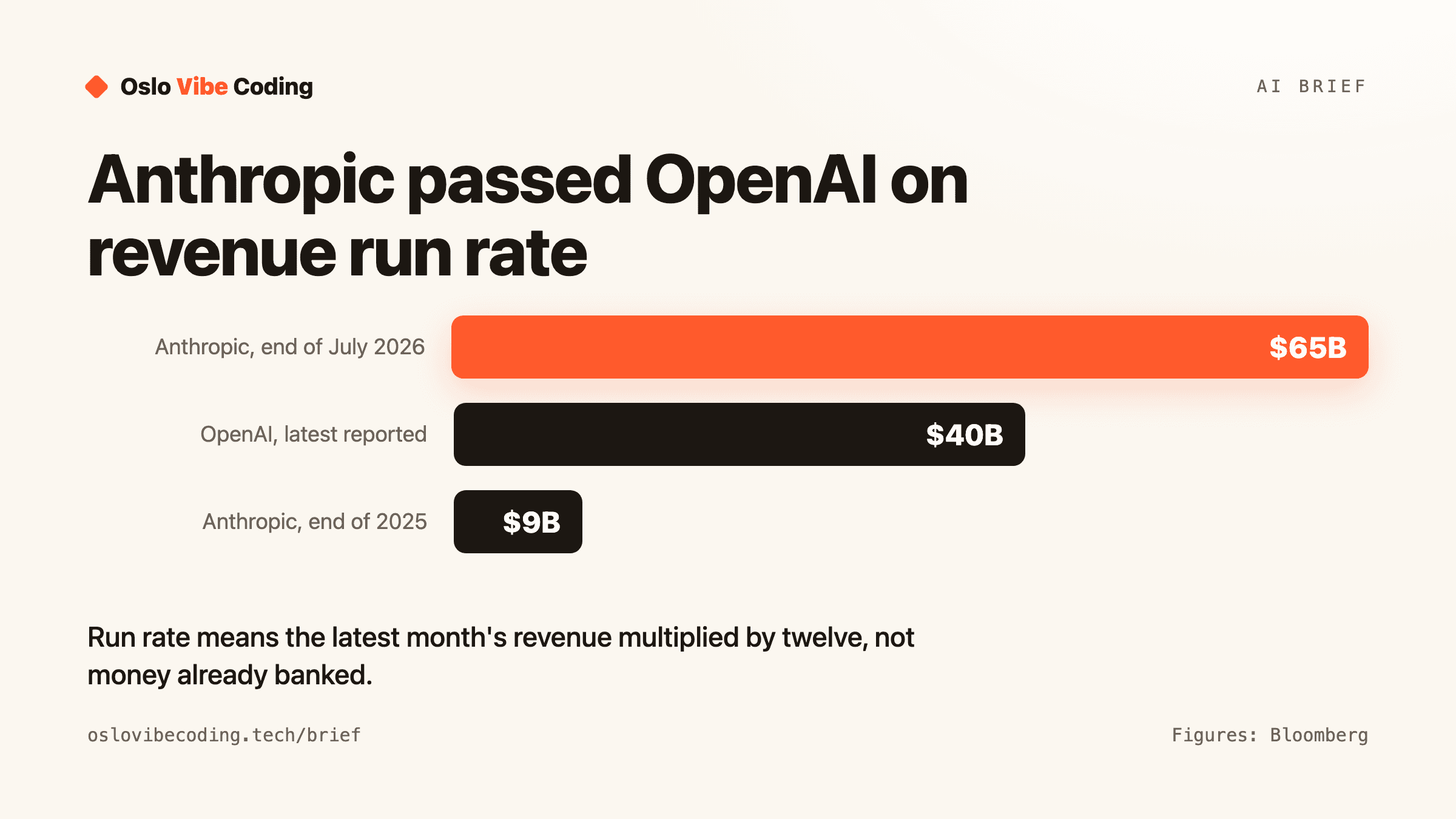
Bloomberg reported on Monday that Anthropic's annualised revenue run rate passed $65 billion by the end of July. OpenAI's latest reported figure is $40 billion, itself a doubling from $20 billion at the end of 2025.
Run rate needs unpacking, because it is one of the most misread numbers in technology. It is not money in the bank and it is not a forecast. You take the most recent month's revenue and multiply it by twelve. It answers exactly one question: if the business froze precisely as it is today, what would a year look like? For a company growing this fast that makes it flattering. For a company shrinking it would be brutal. It is closer to a speedometer reading than an odometer reading.
With that caveat sitting in plain view, the ranking still matters. For most of the last three years the working assumption in public conversation has been that OpenAI is the industry and everyone else is chasing it. On this particular measure, that stopped being true sometime in the spring.
Run rate is closer to a speedometer reading than an odometer reading.
How fast $65 billion arrived
The trajectory is the part that is genuinely hard to hold in your head. Anthropic's run rate was around $9 billion at the end of 2025. It was $47 billion in May. It was $65 billion by the end of July. That is roughly $18 billion of annualised revenue added in two months.
The quarterly figure tells the same story from another angle. Anthropic disclosed preliminary second-quarter revenue above $11.5 billion, against $787 million in the same quarter a year earlier.
Two honest qualifications belong next to those numbers. They come from reporting rather than from audited public accounts, and Anthropic did not respond to TechCrunch's request for comment. Separately, the Financial Times has reported that investors expect 2026 to finish somewhere between $100 billion and $120 billion, which is an expectation held by people with money riding on it, not a result.
Why revenue became the scoreboard at all
It is worth asking whether this is a new situation or just a new headline. In 2023 and 2024 the scoreboard everyone read was capability. A lab released a model, it topped a benchmark table, and that was the lead. What broke that habit is unglamorous: the leads got short. A model takes the top spot and a competitor matches it within weeks, sometimes days.
When the gap between the top few models narrows to something most users cannot feel, the interesting question moves. It becomes who can actually serve that capability at scale, and who can charge for it. Those are business questions, so the scoreboard became a business scoreboard.
There is a specific reason this favours Anthropic right now, and it is one this brief has covered before: the paying use case for AI is overwhelmingly software development. Companies that will not spend much on a chatbot will spend a great deal on something that writes and reviews code all day. Anthropic sells disproportionately into exactly that market.
The prediction that has aged worst
Alongside the two-horse framing sits a claim that has held up badly: that Chinese labs are too short of computing power to reach the frontier at all, and that export controls therefore settle the question.
On 17 July, Moonshot AI released Kimi K3, a 2.8-trillion-parameter model, and claimed it beat Claude Opus 4.8 and GPT-5.5 on coding and agentic benchmarks. Treat that as what it is, a vendor's claim about its own product, measured on tests the vendor chose. Even discounted heavily, it is not the behaviour of a lab locked out of the frontier.
The more useful reading is that the constraint did something. Denied the option of simply buying more chips, Chinese labs put their effort into architectural efficiency and into giving models away with open weights to win distribution. The restriction shaped the strategy rather than ending it. That pattern has a long history outside AI, and it is worth remembering the next time a supply constraint is described as decisive.
The restriction shaped the strategy rather than ending it.
Google: behind is fair, finished is not
Google has had a genuinely bad year inside the building. Fortune reported on 10 August that Gemini 3.5 Pro missed three separate release deadlines, targeted for June and then mid-July and still unreleased going into August, and that Gemini 3.6 Flash now ranks behind models from Anthropic, OpenAI, the leading Chinese labs, xAI and Meta on intelligence benchmarks. Engineers quoted in that reporting blamed a failure to prioritise coding ability, which is the one capability the market is paying for.
The people situation is starker than the model situation. Demis Hassabis moved from chief executive of Google DeepMind to chairman, with Koray Kavukcuoglu taking day-to-day control as a senior vice president reporting to Sundar Pichai. Jeff Dean left. Noam Shazeer, a Gemini co-lead, went to OpenAI in June. John Jumper, a Nobel laureate and AlphaFold co-inventor, went to Anthropic. Google disputes the characterisation that power shifted away from DeepMind, saying the unit keeps its London presence and its research autonomy.
Now the counterweight, because a story that only points one way is usually incomplete. On 13 August Google shipped Gemini 3.7 Flash, three weeks after 3.6 Flash, and it arrived ahead of the Pro model that is still late. Google reported its DeepSWE coding score rising from 49.0% to 65.3% between the two releases, which is a vendor-reported result on a vendor-chosen test and also a large jump. Google additionally puts its models in front of billions of people through Search, Android and Workspace, which is a form of lead that no benchmark table records.
Microsoft had the coding market and let it fragment
The quietest loss on the board belongs to Microsoft. GitHub Copilot was, for a while, the default AI coding tool in roughly the way Excel is the default spreadsheet. That kind of position is normally very hard to lose.
The JetBrains Developer Ecosystem Survey for 2026, run across more than 10,000 developers, puts Copilot at 29%, Cursor at 18% and Claude Code at 18%. The Stack Overflow developer survey published at the end of 2025 recorded Copilot's share among professional developers falling from 67% to 51%.
Read those carefully, because the honest conclusion is narrower than the headline version. Copilot is still the most used tool by a clear margin. What it lost is the thing underneath usage: being the obvious choice. A market with one default and a market with three credible options behave very differently, and Microsoft is now competing in the second kind.
What none of this measures
Every figure above is revenue. None of it is profit. The costs on the other side of these businesses, the chips and datacentres and electricity and the salaries this brief has written about before, do not appear in a run rate at all. A company can set records on this scoreboard and still lose money on every request it serves.
That gap is about to close, at least partly. Anthropic is reportedly seeking a valuation of $2 trillion or more, against $965 billion in May, and could list as soon as this autumn. Both Anthropic and OpenAI have filed confidentially. Reports on OpenAI's own timing currently contradict each other, so it is worth distrusting anyone who states it confidently.
A listing forces audited numbers into public view, with legal consequences for getting them wrong. That is a meaningfully different class of fact from a run rate passed to a reporter. Whoever is winning, the first real evidence for the claim arrives in a prospectus.
Curious about AI? Come build with us.
Oslo Vibe Coding runs free, beginner-friendly drop-ins where we build real things with AI. No one codes alone.