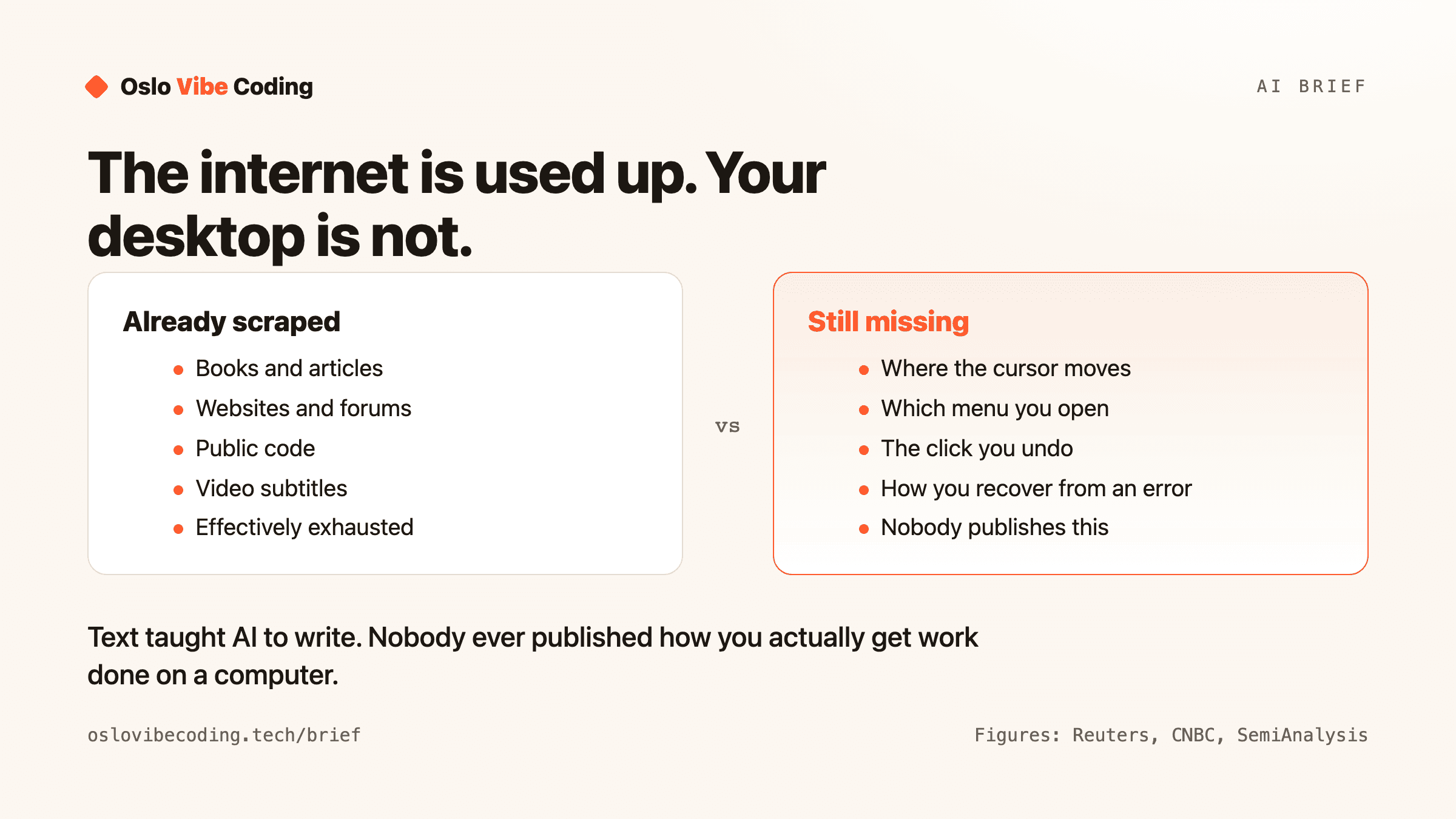
The internet taught AI to write. Nothing on the internet teaches it to use a computer the way an office worker does, because nobody ever recorded that. The only places holding a large, legally clean supply of it are employers, watching their own staff.
The short version
In April, Reuters reported that Meta had begun installing software on the work computers of its US employees that records what they do: keystrokes, mouse movements, clicks, and periodic screenshots, across a designated list of work applications and websites. The programme is called the Model Capability Initiative, MCI internally.
The purpose was stated openly. A Meta spokesperson put it this way: if the company is building agents that help people complete everyday tasks on computers, its models need real examples of how people actually use them, things like mouse movements, clicking buttons and navigating dropdown menus.
Employees were not enthusiastic. CNBC reported staff describing the project as dystopian in internal messages, with concerns that the capture could sweep up passwords, unreleased product details, and personal information about people's immigration status, health or families. Andrew Bosworth, Meta's chief technology officer, was blunt in the April announcement: there is no option to opt out of this on your work provided laptop.
By June, more than 1,500 workers had signed a petition, and Meta gave ground. Staff can now pause the capture for up to 30 minutes at a time, after which it resumes on its own, and a limited set of employees can request a full exemption. The programme was not cancelled.
The bit that is actually interesting
The surveillance angle writes itself, and it is worth understanding why a company would take that reputational hit on purpose rather than assuming somebody in a windowless room simply enjoys watching people.
Every large model you have used was trained mostly on text that other people had already published. Books, articles, forums, public code, subtitles. That worked spectacularly, and it is close to spent. Researchers have been forecasting the exhaustion of high-quality public text for years, with estimates for the crossover clustering somewhere between now and the early 2030s, which is why the labs have spent the past two years signing licensing deals for the corners that were never scraped.
Meanwhile the product everyone is racing toward changed. The goal is no longer a chatbot that answers a question. It is an agent that opens the expense system, finds the right invoice, notices the field is greyed out, backs up, tries the other menu, and finishes the task.
Nothing in the entire written internet teaches that. Documentation describes what software is supposed to do. It never records what a person actually does at 4pm when the button is missing. That gap is the whole story.
Documentation says what software is supposed to do. It never records what a person actually does when the button is missing.
The analogy
Imagine you want to teach someone to cook, and all you have is every cookbook ever written.
They will get impressively far. They will know ingredients, techniques, temperatures, and the theory of why a sauce splits. Ask them to explain hollandaise and they will do it beautifully.
Then put them in a kitchen. They do not know how hard to press the knife. They do not know that this particular oven runs hot. They have never seen anyone recover a sauce that has started to break, because no cookbook contains the sentence "and here is what I did when it went wrong". Cookbooks record the intended path. The kitchen is full of the other paths.
Text data is the cookbook. Screen recordings are the kitchen. The mouse drifting to the wrong menu and coming back is not noise in that data, it is the most valuable part, because recovering from a mistake is precisely what current agents are worst at.
Why employees, of all people
There are two other ways to get this data, and both are worse.
Pay strangers to record themselves. This exists, and academic datasets of human computer-use recordings have been assembled that way, running to tens of hours of video and millions of annotations. Compared to the scale on which models are trained, that is a rounding error, and paying for it at internet scale would be enormously expensive.
Generate it synthetically, by having models drive software and learn from their own attempts. Also real, also being done, and it has a known failure: the model practises against its own idea of how software behaves, which is smooth and consistent in a way that actual enterprise software has never been.
That leaves the third option, which is that the data walks into your building every morning and is already using the exact applications you care about, on machines you own, under a contract you wrote. It is not the cheapest option because it is technically superior. It is the cheapest option because the consent question has an answer you can put in an employment policy.
Is this actually new?
The monitoring is not. Call centres have recorded every customer conversation for decades. Delivery fleets track speed, braking and idle time. Warehouse systems time individual picks. Being measured minutely at work is an old and thoroughly normalised thing, and most people who are subject to it are not paid Meta salaries.
What is new is the purpose. Traditional monitoring is aimed at the worker: are you productive, did you follow the script, why did you stop. The output is a performance review.
MCI is not aimed at the worker at all. It is aimed at the work, harvested as a training set. The output is a model that can do the task. That is a genuinely different arrangement, and the ordinary vocabulary of workplace privacy does not quite cover it. The objection is not only "you are watching me", it is "you are watching me in order to write down how I do this".
Meta's employees noticed. So did the internal critics who reportedly put up flyers calling the programme an employee data extraction factory. Whether that framing is fair depends on assumptions about automation that nobody can currently settle, but it is not an irrational thing to have noticed.
What the climbdown actually changed
It is worth being precise, because "Meta backs down" was the headline and it overstates things.
What changed: workers got a pause button, good for 30 minutes, that reverts on its own. A narrow exemption process appeared for people with specific concerns. Stephane Kasriel's June memo said the company remained confident in the privacy protections it launched with, which had gone through several layers of risk review, but had heard concerns about personal data on work devices, battery life, and wanting more control over when capturing happens.
What did not change: the programme. Capture remains the default state. The pause is a timer, not a setting, and the burden sits with the employee to keep pressing it.
That is a real concession and a small one. The interesting thing is the shape of it. Meta conceded control over timing, which costs almost nothing in aggregate data, and conceded nothing on whether the collection happens, which is the part that matters to the training set.
What to watch
Whether anyone else does it publicly. Meta took the entire reputational hit for this in April. If the data turns out to be as valuable as the theory says, the pattern to watch is not more announcements, it is the same practice appearing quietly in updated acceptable-use policies where no reporter is reading.
Whether it works. This is genuinely unresolved. It is plausible that watching a few tens of thousands of knowledge workers produces exactly the demonstrations agents are missing. It is also plausible that Meta employees using Meta's internal tools generalise poorly to everyone else's software, and that the whole thing is an expensive, unpopular way to learn about Metamate.
The consent question, which is the one that will outlive this story. If demonstrations of ordinary office work become a genuinely valuable commodity, then the people producing them have made something of value at work, and there is currently no mechanism by which that fact means anything to them. Employment contracts already assign the output of your labour to your employer. Nobody wrote them imagining that the recording of how you work is itself the output.
For most people reading this, the practical takeaway is smaller and more immediate. Assume that a work laptop is a work laptop, and that the number of companies with a business reason to record what happens on it just went up by one category.
Curious about AI? Come build with us.
Oslo Vibe Coding runs free, beginner-friendly drop-ins where we build real things with AI. No one codes alone.