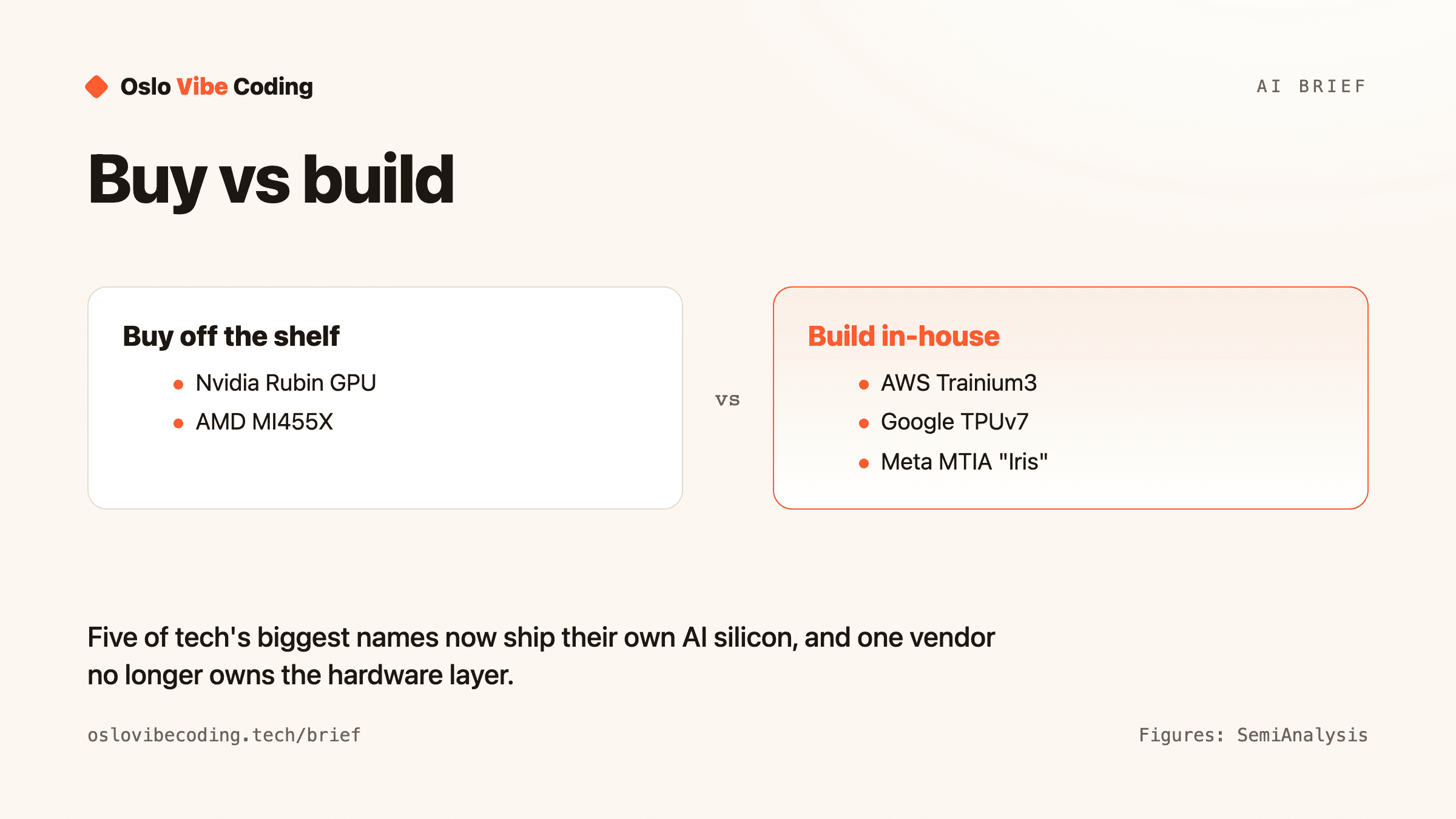
The era of one company owning AI hardware is ending, and memory bandwidth, not raw speed, is what every new chip fights hardest to win.
Five chips, five companies, one message
Within a few months of each other in 2026, five of the largest names in computing have each put a new AI chip on the table. Nvidia (the company that dominates AI hardware) has its Rubin GPU (graphics processing unit, the general-purpose chip that also runs AI). AMD (Nvidia's main rival) has the MI455X. And then the part that would have been a surprise a few years ago: three firms best known as software and cloud giants have their own silicon too. Amazon has Trainium3, Google has TPUv7 (its Tensor Processing Unit), and Meta has MTIA, codenamed "Iris".
The headline figures, compiled by the analysis firm SemiAnalysis, are large. Nvidia's Rubin packs about 336 billion transistors (the tiny switches that do the computing, more of them roughly means more power) built on TSMC's 3nm process (the Taiwanese factory and manufacturing recipe behind nearly every leading-edge chip). That is a 1.6x jump over its previous Blackwell chip's 208 billion. AMD's MI455X sits close behind at about 320 billion.
Three companies best known for software now design their own AI silicon.
The simple version: a kitchen, not a racetrack
It is tempting to read those transistor counts as a straight speed race. But the part every one of these chips fights hardest over is not raw speed. It is memory.
Picture a chip as a professional kitchen. The transistors are the chefs, and they are absurdly fast. But a chef can only cook as fast as ingredients arrive from the pantry. If the runners carrying those ingredients are slow, the fastest chef in the world stands idle, waiting. In an AI chip, those pantry runners are the memory bandwidth, and the pantry itself is HBM (high-bandwidth memory, the fast memory stacked right next to the processor).
This is why the memory numbers matter as much as the transistor counts. Nvidia's Rubin carries 288GB of HBM4 (the newest generation of that stacked memory) feeding it at up to about 22 terabytes per second. Meta's Iris uses eight HBM stacks pushing over 3.5 terabytes per second. Amazon's Trainium3, its first 3nm chip, pairs roughly 2.5 petaflops of compute (a petaflop is a thousand trillion calculations a second) with 144GB of memory. Modern AI models are enormous, and keeping the chefs fed is the hard part.
The fastest chef in the world stands idle if the pantry runners are slow.
Is this actually new?
Custom AI chips are not new. Google has been building its TPUs since around 2016, and TPUv7 is already shipping in volume, notably used by the AI lab Anthropic (the company behind the Claude models) to train its systems. What is new is the breadth. In earlier years, designing your own leading-edge AI chip was a Google-shaped eccentricity. In 2026 it is close to table stakes for every hyperscaler (the handful of companies that run the world's largest data centers).
There is an honest caveat here. None of these in-house chips are sold to you or me. Amazon, Google and Meta build them to run their own workloads and cut their own bills, not to compete with Nvidia on the open market. Nvidia still sells to almost everyone else, and its software ecosystem remains the default. The custom-silicon wave narrows Nvidia's grip; it does not end it.
What it means
The quiet story in this year's chip round-up is a shift in who holds the leverage. For most of the AI boom, one company effectively owned the hardware layer, and everyone else paid its prices. When Amazon, Google and Meta each design their own alternative, they gain a fallback, and a bargaining chip.
For anyone building with AI, the practical takeaway is less about any single spec and more about direction. Expect more chips, from more makers, tuned for narrower jobs. And when you read the next spec sheet, look past the headline transistor count to the memory bandwidth. That number, boring as it sounds, is where the real contest is being fought.
Curious about AI? Come build with us.
Oslo Vibe Coding runs free, beginner-friendly drop-ins where we build real things with AI. No one codes alone.