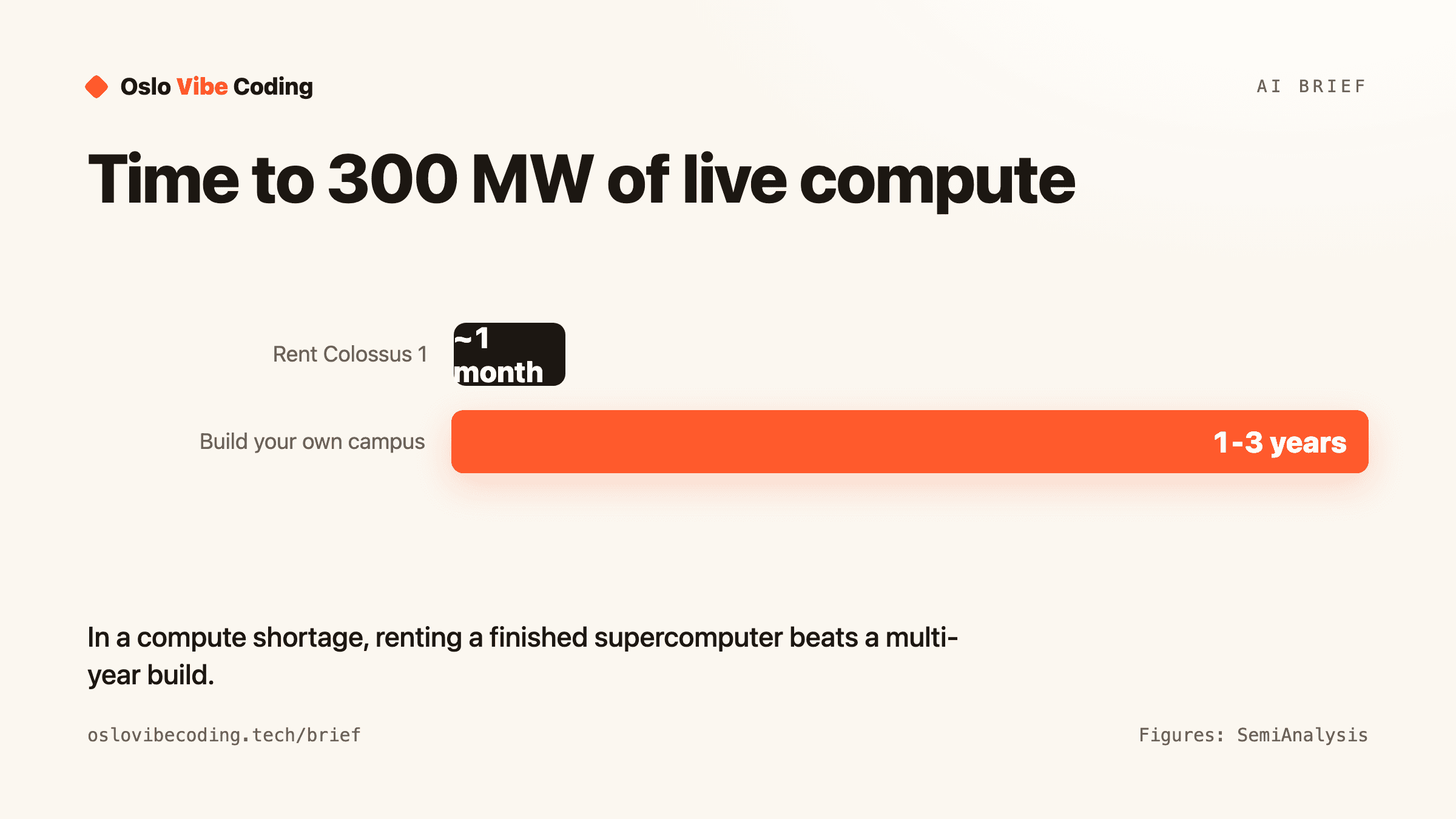
When compute is scarce, being fast to power matters more than being cheap, so Anthropic is renting instead of building.
What Colossus 1 actually is
Colossus 1 is a supercomputer in Memphis, Tennessee, built by xAI (Elon Musk's AI company, maker of the Grok chatbot). According to SemiAnalysis (a research firm that tracks the chip and data-center industry), it holds more than 220,000 Nvidia GPUs (Graphics Processing Units, the chips that do the heavy math for training and running AI models) and draws about 300 MW (megawatts, a measure of electrical power; 300 MW is roughly the draw of a small city).
Anthropic is the company behind Claude, the AI assistant many people in this community use through Claude Code. So the headline is a strange one: Anthropic, a direct rival to xAI, is now renting the whole of Colossus 1 to run its own models. Musk is powering a competitor's AI.
The deal, and the price tag
SemiAnalysis puts the cost at about $1.25 billion per month. That is roughly $15 billion a year, and more than $40 billion in total, with the arrangement running through May 2029. These are SemiAnalysis's figures, not a number either company has published in full.
For that money, Anthropic gets around 300 MW of usable computing capacity that already exists, is already plugged in, and is already cooled and running. It does not have to pour concrete, wait for transformers, or negotiate with a power utility. It rents the finished machine.
Musk is powering a competitor's AI.
The simple version: renting a car in a snowstorm
Here is the everyday version. Imagine you need a car today because a blizzard is coming and everyone wants one. You could buy a car, which is cheaper over five years, but the dealer says delivery takes a year. Or you could rent one this afternoon at a painful daily rate. In normal weather you buy. In the blizzard, you rent, because a car next spring is worth nothing when you need to drive tonight.
AI compute is in that kind of blizzard right now. Building your own data-center campus takes somewhere between one and three years: land, power hookups, cooling, and a global queue for the same Nvidia chips everyone else wants. Anthropic got its roughly 300 MW live in about a month by renting Colossus instead. The rent is eye-watering, but the wait is close to zero.
So the deal is not really about money being cheap. It is about time being expensive. When demand for AI is climbing faster than anyone can build power plants, the scarce thing is not dollars, it is megawatts that are switched on today.
It is not that money is cheap. It is that time is expensive.
Is this new?
Renting computing instead of owning it is the entire premise of cloud computing, so the shape is old. Netflix runs on Amazon's servers; startups have rented compute for twenty years. What is new is the scale and the rival-powers-rival twist. A single tenant renting a whole named supercomputer for over a billion dollars a month, from a company it competes with directly, is not something the industry has seen before.
It also fits a pattern SemiAnalysis and others have flagged all year: the AI labs are power-constrained, not just chip-constrained. The bottleneck has quietly moved from 'can we buy the GPUs' to 'can we find enough electricity, fast enough, to run them.'
Why it eases Claude Code, and the honest caveat
If you use Claude, you may have felt the other side of this. The deal coincided with Claude Code's 5-hour usage limits doubling for paid tiers. More capacity behind the product means Anthropic can serve more requests before it has to throttle, which is why renting a whole supercomputer shows up as a more generous rate limit on your screen.
The caveat worth keeping in mind: $1.25 billion a month is a bet that demand stays this hot through 2029. If the compute shortage eases, or if Anthropic finishes its own campuses, it will be locked into premium rent for capacity it could have built cheaper. Renting in a blizzard is smart. Renting after the snow melts is just expensive. For now, with the queue for power measured in years, speed is winning, and that is why Musk is happy to sell it.
Curious about AI? Come build with us.
Oslo Vibe Coding runs free, beginner-friendly drop-ins where we build real things with AI. No one codes alone.