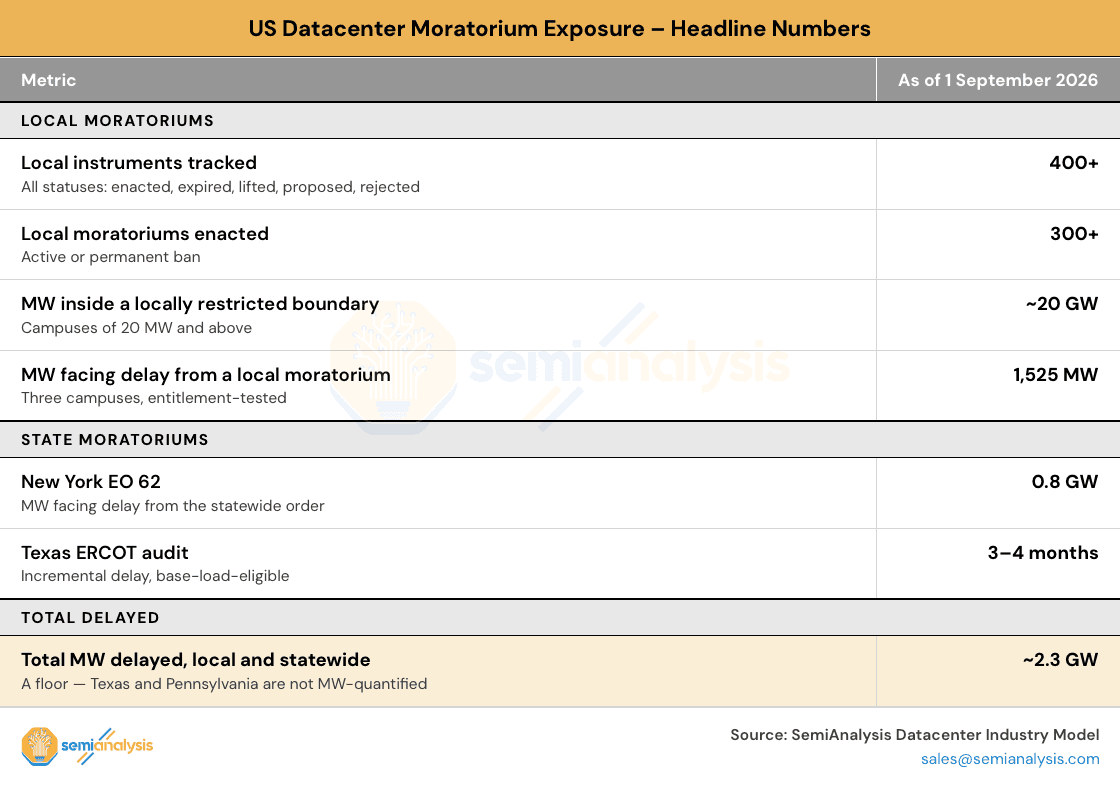
SemiAnalysis, the chip and datacenter research firm, has built a database of more than 400 local datacenter restrictions across 17 US states, of which 300-plus are enacted moratoriums (temporary bans on new applications) or permanent bans. It then matched each one, parcel by parcel, against the 6,000-plus datacenter sites it tracks with satellite imagery. Result: roughly 20 gigawatts of planned capacity sits inside a restricted boundary, but only 1,525 megawatts, 7.6 percent, is actually delayed, and three projects account for essentially all of it: an Amazon Web Services campus in Ohio, a developer's campus in Pennsylvania and a site in Colorado. Add New York's statewide pause, which the firm says delays about 0.8 gigawatts, and the total is around 2.3 gigawatts, against a forecast of 38 gigawatts of new US capacity in 2027. The reasons are mundane: county bans stop at city limits, bans freeze new applications rather than cancel approvals already granted, most bans expire before a 2028 project needs its permit, and developers redesign, relocate or sue. Texas's audit of its grid queue adds three to four months but pushes projects towards building their own power. SemiAnalysis sells this data and its view has a commercial angle; BloombergNEF, for one, thinks the Texas pause alone could delay far more. The backlash is growing fast, it is an election issue, and Wednesday's 417 to 3 House vote shows how bipartisan it is. It has not yet moved the buildout.
What happened
If you only read headlines, the American datacenter boom is being voted out of existence one council meeting at a time. Four states have acted in under two months. On 14 July New York's governor Kathy Hochul signed Executive Order 62, the first statewide pause in the country, which stops the state environment department issuing its permits for any datacenter that can draw 50 megawatts or more until an environmental study is finished. On 3 August Texas governor Greg Abbott ordered the state's grid operator ERCOT to audit every datacenter waiting to connect, roughly 250 to 300 projects out of a queue of 474 gigawatts, before any more can advance; ERCOT says that will take until December. According to SemiAnalysis, Pennsylvania has pulled datacenters out of fast-track permitting and Oregon has frozen datacenter deals on state-owned land. Below the state level, more than 300 towns, cities and counties have voted to halt datacenters over the past 18 months.
Then on Wednesday 16 September the US House of Representatives voted 417 to 3, about as bipartisan as Congress gets, to pass the Ratepayer Protection Act. It would push state regulators to make any datacenter drawing 100 megawatts or more at a single site pay the full cost of the power plants, transmission and distribution built to serve it, even if it later walks away from its contract. It amends a 1978 law under which states must formally consider the standard, not necessarily adopt it, and it now goes to the Senate.
Into this, on 15 September, SemiAnalysis published a piece with a deliberately provocative title: "Everyone Says Datacenter Moratoriums Are Killing the US Buildout. We Mapped All 300 of Them." Its answer, expanded in a podcast episode released on Friday, is that the bans are real, the anger is real, and the delay to actual megawatts is, so far, small.
The firm's forecast is for 38 gigawatts of new US datacenter capacity in 2027, more than double 2026's 18. Of that, 22 gigawatts is already under vertical construction (walls going up, visible from orbit) and most of the other 16 is financed and doing site works. SemiAnalysis says the forecast "has barely moved over the last 12 months".
"Counting moratoriums is not counting megawatts."
How they counted
Most coverage of the backlash counts restrictions, because restrictions are easy to count. SemiAnalysis counted them too: its new database holds more than 400 local instruments across 17 states, each tracked from proposal through enactment, expiry, repeal or rejection, of which 300-plus are enacted moratoriums or permanent zoning bans. Its chart of adoptions per month goes from a handful in early 2025 to around 60 in June 2026 alone. Michigan leads with 45 enacted and 7 proposed, Ohio has 40, and Michigan, Ohio, North Carolina and Georgia together account for about half the national total.
Then it did the part nobody else has done. It matched each active restriction against its project pipeline, the 6,000-plus datacenter sites it follows through property records, permits, power data, freedom-of-information requests and satellite photos. For every ban it checked whether the boundary actually reaches the project's parcel, whether the project still needs an approval the ban freezes, and whether anything else was already holding the schedule. The firm says it used "an army of state-of-the-art research agents" alongside its analysts to work through hundreds of restrictions and thousands of projects.
The result is the table at the top of this brief. About 20 gigawatts of planned capacity sits inside a locally restricted boundary. Only 1,525 megawatts of it, 7.6 percent, is actually delayed. Three campuses account for essentially all of that: an AWS site in Ohio, a powered-land developer's campus in Pennsylvania, and a site in Colorado. New York's order touches about 1.4 gigawatts and delays perhaps 0.8. The Texas audit adds three to four months for grid-connected projects. Total, and the firm calls it a floor: about 2.3 gigawatts.
Why a ban so rarely bites
SemiAnalysis lists a dozen conditions that all have to be true at once before a moratorium moves a delivery date, and its line is blunt: "If you miss just one of these, the moratorium is irrelevant." Four of them do most of the work.
- County bans usually stop at city limits. A county moratorium generally covers only unincorporated land, so a campus inside a town within that county is untouched. The firm names AWS in Atlanta, STACK in Lithia Springs, T5 in Fairburn and Microsoft in Tyrone as Georgia projects the county bans around them cannot reach.
- Bans freeze new applications; they do not cancel approvals already granted. A project that had its permits before the vote keeps them. That covers everything being built in 2026 and most of 2027.
- Most bans are short and most affected projects are far out. A six-month pause in 2026 has expired long before a project due in 2028 needs the permit it froze. The developer waits it out and the delivery date does not move.
- Something else was already the bottleneck. Litigation, transformer lead times or grid connection were often gating the schedule before the ban arrived, so the ban changes nothing.
The one that did bite, and the one that got away
The firm's example of a ban that binds is a NorthPoint campus near Scranton in Pennsylvania. The township passed its resolution unanimously in June 2026. The site is on private land, needs a local special exception the developer had not yet filed for, first buildings were due to start in the last quarter of 2026, and there is no federal route around it and no way to redesign out of it. Every box ticked, so the local approvals slip into 2027. NorthPoint is still pursuing it, with a proposed 165 million dollar package of community benefits.
The counter-example is in Brownsville, Texas. On the night of Saturday 29 August, after a six-hour special meeting, the city commission voted unanimously to "disannex" 444 acres, at SpaceX's request, as part of a 220 million dollar water infrastructure deal. Local reporting says SpaceX told commissioners the money was conditional on the ordinance passing that night. Three days later the city was due to discuss a datacenter moratorium. Activists say the company plans a datacenter and gas power plant on the land; SpaceX has not said. Whatever goes there, it is now outside the city's jurisdiction and any moratorium the city passes. SemiAnalysis's word for it is "sneakily".
Michigan is the whole argument in one state. It has the most local bans in America and, per the firm's project data, "effectively zero pipeline exposure". The Google campus there sits on industrial land where data processing was already a permitted use. Another developer sued a township over exclusionary zoning after a rejection and settled. A 180-day pause in Lyon Township cannot touch a project that was already approved.
What the backlash is really about
None of this means the anger is fake. SemiAnalysis polled American voters in August and found them net-positive on AI (46 percent favourable, 34 unfavourable) and net-negative on datacenters (29 favourable, 46 unfavourable, 24 percent very unfavourable). Forty-six percent would oppose a datacenter in their own town. Gallup finds the top complaints are energy use and electricity bills, then water, land and traffic. In Ohio, where PJM (the grid operator for much of the eastern US) let datacenter demand push capacity costs up, the firm says the average household bill rose 25.7 percent in a year, and 83 percent of Ohio's 40 bans were passed in 2026. In August Vivek Ramaswamy, the Republican candidate for Ohio governor, pledged that no new datacenter would be approved unless it eliminated electricity bills for nearby residents.
This is also why the bans are a favourite tool. With midterm elections in November, a temporary pause lets an official show they have heard residents without permanently turning away tax revenue, and it carries less legal risk than an outright denial. Both Hochul and Abbott acted by executive order, bypassing their legislatures, which means both can lift the pause themselves. Durable statewide laws are harder: SemiAnalysis counts 13 state bills that died in 2026, almost none reaching a floor vote. Wednesday's House bill sidesteps that problem by putting the cost on the datacenter rather than banning it, which is a big part of why 417 members voted for it.
The other consequence is where the power comes from. The Texas audit only slows projects that want to plug into the grid. SemiAnalysis counted 75 gigawatts of firm orders for behind-the-meter equipment (generators and turbines that let a datacenter make its own electricity on site), more of it bound for Texas than any other state, and expects on-site power to supply more than half of new US capacity from 2028. We covered that shift in an earlier brief. A grid pause, in other words, is a subsidy for gas turbines.
Is this actually new?
Local bans that fail to stop a buildout have a recent precedent in the same country. Columbia Law School's Sabin Center has for years catalogued local restrictions on wind and solar farms across US counties, and the list runs to hundreds; over the same period American solar installations kept setting records. The pattern was the same: restrictions cluster where building is fastest, they hit projects years from construction, and developers move a county over.
Norway has its own small version. Cheap hydropower drew datacenters and crypto miners north, and in 2024 the government proposed making every datacenter register and disclose what it does, so municipalities could say no to the ones they did not want. The scale is nothing like Ohio's, but the instinct, that a town should get a say over who uses its power, is the same one now passing through 300 American councils.
Two honest caveats about the source. SemiAnalysis sells the Datacenter Industry Model this analysis comes from, and its business does better when clients believe the buildout is on track; this is the third piece in a year in which it has argued that a popular "datacenters are in trouble" story is wrong. And other analysts see more risk: BloombergNEF has warned that the Texas audit alone could delay up to 49.8 gigawatts of proposed load and cost projects up to 15 billion dollars, a figure SemiAnalysis's three-to-four-months framing implicitly disputes. The parcel-level method is the strongest thing about the piece. The conclusion still comes from a firm with a view.
The everyday version
Imagine 300 planning offices have each taped a sign to the door: "No new datacenter applications until further notice." It looks like a wall. Now walk the sites. The building whose permit was stamped last year is still going up; the sign only stops new applications. The campus across the county line is inside a town the county sign does not cover. The developer with a 2028 opening date reads the sign, notes it comes down in six months, and goes for lunch. The one whose land was just moved outside the city limits does not need to read the sign at all.
Out of 300 signs, three actually stopped somebody who needed to walk through that door this year. That is what SemiAnalysis found. And separately, this week, Congress decided that whoever does walk through the door should pay for the road.
What to take from it
If you want one sentence: America's datacenter backlash has produced 300 local bans, four state actions and a 417 to 3 vote in Congress, and by one careful count it has so far delayed about 2 gigawatts out of nearly 40 arriving next year.
The useful habit here is the one SemiAnalysis modelled: when a story is told in counts of things (bans, cancellations, lawsuits), ask what unit actually matters and go and measure that. The unit here was megawatts on specific parcels, and the answer looked nothing like the count.
Three things to watch. Whether the Senate takes up the Ratepayer Protection Act before the midterms, because cost-sharing is the version of the backlash that scales. What ERCOT's December audit finds, and whether SemiAnalysis's three-to-four months or BNEF's 49.8 gigawatts turns out closer to the truth. And whether the monthly count of new local bans, which hit 60 in June, keeps climbing after November, because the firm's own caveat is that the bans "COULD delay the buildout, but they just aren't yet at scale".
Curious about AI? Come build with us.
Oslo Vibe Coding runs free, beginner-friendly drop-ins where we build real things with AI. No one codes alone.