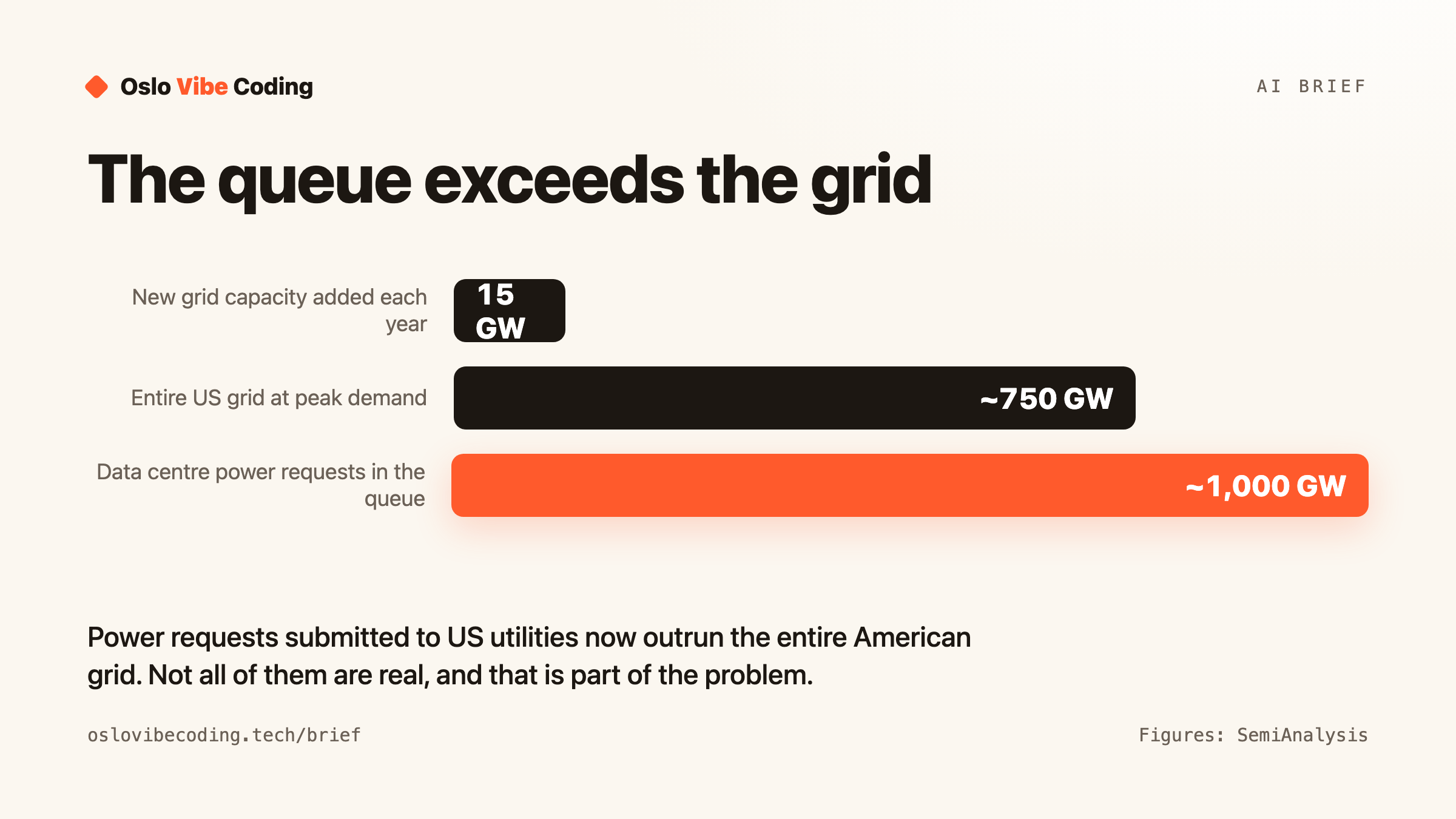
SemiAnalysis estimates that around one terawatt of electricity requests have been submitted to US utilities and grid operators, against a grid that peaks at roughly 700 to 800 gigawatts. New capacity is arriving at about 15 gigawatts a year, and the wait from request to power flowing is now around five years. Because an AI data centre earns roughly 10 to 12 million dollars per megawatt per year, that wait is unaffordable, so operators have started generating their own power on site. The industry calls it bring your own generation. xAI proved it worked in 2024 by renting truck-mounted gas turbines rather than buying them, and siting on a state border to get two shots at a permit. Everyone copied it. In October 2025 OpenAI and Oracle ordered a 2.3 gigawatt on-site gas plant in Texas, the largest ever. Twelve different suppliers now each hold more than 400 megawatts of US data centre orders, including a ship engine maker and a supersonic jet startup. On-site power costs more per unit than grid power, and buyers are paying it anyway because the alternative is waiting.
The bottleneck moved
For three years every conversation about AI limits has been about chips. Can you get GPUs, can you get HBM, which is the fast memory stacked on top of AI chips, has Nvidia allocated you any.
That is no longer the binding constraint. A GPU cluster is a machine that turns electricity into text, and the thing in short supply is now the electricity.
The numbers moved fast. In December 2025 SemiAnalysis forecast US AI power demand above 28 gigawatts by 2026, up from around 3 gigawatts in 2023. That forecast looked aggressive at the time and turned out close to right. Their projection for new data centre power demand by 2030 is 84 gigawatts.
For a sense of scale, Norway's entire electricity consumption runs at an average of roughly 16 gigawatts. The American AI industry is trying to add several Norways to its grid this decade, concentrated into a few dozen sites, on a timetable that the grid was never built for.
A queue larger than the country
Look at Texas. Every month, tens of gigawatts of new data centre load requests arrive at ERCOT, the body that runs the Texas grid. In the twelve months to March 2026, around 2 gigawatts of new generation were approved. Demand arrives by the tens of gigawatts and approval arrives by the gigawatt.
Nationally, SemiAnalysis estimates roughly one terawatt of load requests now sit with US utilities and grid operators. That is 1,000 gigawatts. The entire American grid peaks somewhere between 700 and 800 gigawatts. The requests exceed the system.
Except a lot of those requests are not real, and that turns out to be the deeper problem. In October 2024, the Ohio utility AEP was holding 35 gigawatts of load requests, and 68 percent of them came from developers who did not control the land. No site, no building, just a claim on power.
This is a queue behaving like a queue with no rules. If every developer submitted one honest request for one site they actually owned, the line would move quickly and everyone would connect sooner. But nobody can afford to be the only honest one, so developers file speculative requests with several utilities at once and hope one lands. The phantom requests clog the queue, which makes the wait longer, which makes everyone file more speculative requests.
Meanwhile the grid is slow for good reasons. Electricity supply and demand must match almost exactly, every second, or the lights go out for millions of people, as the Iberian Peninsula discovered in April 2025. Every large new connection triggers engineering studies to check it will not destabilise the network. In some regions the grid now changes faster than the studies can be completed. End to end, the wait from request to power flowing is around five years.
What six months is worth
Five years would be survivable if the delay were cheap. It is not.
SemiAnalysis puts AI cloud revenue at 10 to 12 billion dollars per gigawatt per year, which is 10 to 12 million dollars per megawatt annually. Run that on a mid-sized 200 megawatt cluster and you get around 2 billion dollars a year, so bringing it online six months early is worth roughly a billion dollars.
A billion dollars, for six months, on one site. Once you have that number in your head, every strange decision in this industry starts to make sense. Why a company would rent a power plant instead of buying one. Why it would build on a state line. Why it would knowingly pay more per kilowatt hour, permanently, in exchange for starting sooner.
SemiAnalysis puts it starkly: in frontier AI, cheap power in 2030 can be worse than expensive power in 2027.
There is a phrase for the spare capacity a grid has left after covering its own peak demand and safety margins. Grid headroom. SemiAnalysis's view is that available headroom is already close to zero and goes negative by 2027. That does not mean blackouts. It means that in more and more regions there is no comfortable room left for a large new customer, and every new connection becomes a fight over who gets capacity and who pays for the upgrades.
Cheap power in 2030 can be worse than expensive power in 2027.
The trick xAI pulled
In 2024 xAI stood up a 100,000 GPU cluster in Memphis in four months. Construction began in June, training started in September. The data centre industry did not think that was possible, and the clever part was not the computers.
xAI did not ask the grid. It generated on site, and the specific moves became the template everyone else copied.
First, small turbines. xAI used 16 megawatt modular units from Solar Turbines, a Caterpillar subsidiary. Sixteen megawatts is tiny by power station standards, and that is the point. It fits on a lorry. You drive it in, set it down, and you are generating within weeks.
Second, it rented them. The turbines came from Solaris Energy Infrastructure, and xAI leased 34 truck-mounted gas engine systems from VoltaGrid alongside them. Renting a power plant is not cheaper than buying one. It was faster, because buying means joining another queue, this time for equipment.
Third, when the site needed permits for gigawatt-scale generation, xAI built on the border between Tennessee and Mississippi. Two states, two permitting authorities, two chances at a fast yes. Tennessee could not deliver on the timeline. Mississippi could. Site selection as regulatory arbitrage.
Picture a bakery that needs more power, is told by the city that the upgrade will take five years, and parks a generator in the car park instead. Then, because the generator itself has a three year waiting list, rents one. Then, on discovering the council is slow with permits, moves the bakery fifty metres to sit in the next borough. That is roughly what happened, at a scale of hundreds of megawatts.
A supersonic jet company is now a power company
Everyone followed. In October 2025 OpenAI and Oracle placed the largest order for on-site gas generation ever recorded, a 2.3 gigawatt fleet in Texas, supplied by VoltaGrid. SemiAnalysis, which tracks this building by building, found twelve separate suppliers each holding more than 400 megawatts of US data centre orders, in a market that barely existed in 2023.
The names are the strange part. Doosan, the Korean industrial group, timed a turbine launch well and booked a 1.9 gigawatt order serving xAI. Wärtsilä, a Finnish company that has spent its life building engines for ships, worked out that the engines pushing cruise liners across the Atlantic will also run an AI cluster, and has signed 800 megawatts of US data centre contracts.
And then Boom Supersonic. The company building a Mach 2 passenger aeroplane has sold Crusoe 29 turbines of 42 megawatts each, 1.21 gigawatts in total, for around 1.25 billion dollars, with first deliveries in 2027. It raised a further 300 million dollars alongside the order. A supersonic airliner startup is now partly financed by selling power generation to AI data centres.
This is less bizarre than it sounds. The most sought-after machine in this market is the aeroderivative turbine, which is a jet engine bolted to the ground. GE Vernova's come from GE jet engines, Mitsubishi's from Pratt and Whitney, Siemens Energy's from Rolls-Royce. A jet engine is already designed to make enormous power in a package light enough to fly, so adapting it to sit still is comparatively easy. Boom had the engine core already.
What the market actually rewards is availability, not engineering elegance. Meta and Williams built a behind-the-meter plant in Ohio whose equipment list runs to four different product lines from three manufacturers. Nobody designs a power plant that way deliberately. That is the signature of buying whatever can be delivered on time.
Why it costs more, on purpose
The US grid delivers about 99.93 percent uptime, and it does that by being enormous. Thousands of generators, hundreds of transmission lines, markets rebalancing constantly. If one plant trips, a thousand others cover it.
Go behind the meter and you have to reproduce that reliability with one power plant serving one customer. The only way is to overbuild. Suppliers insist on at least one spare unit, so a failure does not cut output, and preferably two, so you can also take machines offline for maintenance. It is the difference between carrying a spare tyre and carrying a spare tyre plus a repair kit.
In practice a 200 megawatt data centre served by 11 megawatt engines means installing 26 of them, 286 megawatts of nameplate capacity, with 23 running at about 80 percent load. Vantage is building a 1.4 gigawatt campus in Shackelford County, Texas and deploying 2.3 gigawatts of generation to serve it, a 64 percent overbuild. In hot climates you need more units still, because turbines produce less power when the air is hot.
The equipment runs 1,500 to 2,000 dollars per kilowatt for turbines and engines, and 3,000 to 4,000 for fuel cells, which produce power without combustion and are therefore far easier to permit near populated areas. Their catch is that the stacks need replacing every five or six years.
None of this is cheaper than buying grid electricity. All of it is faster. That is the whole trade.
Is this actually new?
Not remotely, and Norway is the best illustration of why. The Norwegian aluminium industry exists where it does because smelters were built next to hydropower. Aluminium smelting is an enormous, constant electrical load, and the answer for a century has been to put the factory where the power is rather than move the power to the factory. Company towns were built on the same logic.
Bitcoin mining ran the modern version of the experiment a decade ago: portable, power-hungry, indifferent to location, and willing to sit next to a stranded gas well.
What is new is the direction and the money. Aluminium went to where power already was. AI data centres are being built where the fibre, the land and the workforce are, and the power is being manufactured on the spot to meet them. And the numbers are large enough to reshape an industrial supply chain in about two years.
The other genuinely new thing is that most of this is temporary by design. Many of these plants are a bridge. The site needs power in 2027, the grid connection arrives in 2030, so the developer builds a power station, uses it, and demotes it to backup when the utility finally shows up. Billions of dollars of generation is being installed with a planned second career as a spare.
What to take from it
The useful reframe is that AI capital expenditure has stopped being a technology story and become an industrial one. The constraint is transformers, turbines, permits and substations, and those are physical objects with factories and lead times behind them. You cannot conjure a high voltage breaker with a funding round.
For Europe this matters in a specific way. The same physics applies here, with less land, tighter permitting and stronger emissions rules, which is one reason so little frontier training happens on this continent. Norway has an unusual position in that comparison, with abundant firm hydropower and a cold climate, and it is worth watching whether that converts into anything at scale or stays a talking point.
The environmental question is real but not simple. On-site gas is more carbon-intensive per unit than the average grid mix in many regions, and it is being deployed at speed with limited scrutiny. It is also true that these plants exist because the grid could not move, and a slow grid is a policy choice as much as an engineering one.
Watch grid headroom. If SemiAnalysis is right that it goes negative in 2027, the fight over who gets electricity stops being an AI story and starts being an everybody story: factories, homes, EV charging, and chip fabs all competing for the same capacity. That is the point at which this arrives on ordinary electricity bills and in ordinary politics.
Curious about AI? Come build with us.
Oslo Vibe Coding runs free, beginner-friendly drop-ins where we build real things with AI. No one codes alone.