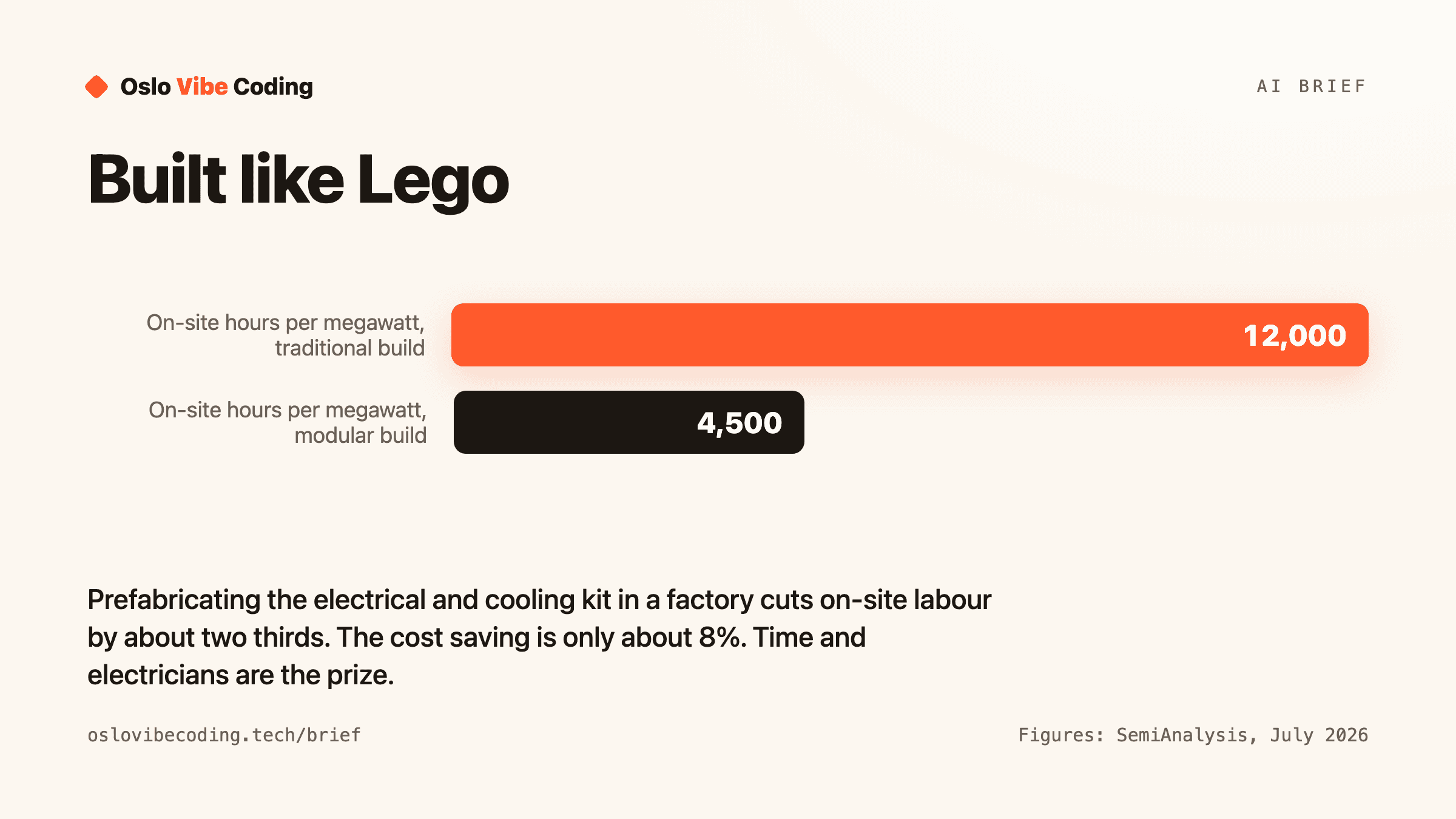
SemiAnalysis, the research firm that tracks AI infrastructure most closely, says the largest datacentres in the world are now being built modularly: the electrical and cooling equipment is assembled and tested in a factory, shipped as sealed units, and plugged together on site. Their tracker counts over 61 gigawatts of capacity and more than 1,000 sites using some form of this, with Amazon, Meta and the Stargate builders leading. Their figures: a traditional build takes 18 to 24 months, a fully modular one 12 to 18, about 36% faster, while on-site labour falls from around 12,000 hours per megawatt to around 4,500 and licensed electrician hours drop by about 85%. The cost saving is small, roughly 8% per megawatt. What the operators are buying is time, because a megawatt of AI computing earns roughly $12 to 15 million a year, and certainty, because you cannot manufacture electricians. The catches are real: modules that do not work when plugged in, trucks tipping over with expensive kit aboard, twelve-month-plus lead times, and a new shortage of factory workers replacing the old shortage of site workers.
The bottleneck moved
For two years, the story of AI infrastructure has been about things you could not get: first the chips, then the memory, then the electricity. We wrote on Wednesday about companies building their own power stations because the grid could not connect them in time. This week's SemiAnalysis podcast is about the constraint that comes after power, and it is people.
Specifically, it is electricians. In a datacentre project, SemiAnalysis estimates electricians alone account for 30 to 40% of all construction hours. The mechanical and electrical fit-out of a single 50 megawatt hall takes around 600,000 hours of field labour and about 300 tradespeople on site at peak. A campus the size of Stargate in Abilene, Texas, needed somewhere between 7,000 and 9,000 workers at its busiest, in a town of 130,000.
The evidence that this is a real shortage rather than a talking point is in the wages. SemiAnalysis tracked the pay of newly hired electricians in the counties around the biggest campuses, including Abilene and Microsoft's Fairwater site in Wisconsin, and found rates doubling and in some places tripling. The Texas Tribune reported in April that the Abilene project was offering electricians double what local subcontractors could pay, and that Crusoe, the developer, had earlier raised wages 30% to fill the site. Home builders in Texas are now competing with datacentres for the same people.
You can, with enough money, make more turbines and more chips. You cannot make an experienced high-voltage electrician in under four years. So the industry has started to ask a different question: how do you build a datacentre with fewer of them?
What Lego means here
The traditional way to build a datacentre is called stick build. You grade the land, pour the foundations, put up the shell, then bring every transformer, switchboard, battery unit and cooling pipe to the site and have crews install and wire them in place, one after another. Then you test the whole thing, a process called commissioning. Everything happens in sequence, on site, in the weather.
The modular way splits the job in two. The site work still happens on site, because you cannot prefabricate a foundation. But the expensive, fiddly part, the power and cooling equipment, is built into steel enclosures in a factory hundreds of miles away, wired and tested there, and then trucked in and set down like Lego bricks. The factory work and the site work happen at the same time instead of one after the other.
SemiAnalysis's own taxonomy runs from small skids (a single steel frame with a few pieces of equipment on it) through prefab power blocks up to full containerised datacentres, and it warns that the word modular is now applied to all of them, which is why they titled the report the Wild Wild West.
The numbers, from their July report and repeated on the podcast: a stick-built datacentre takes 18 to 24 months from breaking ground to switching on, a fully modular one 12 to 18, which they call a 36% shorter build. The site preparation barely changes. What collapses is the mechanical and electrical fit-out, from up to nine months down to about three. On-site labour falls from around 12,000 hours per megawatt to around 4,500, and hours of licensed electricians fall by about 85%, because the wiring was done by factory workers earning roughly the same hourly rate but without the overtime, travel and premiums that push a field electrician's effective cost to around $63 an hour.
Why 8% is enough
Here is the part that surprises people. Modular is not much cheaper. SemiAnalysis puts the saving at about 8% per megawatt of capital cost, roughly $1.1 million on a build that costs around $14.6 million per megawatt the traditional way. On the podcast, their consulting analyst said clients keep asking whether modular is about cost, and the answer is no.
The reason is what a megawatt earns. A megawatt of AI computing, once full of chips and rented out, brings in on the order of $12 to 15 million a year by SemiAnalysis's estimate. Finish a 50 megawatt hall eight months early and you have earned something like $200 million you would otherwise not have. Against that, an 8% saving on the building is a rounding error and a delay is a catastrophe. Every operator on the podcast's list is optimising for the same thing: the day the first chip switches on.
The everyday version is a restaurant. Two owners open on the same street. One builds a kitchen from scratch: plumbers, then electricians, then the gas fitter, then the inspector, each waiting for the last. The other buys a kitchen already assembled and tested in a factory, drops it into the building and connects four pipes. The second kitchen cost about the same. It also opens seven months earlier, and the restaurant next door has already had seven months of full tables.
Who is doing it
This is not a fringe practice. SemiAnalysis's tracker counts over 61 gigawatts of capacity and more than 1,000 sites using some form of prefabrication, and it estimates modular methods will account for 30% or more of live capacity by the end of 2028.
Amazon Web Services runs an internal programme called SAMDC with a project named Houdini, which turns the fit-out of a server room into factory-built units about 45 feet long. AWS's target is to cut the time from construction start to first live server room to around 25 weeks, and SemiAnalysis says each unit removes more than 50,000 hours of on-site electrical work.
Meta went furthest. At its Prometheus campus in New Albany, Ohio, it put its computers under aluminium-framed fabric structures, essentially very large tents, of roughly 125,000 square feet each. The buildout was announced in July 2025 and satellite images showed eight of them standing by April 2026. The five permanent buildings on the same campus took two to three years each. Meta calls them rapid deployment structures. Everyone else calls them tents.
At Stargate in Abilene, the developer Crusoe had the walls of each building made as 672 factory panels, fabricated in under 40 days and installed at 15 to 20 a day, so that a building was weathertight in under eight weeks. Behind the operators sits a supply chain that is changing shape: equipment makers like Vertiv, Schneider Electric and Eaton, which used to sell individual transformers and battery units and now sell them pre-assembled in a box, which roughly doubles what they can charge per megawatt, and construction contractors like Comfort Systems USA and Sterling that have spent heavily on factory space to assemble modules for the biggest customers.
The catches
The podcast is candid about what goes wrong, and it is a useful list because the marketing does not mention any of it.
Plug and play sometimes does not play. Contractors described being called in the middle of the night to sites where an off-the-shelf module simply did not work when connected, and nobody on site could say why. A module that passed every test in a factory can still fail when the whole system has to behave together, for instance when the utility power drops and every backup has to kick in, in the right order, at once. That final system-level test, which the industry calls level 5 commissioning, cannot be done in a factory and still takes three to eight months. Some operators, under pressure to switch on, are skipping parts of it.
Logistics is a bigger problem than anyone planned for. These are heavy, valuable objects. SemiAnalysis's analysts told of a truck in Northern Virginia that tipped onto its side on a bumpy highway with a module aboard, and of insurers becoming reluctant to cover the transport at all. The response has been to build the factories closer to the sites.
And the bottleneck has not gone away, it has moved again. Lead times for a standard module from the leading suppliers are now over twelve months, and eighteen if you want anything changed. The suppliers who took the electrical work into their factories are now short of factory space and factory workers instead of site electricians. Because a module ships as one unit, a single missing component now holds up a whole box rather than one part. The industry has industrialised the building of datacentres, and inherited the problems of industry.
Is this actually new?
No, and the precedent is instructive. Ships have been built from prefabricated blocks since the Second World War, when American yards assembled Liberty ships from factory-made sections in weeks rather than months, precisely because there were not enough skilled shipwrights. Norway's own offshore industry has spent decades building oil platform modules in yards at Stord and Verdal and floating them out to be lifted into place, for the same reason: it is cheaper and safer to do the work in a hall on land than on a platform in the North Sea. Datacentres are simply the latest heavy industry to discover that the site is the worst place to do skilled work.
What is new is the scale and the hurry. Modular datacentres have existed as a niche product for fifteen years, mostly for the military and for cryptocurrency miners. What changed in 2025 and 2026 is that the largest companies in the world adopted it for their flagship sites, and that the reason is not cost but the price of a month.
What to take from it
If you want one sentence: the AI build-out has run into the limit of how many skilled people exist, and the answer is to move the skilled work into factories, which buys months rather than money.
It is worth being sober about what that does and does not solve. It does not create more electricians. It uses the ones there are more efficiently and moves the demand to a different set of workers, in a different place, with their own shortages. It makes a datacentre faster to build, not faster to power or fill with chips. And it pushes risk down the chain to equipment makers who are now selling systems rather than parts, and who have not all learned yet what it means when a system fails at three in the morning.
The thing to watch is lead times. If the module suppliers' twelve-month queues stretch to eighteen or twenty-four, the industry will have swapped a labour bottleneck for a manufacturing one, and the next SemiAnalysis podcast will be about factories rather than electricians. If the queues shorten, because the sixty-odd new entrants on their vendor map find their feet, then a datacentre in 2028 really will take a year to build, and the argument about where the electricity comes from becomes the only argument left.
Curious about AI? Come build with us.
Oslo Vibe Coding runs free, beginner-friendly drop-ins where we build real things with AI. No one codes alone.