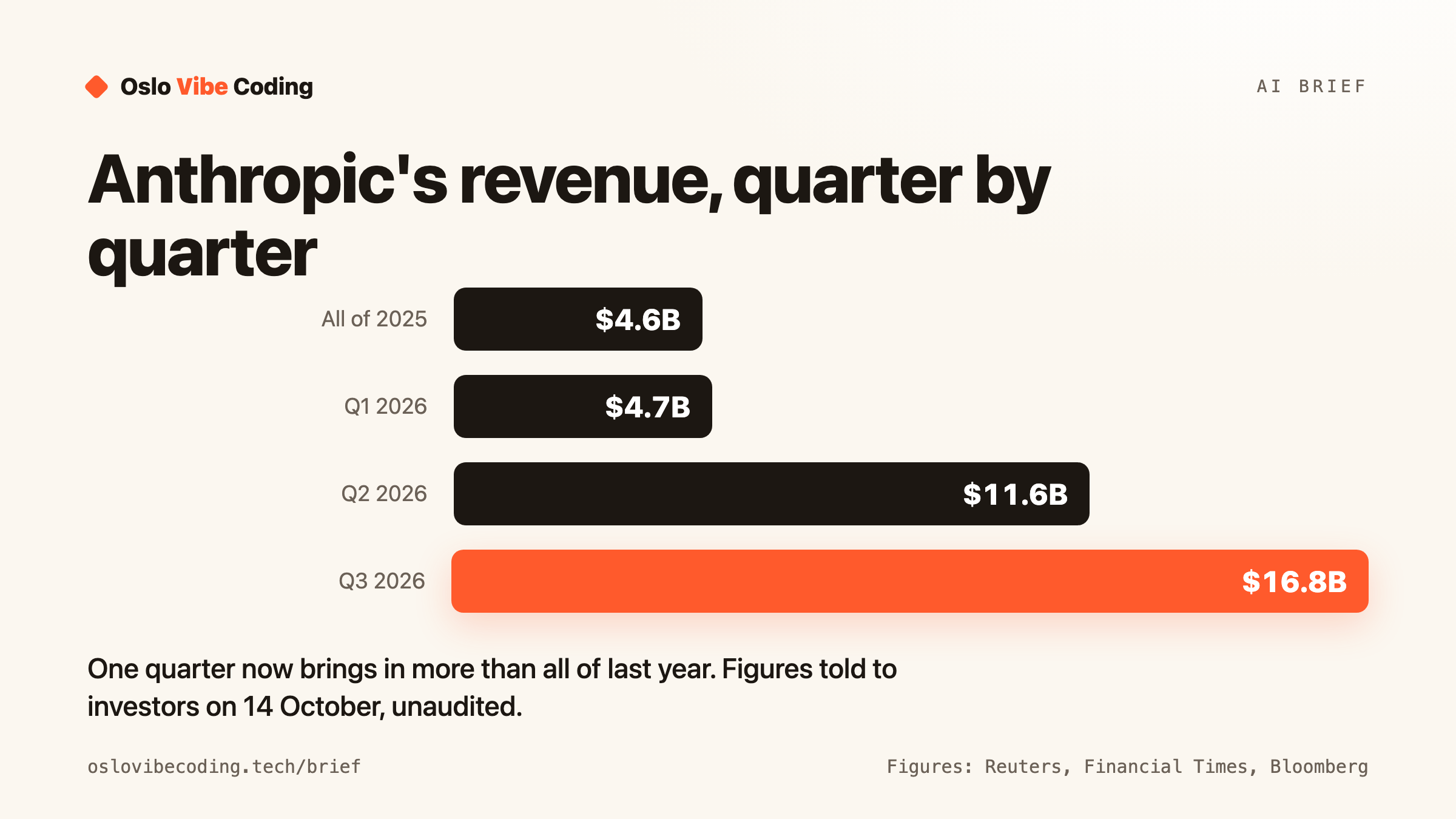
On Wednesday 14 October 2026 Anthropic, the maker of the Claude models, held an investor day at its San Francisco headquarters ahead of a stock market listing. According to the Financial Times, Reuters and Bloomberg, citing attendees, it reported third-quarter revenue of $16.8 billion, up 45% from $11.6 billion in the second quarter and $4.7 billion in the first; revenue for all of 2025 was nearly $4.6 billion. It said it was profitable on an adjusted basis and cash-flow positive, taking in $1.70 for every dollar spent on computing. It also carries at least $518 billion of computing commitments over a decade and is reportedly targeting a valuation above $2 trillion, with the listing now expected after the US midterm elections in November. Anthropic has not published or confirmed any of it, and nothing is audited until the public prospectus appears.
What happened
On Wednesday 14 October 2026 Anthropic, the company behind the Claude AI models, invited a selected group of institutional investors (pension funds, asset managers and the like) to its San Francisco headquarters. Chief executive Dario Amodei and chief financial officer Krishna Rao presented. Guests got caps, some printed with the word "thinking". The purpose, Reuters reported, was to familiarise prospective investors with the company before its initial public offering (IPO, the first sale of a company's shares to the public on a stock exchange).
The number everyone left with: revenue of $16.8 billion in the third quarter, July to September. The Financial Times reported it first; Reuters, citing two attendees, and Bloomberg, citing people familiar with the matter, matched it. For scale, Reuters saw the company's confidential prospectus last month, and it put revenue for the whole of 2025 at nearly $4.6 billion. One quarter now brings in more than the entire previous year.
Anthropic has not published the figures. It declined to comment to Bloomberg and did not respond to Reuters. Everything below comes from people who were in the room. It is unaudited, and it stays unaudited until the public prospectus (the S-1 form, the document a company files with the US securities regulator before listing) is published. We checked the regulator's filing database on Friday morning; Anthropic's is not there yet.
The facts
The quarterly sequence, per Reuters: $4.7 billion in the first quarter of 2026, $11.6 billion in the second, $16.8 billion in the third, a rise of 45% in three months. Annualise the latest quarter (multiply by four) and you get roughly $67 billion a year. CNBC, citing the Wall Street Journal, says investors expect the annualised rate to reach $110 billion by year end. That is an investor expectation, not a company forecast.
The profit claim: Anthropic told the room it was profitable in the third quarter "on an adjusted basis" and, according to the Financial Times, cash-flow positive, taking in $1.70 of revenue for every dollar spent on computing power. None of the reports says what was adjusted out. The 2025 accounts Reuters saw showed an operating loss of more than $8 billion before writedowns linked to earlier fundraising, which Reuters put at roughly $34 billion of a $42 billion net loss. Those writedowns are accounting charges, not cash, which is the kind of item an 'adjusted' figure usually removes.
The bills ahead: at least $518 billion of commitments over a decade for cloud services, computing and infrastructure, per Reuters. That is more than thirty quarters like this one. It is the bet that the queue keeps growing.
The listing: Anthropic confirmed on 1 June that it had confidentially submitted a draft S-1. Its last private round, in May, raised $65 billion at a $965 billion valuation. Reuters reports the company is targeting more than $2 trillion at the IPO and that the debut is likely to slip until after the US midterm elections on 3 November; Bloomberg reports formal marketing could start the week of 9 November with trading before Thanksgiving on 26 November, and adds that the plans are fluid. Reuters also reports the listing is expected to come before OpenAI's. One attendee told Reuters that Amodei reiterated the company's focus on AI safety but avoided the extinction language that its own prospectus uses, where advanced AI is said to pose possible "catastrophic or existential risks to humanity".
$16.8 billion in three months is about $180 million a day, every day, including Sundays.
The everyday version
Think of a bakery. Last year it sold $4.6 of bread and lost more than $8 doing it, because it was building ovens faster than it could sell loaves. This quarter it sells $16.8 of bread, and the owner tells you that for every $1 of flour and oven time it brings in $1.70. "Profitable on an adjusted basis" means: after flour, ovens and staff, the bakery is in the black, but before certain large bills the accountants insist on counting. Typically those are paper charges rather than cash, such as the value of shares handed to staff, or write-downs from earlier fundraising. They are real costs in the long run; they are not cash leaving the till this quarter.
And the bakery has signed leases on $518 of future ovens. Whether that is reckless or clever depends entirely on one thing: does the queue keep growing at this pace? Everything in the valuation argument comes back to that question, and it is the one number nobody in the room could actually know.
Is this actually new?
Partly. In August we covered an estimate from the research firm SemiAnalysis that Anthropic had turned an operating profit in the second quarter. This is the first time the company itself has said so to investors, and the first time it has put a quarterly revenue figure in front of outsiders. The growth rate is the unusual part. OpenAI, by Bloomberg's account, was at an annualised run rate of roughly $50 billion at the end of September with a target of $70 billion by year end; on these numbers Anthropic's $67 billion run rate has passed it. Treat that comparison loosely: the two companies count revenue sold through cloud partners differently, and both sets of numbers are unaudited.
The nearest precedent for revenue this size growing this fast is Nvidia's data-centre business, which roughly tripled in a year in 2024 and sells the chips Anthropic rents. The profit claim has a precedent of a different kind: every 'adjusted' profit announced before an IPO deserves the question 'adjusted for what?', and the public S-1 is the document that has to answer it, with audited figures and a balance sheet. We said the same about OpenAI in August, and it applies here just as much.
What it means
For investors the question is price. A company taking in $67 billion a year, growing 45% a quarter, with an adjusted profit, is what a $2 trillion valuation is being hung on. If the growth holds, that price is ordinary by software standards. If it halves, the $518 billion of computing commitments becomes the main story. Half a trillion in promised spending against $17 billion a quarter is the pair of numbers to keep side by side.
For everyone else, two things. First, this is where the whole AI buildout we keep writing about gets paid for: the data centres, the chips, the gas turbines and the loans only make sense if a few companies can show bills like this one, and now one of them has. Second, the regulatory bill is growing in the same week: Axios reported on Wednesday that the US Federal Trade Commission sent both Anthropic and OpenAI formal investigative demands about safety, privacy and marketing practices. That is fact-finding, not a finding of wrongdoing, but it will sit in the risk section of the S-1.
Two things to watch: the public S-1, which the November timeline would put in late October, and whether the fourth quarter shows the same slope. Disclosure: we use AI tools from several companies, including Anthropic's, to help produce this brief. Every figure here is what attendees told reporters, not an audited account.
Half a trillion in promised spending against $17 billion a quarter is the pair of numbers to keep side by side.
Curious about AI? Come build with us.
Oslo Vibe Coding runs free, beginner-friendly drop-ins where we build real things with AI. No one codes alone.