Anthropic, PBC filed a public S-1 registration statement with the US Securities and Exchange Commission on Monday 26 October 2026, applying to list Class A shares on the Nasdaq Global Select Market; TechCrunch reports the ticker will be ANT. The filing covers audited results to 31 December 2025 and unaudited results to 30 June 2026: revenue of $16.3 billion in the first half of 2026 against $1.2 billion a year earlier, a second-quarter operating profit of $1.0 billion on $11.6 billion of revenue, and a first-half net loss of $80.7 billion of which $72.4 billion is a non-cash accounting charge for convertible notes and similar instruments whose value rose with the company's valuation. Quarterly compute and infrastructure cost rose from $944 million in the first quarter of 2025 to $5.6 billion in the second quarter of 2026 while falling from 251% of revenue to 48%. Net revenue retention was about 900% as of 30 September 2026; more than 11,900 customers spend $100,000 or more a year, about 250 spend $10 million or more, and the top five customers are about 25% of revenue. The company had about 5,300 employees, had raised $141.1 billion and held $112.4 billion in cash at 30 June. The seven founders will hold 50.1% of the votes through a Founder LLC for ten years and the Long-Term Benefit Trust will appoint a majority of the board. The aggregate compute commitment figure is left blank in this version of the filing; earlier reports put it at about $518 billion. The offer price, size and date are not yet set.
What happened
On Monday 26 October 2026 Anthropic filed its S-1 (the registration document a company must file with the SEC, the US stock market regulator, before it can sell shares to the public) and made it public. The company has applied to list its Class A shares on the Nasdaq Global Select Market; TechCrunch reports the ticker will be ANT. The filing does not yet say how many shares will be sold, at what price, or when. Bloomberg reported earlier this month that marketing to investors starts the week of 9 November and trading could begin before the US Thanksgiving holiday on 26 November; the filing itself gives no date.
The document is the first audited look at the company behind Claude, Claude Code and Cowork. It arrives twelve days after Anthropic showed unaudited third-quarter numbers to investors behind closed doors, which we covered on 16 October. The S-1's financial statements stop at 30 June, so the headline figures here are from the first half of 2026, with a few September numbers for customers and staff. The third-quarter revenue of $16.8 billion that leaked from investor day is not in the audited section.
Within a day SemiAnalysis, the chip and AI research firm whose work this channel follows, had an emergency episode out on the filing. Its reading in one line: revenue per dollar of computing is up 5.2 times since the start of 2025, a customer who spent $1 a year ago now spends $9, and the margin on each extra dollar of revenue is running near 90%. Below are the numbers from the filing itself, then what they mean.
The facts
Revenue. Anthropic took in $16.3 billion in the first six months of 2026, up from $1.2 billion in the same period of 2025, a rise of 1,300%. The second quarter alone was $11.6 billion, against $787 million a year earlier. For the whole of 2025 revenue was about $4.6 billion, which was itself an 1,088% rise on 2024. About three quarters of revenue comes from customers paying $100,000 a year or more; the rest comes from roughly 40 million smaller customers, including individual subscribers.
Profit, two ways. On the ordinary accounting measure the company lost $693 million from operations in the first half of 2026, down from a $2.1 billion loss a year earlier, and it made an operating profit of $1.0 billion in the second quarter, an 8% margin. On its own 'adjusted' measure, which strips out share-based pay and similar items, the first half was a $1.6 billion profit and the second quarter $2.2 billion, a 19% margin. The filing warns that margins will swing in quarters when big new batches of computing arrive and have to be paid for before they earn anything.
The $80.7 billion loss. The number that will make headlines is the net loss for the first half: $80.7 billion, after $42.0 billion for 2025, $8.3 billion for 2024 and $1.5 billion for 2023. Of the $80.7 billion, $72.4 billion is a single line called 'change in fair value of convertible notes, derivative liabilities and SAFEs'. These are the promises Anthropic made to early investors, above all Amazon, to hand over shares at a later date. When the company's valuation rises, the value of those promises rises with it, and accounting rules require the increase to be booked as a loss, even though no cash leaves the building. Amazon's notes total $6.2 billion in principal, and Amazon's own filings valued them at $97.9 billion on 30 June. They convert to shares at the IPO, capped at 12% of the company unless Amazon waives the cap.
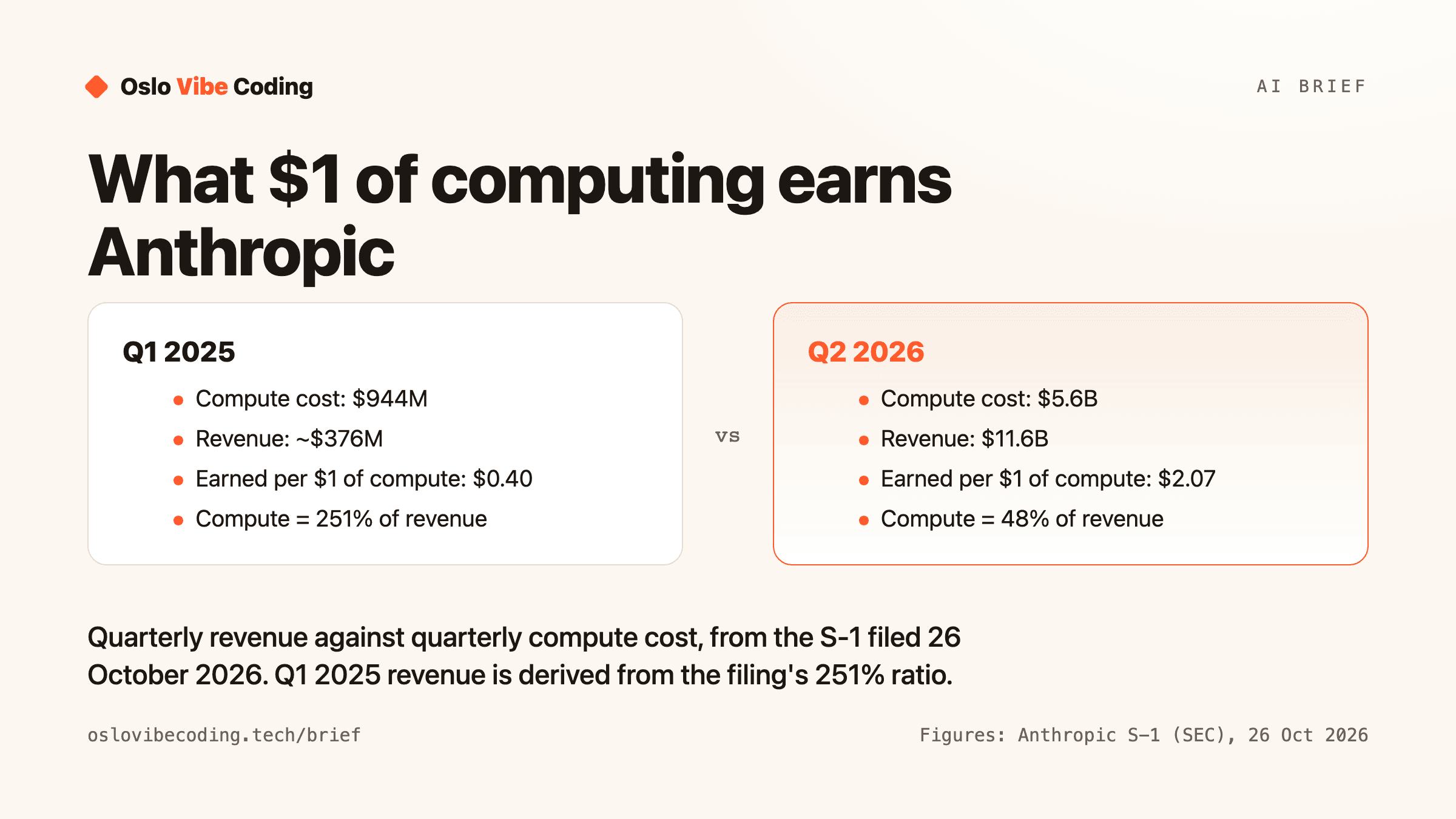
Computing. This is the heart of the filing. Compute and infrastructure cost rose every quarter, from $944 million in the first quarter of 2025 to $5.6 billion in the second quarter of 2026, because Anthropic buys computing 12 to 18 months ahead and pays for it as it arrives whether or not demand has caught up. But revenue grew faster: in the second quarter revenue was up 1,368% on a year earlier while compute cost was up 300%. As a share of revenue, compute fell from 251% to 48%. Put the other way round, which is how SemiAnalysis and the Hacker News thread both did it, each dollar spent on computing brought in about 40 cents in early 2025 and $2.07 by mid 2026. (The 40 cents is derived from the filing's 251% ratio; the $2.07 is $11.6 billion over $5.6 billion.) For 2025 as a whole, the company still spent about $7.3 billion on computing against $4.6 billion of revenue.
Customers. Net revenue retention, the standard software measure of how much last year's customers spend this year, was 'approximately 900%' as of 30 September, meaning a customer base that spent $1 a year ago now spends about $9. The filing explains it with examples: Claude Opus 5.5 cut customers' cost per task by about 40% against Opus 5, and the top 5% of enterprise customers using Claude Code spend about 20 times as much a month as enterprise users who do not. The number of customers spending $100,000 or more a year went from about 20 at the end of 2023, to 200 at the end of 2024, to 1,500 at the end of 2025, to more than 11,900 on 30 September 2026. More than 1,900 spend $1 million or more and about 250 spend $10 million or more. No single customer is more than 10% of revenue; the top five together are about 25%, and 79% of third-quarter revenue came from outside the top five, up from 64% in the first quarter. Over half the Fortune 500 are customers at $100,000 or more, and on average Anthropic is still under 0.1% of their total costs.
The balance sheet, and a blank. Anthropic had raised $141.1 billion in total and held $112.4 billion in cash and equivalents at 30 June. It had about 5,300 employees at 30 September, and revenue per employee over the previous twelve months was $6.6 million, up from $1.4 million a year earlier. The filing says over 90% of the contributions to its own codebase in September were written by Claude. The one figure most analysts wanted is not there yet: the sentence on long-term compute commitments reads 'an aggregate committed spend of more than $' with the number left blank, to be filled in before the sale. Reuters reported $518 billion over a decade in mid October, and SemiAnalysis calls it 'the half trillion in compute commitments'. The filing does confirm at least $110 billion committed to Amazon Web Services over ten years and, per TechCrunch, at least $114 billion to Google Cloud through 2033.
Who is in charge. Anthropic is a public benefit corporation, a for-profit company whose charter lets the board weigh a stated mission alongside profit. The seven co-founders, including Dario and Daniela Amodei, will hold their special Class F shares through a 'Founder LLC' that carries 50.1% of all votes, for ten years after the IPO or until fewer than three founders remain. The Long-Term Benefit Trust, an independent panel chaired by former GiveWell director Neil Shah and including former Federal Reserve chair Ben Bernanke, holds a share class that appoints a majority of the board. Public shareholders get the economics and very little of the control; the filing says plainly that it will be a 'controlled company' under Nasdaq rules. Separately, the company has put 5% of its fully diluted shares, 846,840,960 of them, into an Anthropic Public Benefit Fund, with up to 2% more each time the share price rises 50% above the last milestone, and the founders have each pledged 80% of their personal stakes to philanthropy.
The politics. The risk section records something no other S-1 has: that in February 2026 the US president ordered federal agencies to stop using the company's technology and the Secretary of War designated it a 'supply-chain risk to national security', after Anthropic refused to let its models be used for mass domestic surveillance or fully autonomous weapons. Anthropic sued, and on 27 August 2026 a federal court in California largely ruled in its favour, finding the actions were retaliation for speech protected by the First Amendment. The filing also discloses that in September 2025 it detected a Chinese state-sponsored group manipulating Claude Code into attempting to break into about 30 organisations.
Compute cost: 251% of revenue in early 2025, 48% by mid 2026. The number is left blank for how much more is on order.
The everyday version
Think of a bakery that signed a ten-year lease on an enormous set of ovens, delivered in instalments, paying for each oven the day it arrives. In early 2025 the ovens cost two and a half times what the bread brought in. By mid 2026 the same bakery sold two dollars of bread for every dollar of oven, and the ovens were still arriving. The $80.7 billion 'loss' is a different thing entirely: years ago the bakery promised a big supplier a slice of the business instead of cash, and because the business is now worth far more, the accountants have to write down how much more that slice would cost today. Nothing left the till.
The question an investor has to answer is whether the bread keeps selling at that pace while the oven bill, the blank number, keeps growing for twenty years. The filing's own answer is the 900% retention figure: the customers who already buy are buying nine times more than they did a year ago.
Is this actually new?
A fast-growing company going public with huge paper losses is not new; Uber's 2019 S-1 showed an operating loss of about $3 billion for 2018, and Amazon lost money for years after its 1997 listing. The scale is new. No company has filed an S-1 showing revenue rising thirteen-fold in a year at this size, and none has shown a net loss of $80 billion that is mostly an accounting artefact of its own rising valuation. Only a handful of public benefit corporations have listed before, Coursera and Warby Parker among them, and none with a founder voting block and an outside trust that together appoint the whole board.
The nearest comparison is the one the whole market is waiting on: OpenAI. Bloomberg reported in October that OpenAI's run rate was about $50 billion a year with a $70 billion target, against Anthropic's reported $16.8 billion quarter, but OpenAI has not filed and its figures are not audited. SemiAnalysis's episode asks directly whether OpenAI can keep up on efficiency; its view, labelled as opinion, is that Anthropic's revenue per dollar of computing is the moat. On Hacker News, where the filing drew 1,700 points, the counter-view was equally direct: one commenter noted that the top five models by usage on OpenRouter, a popular model marketplace, were all free Chinese models the day the filing dropped, and the filing's own risk section admits open models 'may capture a portion of the market'. Others noted that OpenRouter is a small slice of total usage.
What it means
For anyone who uses these tools, the filing settles an argument that has run for two years: whether the AI you pay for is sold below cost. For Anthropic, as of mid 2026, it is not. Each dollar of computing earns two, and the company says the gap widens with every model that does the same work for fewer tokens. The flip side is in the same pages: 'adjusted' profits, a compute bill that arrives on a schedule set 18 months earlier, and a commitment figure so large it has been left blank. If demand ever grows slower than the oven deliveries, the 48% turns back into something closer to 251%.
For Oslo, the practical question is price. Anthropic cut customer cost per task by 40% with its last flagship and is still earning more per dollar of computing, which argues that API prices have room to fall rather than rise. For the market, the IPO will be the first time anyone can buy a pure frontier AI lab, at a last private valuation of $965 billion, with the founders keeping 50.1% of the votes. A note on this channel's own position: we use Claude to help write and check these briefs, as the filing says Anthropic's own engineers use it to write 90% of theirs.
The customers who already buy are spending nine times what they did a year ago. The bill for the ovens is still being filled in.
Curious about AI? Come build with us.
Oslo Vibe Coding runs free, beginner-friendly drop-ins where we build real things with AI. No one codes alone.