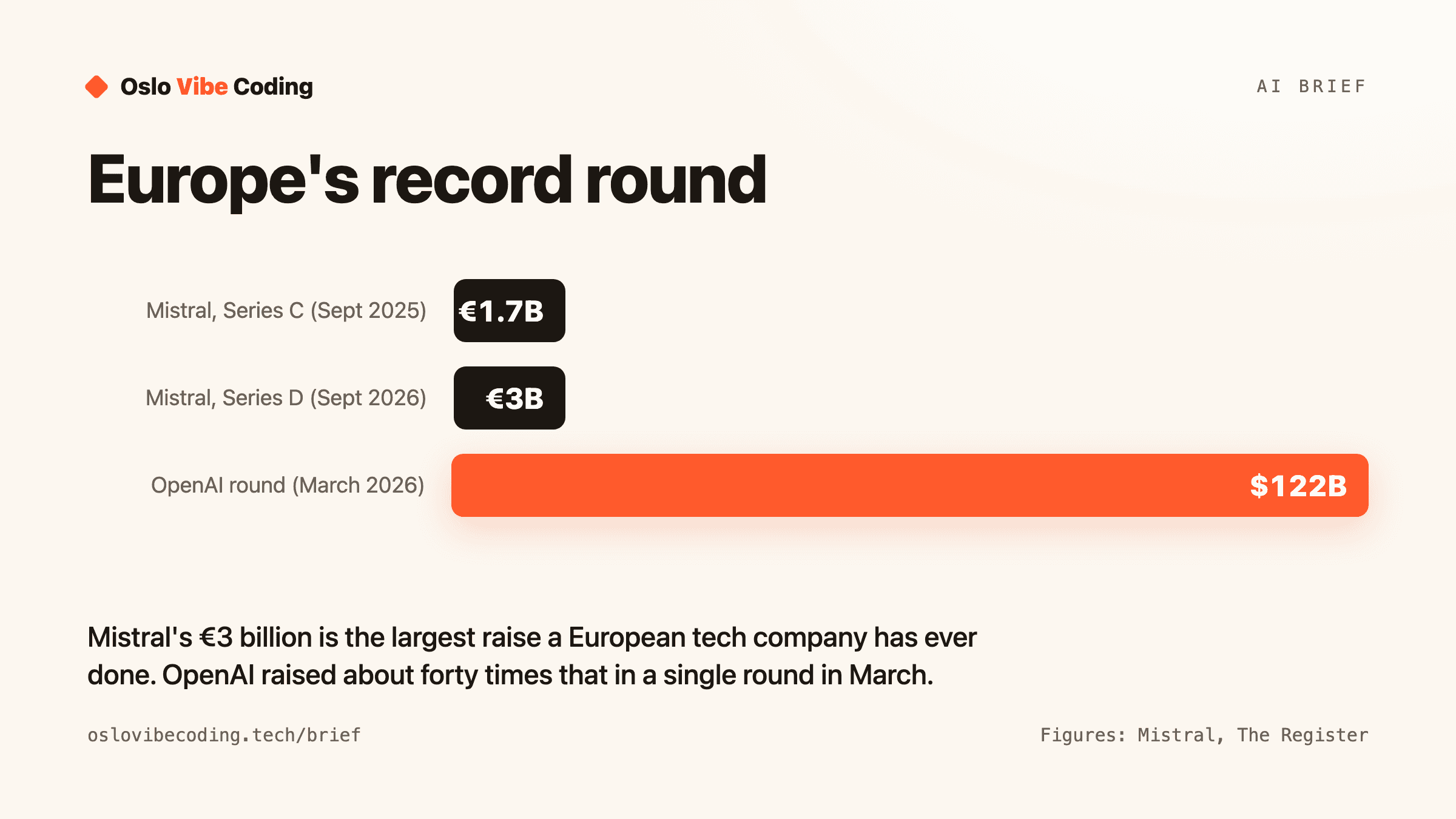
On 8 September Mistral announced a €3 billion Series D at a valuation above €21 billion, led by Samsung Electronics with the EU-backed Scaleup Europe Fund and PSG Equity. Mistral calls it the largest equity round ever completed by a European technology company, and the valuation has roughly doubled from €11.7 billion a year ago. The money is going into compute: Mistral says it wants to control a gigawatt of European capacity by 2030, on top of data centres already under construction outside Paris and in Sweden. The strategic shift is the real story. Mistral's own models trail the best Chinese open models and do not compete with the closed American ones, and the company now says its job is to build the full stack, meaning open models, the infrastructure they run on, and the products around them, including other people's models. For a European business, the pitch is control over where your data goes and who can switch you off. That pitch has never been stronger, and it is not the same thing as having the best model.
What was announced
On Tuesday 8 September, Mistral said it had raised €3 billion, about $3.5 billion, in a Series D round at a post-money valuation of more than €21 billion. Post-money means the value of the company after the new cash is counted in. Mistral describes it as the largest equity fundraising round ever completed by a European technology company, and nobody has disputed the claim.
The round was led by Samsung Electronics, the Korean chip and phone maker. The co-leads were the Scaleup Europe Fund, a vehicle backed by the European Union and managed by the Swedish investor EQT, and PSG Equity, which already held a stake. New names on the list include Advent, funds managed by BlackRock, and the government of Luxembourg. Nearly everyone from earlier rounds came back too: Andreessen Horowitz, Nvidia, ASML, Bpifrance, Lightspeed, General Catalyst, Salesforce Ventures and a dozen others.
A year ago Mistral raised €1.7 billion at an €11.7 billion valuation, in a round led by ASML, the Dutch company that makes the machines that make advanced chips. So the price of the company has roughly doubled in twelve months, and the total raised since it was founded in 2023 is now around €6 billion.
For scale, OpenAI's round in March was $122 billion at a valuation of $852 billion. Europe's record is about two and a half percent of that single American round.
What the money is for
The short answer is computers. Mistral's announcement lists four uses for the money: frontier research, compute capacity for training, infrastructure, and international expansion. Three of the four are ways of saying data centres.
The company already borrowed €830 million in March to build a data centre campus near Paris, and in February it committed around €1.2 billion to its first sites outside France, in Sweden. The stated target now is a gigawatt of European compute by 2030. A gigawatt is a large number: roughly the output of one nuclear reactor, running flat out, feeding nothing but AI chips. We wrote yesterday about American labs building their own power stations to get there. Mistral is the first European company to talk about the same scale.
Arthur Mensch, the chief executive, put it this way to French Tech Journal: with this round Mistral will be controlling an amount of compute "very comparable to what the Chinese labs have." Note the comparison he chose. Not OpenAI, not Anthropic, not Google. The Chinese labs, which are the ones that have shown you can stay relevant on a fraction of the American budget.
Samsung's motive is worth a sentence. It plans to use Mistral's models inside its own chip manufacturing, and the French and Korean governments have both framed the deal as building what President Macron called a "third way" in AI, one that is neither American nor Chinese.
Three of the four uses for the money are ways of saying data centres.
The sentence that changed
When Mistral launched in 2023, the pitch was simple: a European lab that would build frontier models to rival OpenAI, with the weights published so anyone could download and run them. That was the reason a team of ex-Meta and ex-DeepMind researchers could raise €105 million before shipping anything.
This week's announcement says something different. It describes Mistral as "the only AI company in the world building the full stack": open-weight models, the infrastructure and compute they run on, and the products that put them into production. The AFP wire went further and called it a strategy shift, away from competing head-on with OpenAI, Anthropic and DeepSeek, and toward building data centres and infrastructure that European businesses can use to run AI, including AI that Mistral did not build.
That last part is not an interpretation. In August Mistral began commercialising GLM-5.2, an open model built by the Chinese company Z.ai, and the announcement now says explicitly that its platform will host third-party open-weight models. The German outlet The Decoder was blunt about why: Mistral's current flagship, Mistral Medium 3.5, trails Chinese open models like Qwen and Kimi, and does not compete with the closed American models at all.
Mensch pushes back on the idea that Mistral has given up on the model race. "We have built Mistral to train models and to scale them. We will continue to do that," he said, and promised models arriving "very soon" that will be "very competitive." Both things can be true. A company can keep training models and also have quietly moved its centre of gravity to the floor underneath them.
Why a European business would pay for this
The word Mistral uses for its offer is sovereignty. In plain terms it means three things: your data stays on servers in Europe, the model you depend on can be downloaded and kept rather than switched off by a supplier, and no foreign government can decide overnight that you are not allowed to use it.
The third point stopped being theoretical this year. In June the American administration briefly put export restrictions on Anthropic's models, later lifted, and it was a reminder to every European bank, defence contractor and hospital that their most important new supplier answers to Washington first. Johan Bergqvist, Mistral's finance chief, said companies are "increasingly reaching out to us because they want to be in control of their own AI transformation."
Here is the everyday version. Imagine you run a bakery and the only oven supplier in town is excellent, cheap, and based abroad. Then one week their government says the ovens cannot be sold to bakeries in your country. It gets reversed after a fortnight, but you have now had the thought. The next time someone local offers to sell you an oven that is a bit worse, a bit more expensive, and impossible to switch off from abroad, you take the meeting. Mistral is the local oven company, and this year gave it a lot of meetings.
The customer list reflects that. Mistral says it serves more than 125 large enterprises in 20 countries, and the names it chooses to highlight are Airbus, ASML and HSBC: aerospace, chip equipment and banking. These are precisely the industries that cannot send their data to a server in Virginia and hope.
Is this actually new?
Europe has had national champions before, and the pattern is familiar. Airbus was assembled from French, German, British and Spanish pieces in 1970 to make sure Boeing did not own the sky, and it took decades and a great deal of public money before it did. Galileo, the European satellite navigation system, exists because Europe did not want to depend on American GPS, and it cost far more and arrived far later than planned. The instinct to build a third way is old, and it usually works slowly and expensively when it works at all.
What is new is that the champion is being built with private money, most of it from outside Europe. Samsung is Korean. Andreessen Horowitz, Nvidia, General Catalyst, Lightspeed and BlackRock are American. The EU's contribution comes through a fund, not a subsidy, and Luxembourg's stake is small. The Register spotted the awkward version of this: Mistral takes investment from Nvidia while spending the money on data centres full of Nvidia chips. Sovereignty over the model, dependence on the silicon.
The other thing that is new is the revenue. In February Mensch said annual recurring revenue was north of $400 million, up from about $20 million a year earlier, and that the company expected to pass €1 billion in 2026. Those are the company's own figures and they are unaudited, but they are the kind of numbers that make a €21 billion valuation an argument rather than a joke. Two years ago Mistral was a research team with a good story. This is a business.
What to take from it
If you want one sentence: Europe's best-funded AI company has stopped trying to win the model race outright and is instead building the place where Europe runs AI, whoever built it.
That is a sensible strategy and it is worth being clear about the trade. The best models in the world will still be made in San Francisco and Hangzhou. A European company that hosts them, wraps them in products, keeps the data at home and cannot be switched off from abroad is a genuinely valuable thing. It is not the thing Mistral set out to be, and €3 billion does not change the fact that Mistral's own models are currently behind.
For a Norwegian reader the practical point is simpler. If you are choosing an AI supplier for anything regulated, sensitive or long-lived, there is now a European option with the money to still exist in five years. Whether it is the right option depends on whether you need the best model or the safest arrangement. Mistral has decided which of those it is selling.
The thing to watch is the next model release. Mensch says it is coming soon and will be very competitive. If it is, the story of this round becomes a lab that funded both halves of its ambition. If it is not, the story is a very well-funded hosting company that used to be a lab.
Curious about AI? Come build with us.
Oslo Vibe Coding runs free, beginner-friendly drop-ins where we build real things with AI. No one codes alone.