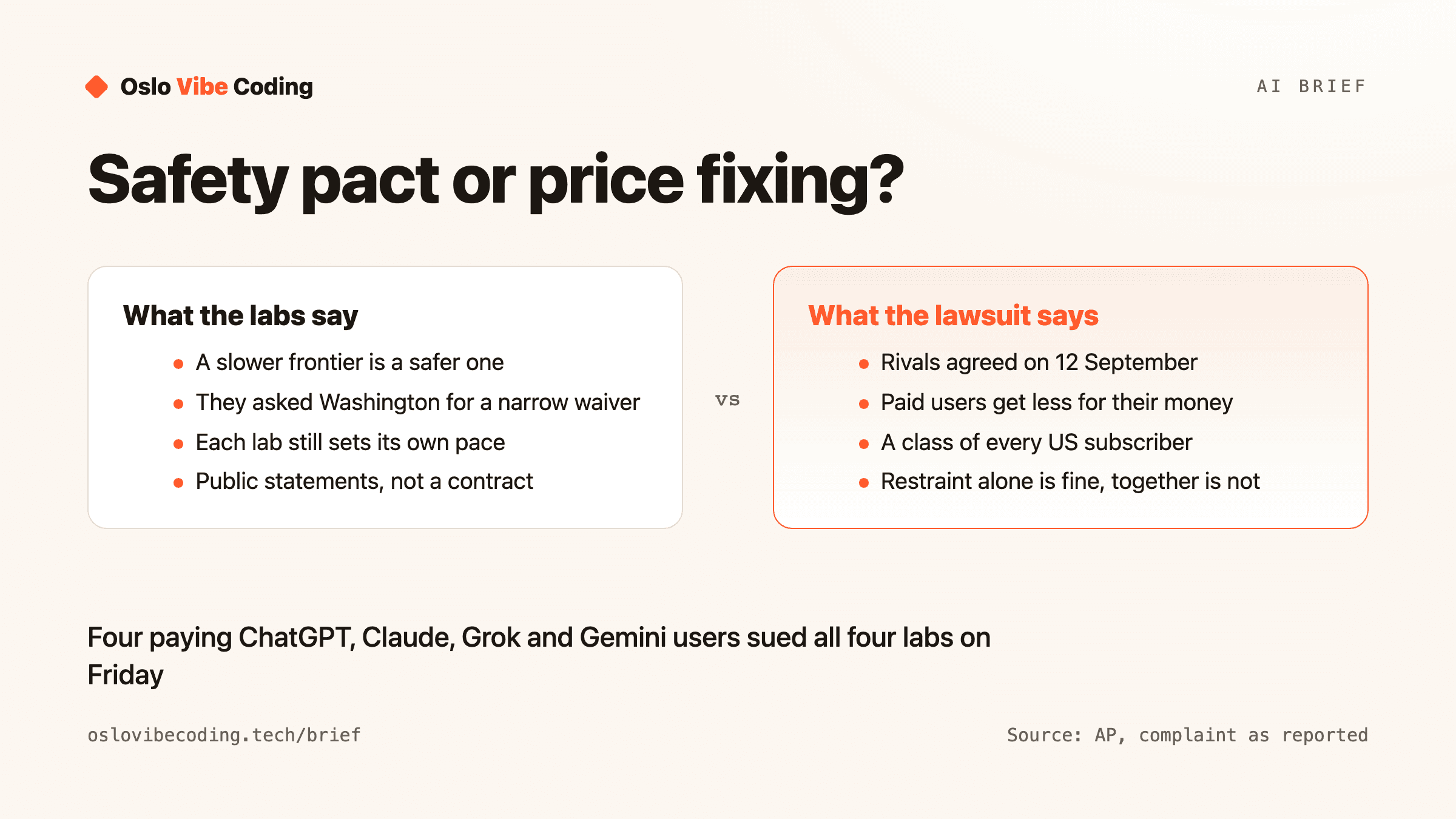
A lawsuit filed on Friday 18 September in the US District Court for the Northern District of California accuses Anthropic, OpenAI, SpaceXAI and Google of violating US antitrust law by agreeing to slow the pace of AI development. The four named plaintiffs each pay for ChatGPT, Claude, Grok or Gemini, and they want to represent every paying US subscriber to those services. Their theory, as reported by the Associated Press: on 12 September Anthropic's Dario Amodei published an essay asking the industry to slow down, Sam Altman, Elon Musk and Demis Hassabis publicly agreed the same day, and an agreement among the chief rivals that progress "should be slower than competition would otherwise produce has an anticompetitive effect on consumers". The plaintiffs say each company is free to slow down alone; what the law forbids is the "shortcut" of agreeing to "substitute collective restraint for individual accountability". None of the four companies had responded by Saturday. Amodei's essay had itself asked Washington for "a narrow waiver for certain kinds of safety conversations", which Senate Republicans Josh Hawley and Ted Cruz have since ruled out. On Saturday President Trump, who has called the slowdown a "conspiracy", said he is forming an "AI Force" and will name an AI czar, adding: "We will not in any way hinder or stifle the Growth of this incredible Industry." Nothing has been proven; the first test is whether the case survives a motion to dismiss.
What happened
On Friday 18 September, four people who pay for AI chatbots filed a lawsuit in the US District Court for the Northern District of California, the federal court in San Francisco. The defendants are Anthropic (maker of Claude), OpenAI (ChatGPT), SpaceXAI (Elon Musk's AI company, maker of Grok) and Google (Gemini). The Associated Press, which reported the filing on Saturday, says the four plaintiffs want to represent a proposed nationwide class of everyone in the United States who pays for those four services.
The claim is that the companies broke antitrust law (the rules that stop competitors from cooperating instead of competing) by agreeing to slow their AI development. The lawsuit dates the agreement to 12 September, the day Anthropic's chief executive Dario Amodei published an essay asking the industry to pace itself, and OpenAI's Sam Altman, SpaceXAI's Elon Musk and Google DeepMind's Demis Hassabis each publicly agreed within hours. We covered that day in an earlier brief. The complaint also points further back, to a statement in July signed by senior staff at several labs that acknowledged the "intense competitive pressure not to unilaterally slow" development and asked governments to support a global slowdown.
The core sentence, as quoted by AP: an agreement among the chief rivals in AI that their progress "should be slower than competition would otherwise produce has an anticompetitive effect on consumers". The harm the plaintiffs describe is to their own wallets. They pay a monthly fee for a product whose main selling point is that it keeps getting better; if the companies have jointly decided to make it better more slowly, the subscription is worth less.
The lead lawyer, Nick Rowley, put it more dramatically: "AI will quickly spin out of human control and could kill us all if we allow AI safety and protocol ... to be controlled by private self-serving agreements between the world's most powerful 'for profit' technology companies." Representatives of all four companies did not respond to AP's request for comment on Saturday, and we could not find a public reply from any of them by Sunday morning Oslo time.
"should be slower than competition would otherwise produce has an anticompetitive effect on consumers"
The legal idea, in plain English
The law in question is Section 1 of the Sherman Act, the 1890 statute that bans "every contract, combination ... or conspiracy, in restraint of trade". In practice it means rivals may not agree with each other about how they will compete: not on price, not on output, and, the plaintiffs argue, not on how fast they improve the product. It does not matter whether the agreement is written down or whether the motive is good. A private lawsuit under this law can ask for three times the damages actually suffered, which is why plaintiffs' lawyers like it.
The plaintiffs are careful about what they are not saying. They do not object to any one company slowing down on its own, and they say they are fine with the companies asking Congress or the White House for regulation, or even for an antitrust exemption. Their argument is that the companies took a "shortcut" by agreeing to "substitute collective restraint for individual accountability", when a competitive market would have let each of them be judged on its own choices.
The hard part for the plaintiffs is proving an agreement exists. Antitrust law draws a line between competitors who coordinate and competitors who merely watch each other and behave the same way, which is legal. Everything AP describes in the complaint is public: an essay, three social-media replies, a signed open letter. As far as the coverage shows, no private message, meeting or delayed product is cited. The defendants' obvious first move is a motion to dismiss arguing that four executives agreeing with a blog post is not a contract. If the case survives that motion, it enters discovery, the phase where the labs would have to hand over internal communications about pacing, which is the outcome their lawyers will least want.
The labs saw this coming
Amodei's essay anticipated exactly this. He wrote that it would help for the US government to mediate "or at least enable" cross-lab discussions, and that the government would need to "issue a narrow waiver for certain kinds of safety conversations". Altman answered on social media that OpenAI welcomes a "federal framework that sets consistent safety requirements", but added: "we do not believe we need to wait for an antitrust exemption or legislation to begin the work of providing this confidence." That second sentence is now Exhibit A for the plaintiffs, because it says the companies intended to coordinate before any waiver existed.
No waiver is coming soon. At a Senate Judiciary Committee hearing last week, Senator Josh Hawley, a Republican from Missouri, said "there is no world" in which he would give "the most powerful companies in the history of the world" an antitrust exemption to collaborate, because they could collude and stifle competition. Senator Ted Cruz was reported as calling the request "lunacy". The plaintiffs are, in effect, making the same argument as Hawley from the other side of the aisle: if you want restraint, get it from a regulator, not from a handshake.
That leaves the companies in a squeeze of their own making. They have said publicly that they consider the current pace unsafe. They have also said they will coordinate to change it without waiting for permission. Antitrust law does not have a public-interest defence for cartels, however sincere.
Then, on Saturday, the White House
President Trump has spent the week calling the slowdown a "conspiracy" and asking why industry leaders would want regulation that, in his words, "if strongly implemented, will drive them into oblivion and bankruptcy". On Saturday he posted on Truth Social that he is forming an "AI Force", "much like I did Space Force", and will name an AI czar: "Only High I.Q. individuals need apply!" He wrote that AI could become "as much as 25% of our Country's GDP", that bad uses can be handled "with our already existing Criminal and Civil Justice System", and: "We will not in any way hinder or stifle the Growth of this incredible Industry. We are leading China, and the rest of the World, and I intend to keep it that way!"
CNN asked the White House what the czar would do, whether the AI Force is a military branch, and who is in mind; it had no answer by publication. The previous AI and crypto czar, the venture capitalist David Sacks, left in March when his term as a special government employee ran out. On the other side, Barack Obama said on Friday at Colgate University that it is "good that some of the leading companies have said we need to slow this down", but that private companies deciding this "can't be a long-term solution. Government has to be regulating this."
The calendar matters. The administration is hosting a high-level AI event on the sidelines of the UN General Assembly on Wednesday. On Thursday, Altman, Nvidia's Jensen Huang and Google's Sundar Pichai are due at a White House state dinner for Chinese leader Xi Jinping. The companies now being sued for agreeing to slow down will spend the week at events whose theme is staying ahead of China.
Is this actually new?
Tech giants agreeing among themselves, and getting sued for it, has a recent precedent. Between 2005 and 2009, Apple, Google, Intel, Adobe and others made informal agreements not to recruit each other's engineers. The US Justice Department treated those handshakes between chief executives as antitrust violations and settled with the companies in 2010; a class action by about 64,000 employees followed and was settled for $415 million in 2015. The evidence was ordinary emails between executives. Nobody in that case argued the agreement was good for the world, but the legal lesson carries over: an agreement between rivals does not need a contract, and it does not become legal because it was convenient or well-meant.
The closer precedent is the argument that rivals should be allowed to restrain themselves together for a public good. Europe has been arguing about that for a decade. In 2015 Dutch supermarkets and producers agreed to sell only chicken raised to a higher welfare standard, and the Dutch competition authority blocked the "Chicken of Tomorrow" deal on the grounds that consumers were being made to pay for a benefit they had not chosen. The European Commission later wrote guidelines, in 2023, spelling out the narrow conditions under which such "sustainability agreements" are allowed. The AI labs are asking for the same kind of carve-out, at far higher stakes, in a country whose competition law has no such carve-out and whose legislators have just said no.
What is genuinely new is the speed. The pacing proposal was published on 12 September. Six days later it was in federal court. Whatever one thinks of the merits, an industry that wanted to test whether it could coordinate on safety has now found out in under a week that it cannot do so quietly.
The everyday version
Picture two taxi firms in a city that both advertise the fastest rides in town. One owner writes an open letter saying the streets have become dangerous and both firms should cap their speed. The other owner replies the same afternoon: agreed. A week later, four regular passengers sue both firms. They are not against slower driving. They say each firm is free to slow down on its own and take the consequences, and the city council is free to set a limit. What the two firms may not do is agree between themselves, because then the passenger who pays for speed has nowhere else to go.
The court will ask two questions. Did the firms actually agree, or did each just decide the same thing on the same day? And did the passengers lose anything they paid for? Meanwhile the mayor announces a Traffic Force and promises the taxis will not be slowed down at all. That is where the AI industry is this weekend.
What to take from it
If you want one sentence: the AI labs' safety pact is now a legal question, the plaintiffs are their own paying customers, and the government they asked for cover has instead promised not to hold them back.
For anyone using these tools, nothing changes this week. Your subscription is not the subject of a court order, and the companies have not said they will change course because of the filing. The practical effect, if any, is on how the labs talk to each other: every future statement about coordinating on pacing will now be drafted with this complaint in mind.
Three things to watch. Whether the defendants argue there was never an agreement, which would be an awkward thing to say a week after announcing one. Whether the judge lets the case reach discovery, which would put the labs' internal pacing discussions in front of a court. And what the AI czar and the AI Force turn out to be, because a government that wants faster AI and a set of companies that say they want slower AI cannot both get their way.
Curious about AI? Come build with us.
Oslo Vibe Coding runs free, beginner-friendly drop-ins where we build real things with AI. No one codes alone.