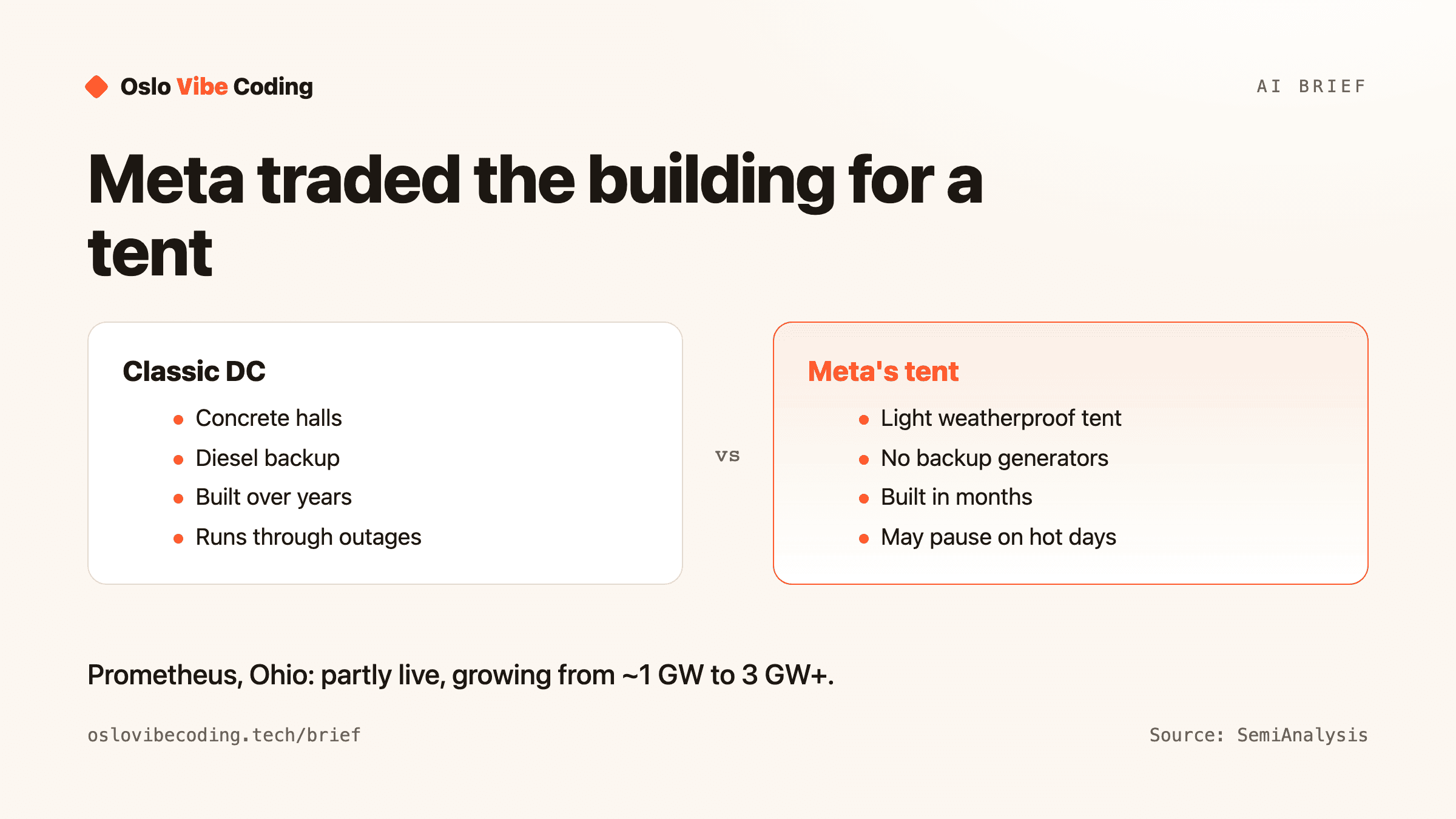
In July 2025 the research firm SemiAnalysis reported that Meta, inspired by how fast Elon Musk's xAI had built its Colossus supercomputer, had dropped its own polished datacentre design and started housing AI chips in tents: prefabricated power and cooling modules under ultra-light weatherproof structures, with no diesel backup generators at all. Mark Zuckerberg confirmed it, describing the method as building weatherproof tents and putting the networks and chip clusters inside them to build faster. The trade-off is reliability for speed. A normal datacentre keeps running through a power cut; a tent site might, in SemiAnalysis's words, even need to shut down work on the hottest summer days. That trade works for training AI (the months-long process of teaching a model), which can pause and resume from saved progress, in a way it never would for a bank or a hospital system. In July 2026 SemiAnalysis said Meta's Prometheus site in Ohio is partly running, "fully embracing" the tent design, and that its plans there have grown from about 1 gigawatt to over 3 gigawatts, while Meta builds five gigawatt-scale campuses at once.
What happened
A datacentre (a warehouse full of computers) is normally one of the most over-engineered buildings in the world: thick walls, huge cooling plants, and rows of diesel generators ready to take over the instant the grid flickers. Meta had spent a decade refining its own design, and in 2024 it replaced that with a new one optimised for AI.
A year later it changed course again. In July 2025 SemiAnalysis, a research firm that tracks datacentres partly through satellite images, reported that Meta had started building AI clusters inside tents: prefabricated power and cooling modules under ultra-light weatherproof structures. There were no backup generators, "no diesel generators in sight", in their words. Power comes from Meta's own substations connected to the grid. Mark Zuckerberg confirmed the approach in an interview that month, describing it as basically building weatherproof tents and installing the networks and chips inside them so they could be built faster.
SemiAnalysis said the trigger was Elon Musk's xAI, which built its Colossus supercomputer in Memphis in a matter of months in 2024 and shocked an industry used to multi-year timelines.
A year later
This is not a one-off stunt. In a July 2026 update, SemiAnalysis said Meta's Prometheus site in New Albany, Ohio, is already partly running and is "fully embracing" the tent design, and that the plans there have grown from roughly 1 gigawatt (about the electricity of a mid-sized city) to more than 3 gigawatts within two years.
Meta is now building five campuses of a gigawatt or more at the same time: Prometheus in Ohio, Hyperion in Louisiana, and three more in El Paso, Iowa and Indiana. SemiAnalysis says it has never seen anyone build two full gigawatt campuses at once; Meta is doing it at Hyperion and Iowa. At Hyperion, the individual buildings are 400 megawatts each, which SemiAnalysis calls the largest single datacentre buildings in the world.
"This design isn't about beauty or redundancy" (SemiAnalysis)
Why a tent is not as crazy as it sounds
The trade is reliability for speed, and it makes more sense for AI than for almost anything else. Training a model (teaching it, over weeks or months, by running the same calculations again and again) saves its progress regularly. If the power drops, the job stops and picks up from the last save. That costs hours, not customers. A bank, an airline booking system or Instagram's feed cannot do that, which is why Meta still runs those in conventional buildings.
SemiAnalysis adds that Meta probably juggles its workloads to squeeze every watt out of the grid connection it has, and that it might even need to shut down work on the hottest summer days, when cooling is hardest and the grid is most stretched. That is the honest cost: a tent site will sometimes simply be off. Meta has decided that a supercomputer switched on a year earlier, and occasionally paused, beats a perfect one that arrives late.
Is this actually new?
Partly. In 2008 two Microsoft engineers famously ran a rack of servers in a tent outside one of their datacentres for several months, to test how much protection computers really need; the servers ran fine. Bitcoin miners have long used cheap sheds and shipping containers for the same reason: when the machines are the expensive part, the building is overhead. What is new is the scale. Meta is applying a scrappy, experiment-style idea to buildings that consume as much electricity as a city.
The everyday version
Think of a summer music festival. Nobody builds a concert hall for it. The stage, the lights and the sound system are the expensive, valuable part, and they go up under a temporary roof in weeks. If a storm comes, the show pauses and starts again. A concert hall is better in every way except one: it takes years to build, and by then the festival season is over.
Meta has decided the AI race is a festival season.
What it means
For Meta, speed is the strategy. It has fallen behind OpenAI and Anthropic on model quality, and the fastest way it knows to catch up is more computing power, sooner. For everyone else, the story is a reminder that the AI buildout is now limited less by buildings than by electricity. Dropping the backup generators does not reduce how much power these sites draw from the grid; it only means the site goes dark when the grid does. That puts even more weight on local power networks, which is one reason towns across the US have started pushing back, as we covered in our brief on datacentre bans.
A caveat: Meta has said little publicly about how often its tent sites stop, and SemiAnalysis's detail comes from its own paid datacentre model and satellite tracking. Treat the specific figures as an informed outside estimate, not company data.
Curious about AI? Come build with us.
Oslo Vibe Coding runs free, beginner-friendly drop-ins where we build real things with AI. No one codes alone.