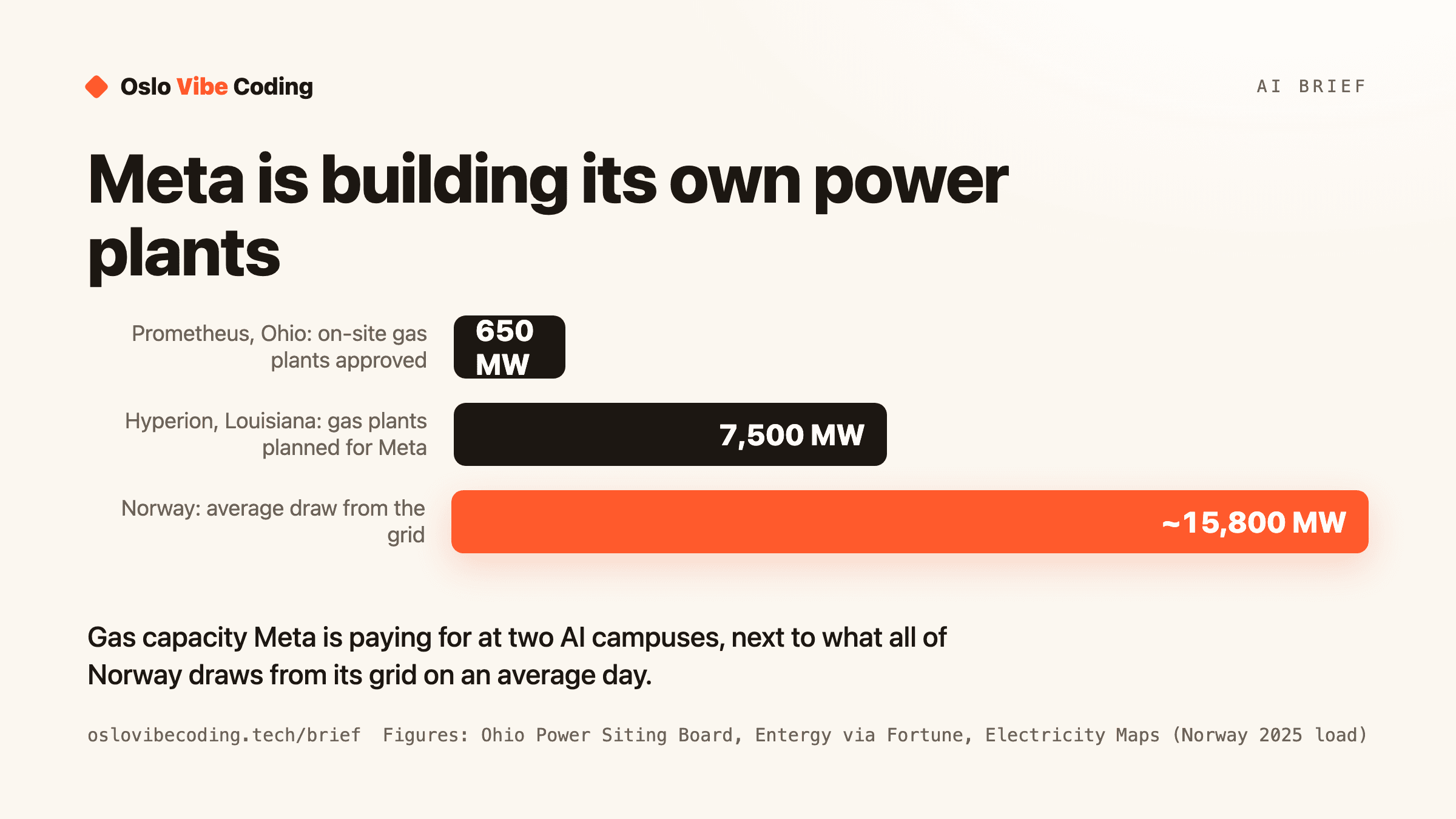
Meta's 1-gigawatt Prometheus AI cluster in New Albany, Ohio, is being fed by gas power plants built inside the campus fence: two 200-megawatt plants under construction by the pipeline company Williams, approved in June 2025 and due in service late this year, plus a third 250-megawatt plant with batteries approved in June 2026. None of them connect to the public grid. In Richland Parish, Louisiana, Meta's much larger Hyperion campus has led the utility Entergy to plan ten gas plants totalling about 7.5 gigawatts at a cost of nearly $11 billion, which Meta says it will cover; three are approved and seven are in hearings, with a regulator's vote expected in December. The reason is time: a large new grid connection in the United States can take around five years, and Meta wants the compute now. Critics say Louisiana households could be left paying for the plants if Meta leaves when its contract ends.
What happened
In July 2025 Mark Zuckerberg announced that Meta (the owner of Facebook, Instagram and WhatsApp) would build what he called titan clusters for training AI: Prometheus, a 1-gigawatt cluster in New Albany, Ohio, due online in 2026, and Hyperion in Louisiana, which he said could grow to 5 gigawatts over several years. A gigawatt is a thousand megawatts, about the output of a large nuclear reactor, or by the usual rule of thumb enough for around 700,000 American homes.
The catch is that you cannot plug a gigawatt into the wall. In much of the United States a big new customer waits years for a grid connection, and the transformers needed are on back-order measured in years too. So Meta is doing what the chip research firm SemiAnalysis flagged in July 2025 when it first described Prometheus: it is getting power plants built next to the computers, fuelled by natural gas, and in Ohio not connected to the public grid at all.
The facts
In Ohio the plants are not Meta's on paper. They belong to Will-Power, a subsidiary of Williams, one of America's largest gas pipeline companies, and sell their output to Sidecat LLC, a Meta affiliate. The Ohio Power Siting Board approved the first, Socrates South, on 9 June 2025: 200 megawatts, with a twin, Socrates North, of the same size. Williams puts the investment at more than $2 billion, and its target is for both to be in service in the third and fourth quarters of 2026. Gas arrives through two dedicated 24-inch pipelines, and the electricity never leaves the campus fence. On 26 June 2026 the board approved a third plant, Socrates the Younger: 250 megawatts of gas generation plus 116 megawatts of batteries, to serve an adjacent Meta data centre.
The computers arrived faster than the power plants. Epoch AI, a research group that tracks large data centres from satellite images and filings, counted 12 Prometheus buildings operating by August 2026, with about 562 megawatts of IT load, five of them tent-style structures Meta put up to save time, and projects about 854 megawatts by early 2027. Until the on-site plants switch on, that power has to come from the existing grid and local supply; Meta also points to about 440 megawatts of Ohio solar it has contracted.
Louisiana is the bigger story. Hyperion, in Richland Parish in the north-east of the state, is financed through a joint venture with Blue Owl Capital with up to $27 billion in development costs, and Entergy's chief executive Phillip May has said the full campus will use 4,500 megawatts, about four times the city of New Orleans. Rather than build its own plants, Meta is paying the utility Entergy Louisiana to build them. Three gas plants were approved in August 2025. On 27 March 2026 Entergy announced seven more, taking the total to ten plants and about 7.5 gigawatts, at an estimated cost of nearly $11 billion. Meta has also agreed to help fund up to 2.5 gigawatts of renewables and batteries and 240 miles of transmission lines.
The seven new plants are not yet approved. On 15 April 2026 the Louisiana Public Service Commission voted 4 to 1 to fast-track the review, skipping the competitive bidding normally used to find the cheapest option. Hearings opened on 7 October under a settlement between Entergy and the commission's staff, and the five elected commissioners are expected to vote in December. Entergy says Meta pays its full cost of service and that other customers will come out about $2 billion ahead over 20 years. In August the commission also voted 3 to 1 to let Meta keep details of the data centre confidential, overruling a judge.
Ten gas plants for one customer. That is roughly half of what the whole of Norway draws from its grid on an average day.
The everyday version
Imagine a bakery that wants to open the biggest oven line in the country, and the power company says the connection will take five years. The bakery does not wait. It buys its own generators, runs a gas pipe to the back door, and bakes from day one with the generators humming behind the shop. That is Ohio.
In Louisiana the bakery is so large that it asks the power company to build ten new power stations just for it, promises to pay the bills for the length of its contract, and the neighbours start asking who pays for the stations after that. The ovens, in this case, are halls of Nvidia chips, and the bread is AI models.
Is this actually new?
Big factories have generated their own power for a century; aluminium smelters, including Norway's, were built next to hydro dams for exactly this reason. What is new is the speed and the fuel. Williams says the US interconnection queue for large loads now averages about five years and a large substation transformer can take over two years to deliver, so 'behind-the-meter' gas (power generated on the customer's own side of the utility meter) has become the fast lane. Williams has told investors it intends to repeat the Socrates model for other hyperscale customers, and xAI, Elon Musk's AI company, was widely reported in 2025 to have run dozens of gas turbines at its Memphis site to get going. We covered how much electricity a single AI campus now draws in an earlier brief.
It is also new that one private customer can reshape a state's electricity system. The Union of Concerned Scientists estimates data centre growth could add $26 billion to Louisiana's electricity system costs over 15 years, and consumer and environmental groups including the Alliance for Affordable Energy and the Sierra Club are fighting the fast-track. Their argument is not that Meta will not pay while it is there. It is that three of the plants would be written off over 32 years while Meta's contract is reported at 15 to 20 years, so if demand for AI compute falls, or Meta moves on, households could be left with several billion dollars of power plant.
What it means
For the AI race: electricity, not chips, is now the pacing item, and the company with the fastest route to power buys itself time. Meta's answer is gas because turbines and engines can be bought and installed in months, while nuclear and large-scale renewables take years. The price is carbon and local air pollution, and Meta's climate pledges now sit next to three gas plants in Ohio and ten in Louisiana. Meta says it is also funding solar, batteries and, as reported in January 2026, nuclear deals, but those arrive later.
For people who pay power bills: the fight in Louisiana is about the years after the contract. Asked whether Entergy had examined the argument that data centres are being overbuilt, its chief executive told The Advocate: 'I don't know that we have exactly looked into that.' The commission's vote in December will show which way Louisiana leans, and other states with data-centre ambitions are watching.
For Norway, which courts data centres with cheap hydro, the lesson cuts both ways. Firm, clean power is exactly what these campuses want and most US sites cannot get. The question Louisiana is asking, who pays if the tenant leaves, applies as much to a fjord as to a bayou.
Electricity, not chips, is now the pacing item in the AI race.
Curious about AI? Come build with us.
Oslo Vibe Coding runs free, beginner-friendly drop-ins where we build real things with AI. No one codes alone.