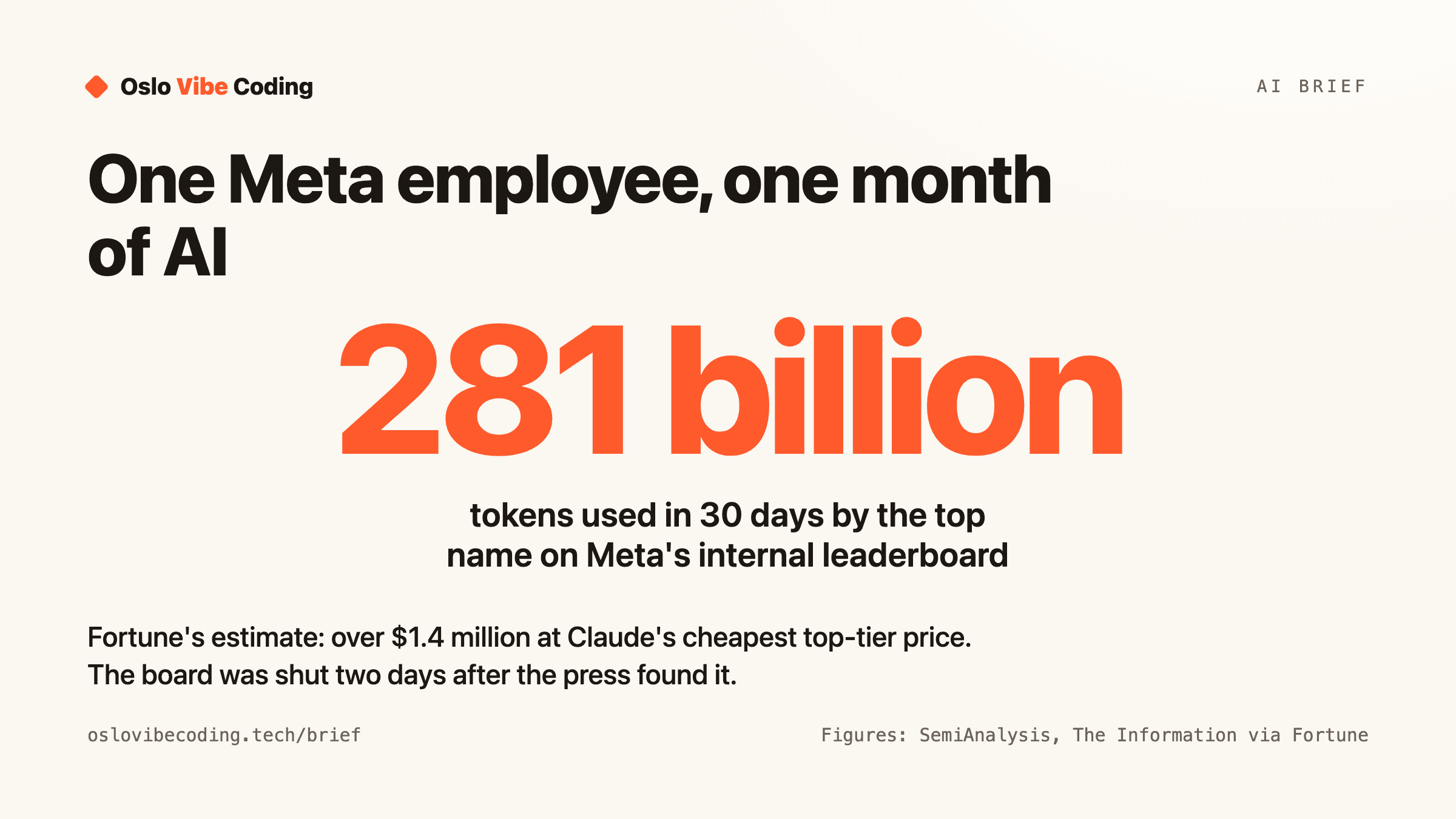
In April 2026 The Information reported on "Claudeonomics", an internal Meta dashboard built by one employee that ranked the top 250 users of AI at the company and handed out titles such as "Token Legend" and "Cache Wizard". Over 30 days Meta staff on the board used more than 60 trillion tokens (chunks of text an AI reads or writes). The top person alone used about 281 billion, which Fortune estimated could cost over $1.4 million at the cheapest top-tier Claude price of the time. According to the research firm SemiAnalysis, some employees set AI agents to research things for hours simply to burn tokens and climb the rankings. The dashboard was shut down two days after the story broke; Meta said the employee took it down and the company did not ask them to. The episode marks the peak of "tokenmaxxing", the early-2026 fashion for treating AI use itself as proof of productivity. By mid-year, SemiAnalysis found, most large companies had swung the other way, to monthly AI budgets per employee.
What happened
In early April 2026 a Meta employee built a dashboard on the company's internal tools and called it "Claudeonomics", after Anthropic's AI model Claude. It tracked how many tokens Meta's more than 85,000 employees were using. A token is the unit AI is billed in, a chunk of text roughly three quarters of a word long. The more you ask an AI to read, write and think, the more tokens you burn.
The dashboard showed the top 250 users and gave them titles that could have come from a video game: "Token Legend", "Cache Wizard" and others. Over one 30-day period, total usage on the board passed 60 trillion tokens. The single heaviest user averaged about 281 billion. Neither Mark Zuckerberg nor Meta's chief technology officer made the top 250.
The tech outlet The Information reported on the leaderboard. Two days later it was gone, replaced by a note saying it had been meant as a fun way to look at tokens but was being shut because its data had been shared outside the company. Meta told Fortune that the employee took it down themselves and that Meta did not ask them to.
What went wrong
The research firm SemiAnalysis, which later interviewed more than 50 companies about their AI spending, described what the rankings did to behaviour. Employees started competing for the titles by having AI agents (programs that keep working through a task on their own) "do research for hours simply to burn tokens". The rank had become the goal.
That is expensive. Fortune worked out that at $5 per million tokens, the cheapest public price for Anthropic's top model at the time, the leading user alone could have cost Meta more than $1.4 million in a month. That is an outside estimate: big companies negotiate their own prices, and Meta did not say what it actually paid.
"The dashboard was shut down 2 days later after The Information reported the spend" (SemiAnalysis)
Why anyone thought this was a good idea
It made more sense in the mood of early 2026. SemiAnalysis says companies including Meta and Salesforce were openly encouraging staff to use as much AI as possible, on the theory that more AI meant more output. The trend got a name, "tokenmaxxing". In March Nvidia's CEO Jensen Huang said on the All-In podcast that he would be "deeply alarmed" if an engineer he paid $500,000 a year did not use at least $250,000 worth of tokens. If the boss of the world's most valuable chip company treats AI spend as a sign of effort, an employee building a scoreboard for it is not so strange.
Is this actually new?
Not at all. Economists call it Goodhart's law, after the British economist Charles Goodhart: when a measure becomes a target, it stops being a good measure. Software has been here before. In the 1980s some companies judged programmers by how many lines of code they wrote, which rewarded long, bloated programs. A famous story from Apple has one of its best engineers, Bill Atkinson, filling in "-2000" on his weekly lines-of-code form after a week spent making a program smaller and faster. Counting tokens is the AI-era version of counting lines.
The everyday version
Imagine a delivery company that wants its drivers to work hard, so it puts up a leaderboard of who used the most fuel this month. Within a week, some drivers are taking the long way round and leaving the engine running at lunch. Fuel use did rise with real work, until the moment people were rewarded for it. After that it measured only how good they were at burning fuel.
What it means
The swing back was quick. By mid-2026 SemiAnalysis found that most companies it spoke to had put hard monthly caps on AI use, anywhere from $250 to around $2,000 per employee, and some had switched off their most expensive models. Uber, as we covered in August, burned through its whole annual AI coding budget in four months and moved everyone to a $1,500-a-month limit.
SemiAnalysis's verdict is that the wild spending stories were overstated and came from poor incentives at a few companies rather than runaway costs everywhere. That is the useful lesson for any workplace adopting AI: measure what the AI helped people get done, not how much of it they used. A leaderboard for consumption will always find the people best at consuming.
Curious about AI? Come build with us.
Oslo Vibe Coding runs free, beginner-friendly drop-ins where we build real things with AI. No one codes alone.