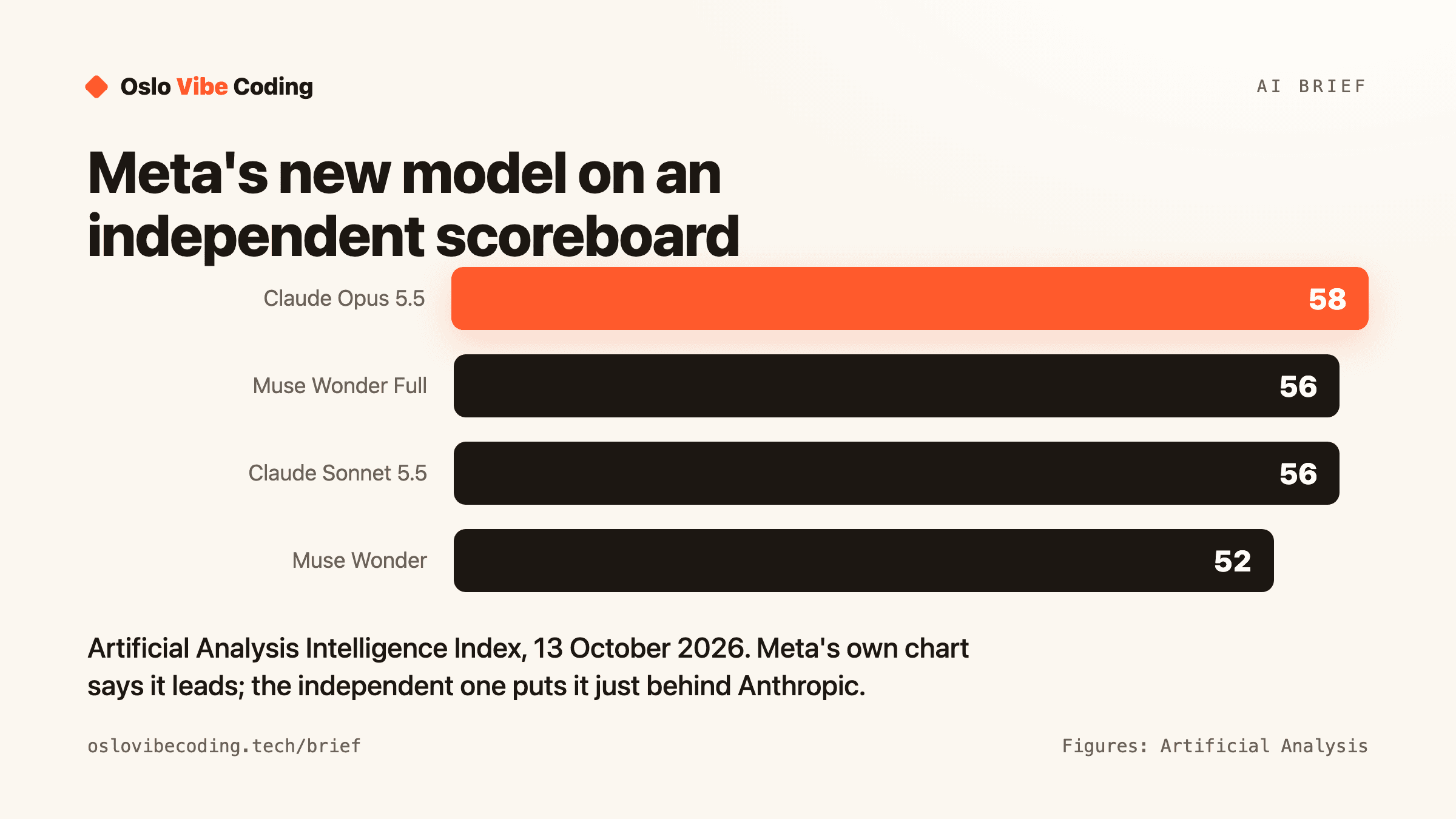
On Monday 12 October 2026 Meta released Muse Wonder and a larger Muse Wonder Full, which it calls its most capable models and the first frontier-level release from the AI unit Alexandr Wang has run since August 2025. Meta's own chart claims leads over Claude Opus 5.5, Fable 5.1 and GPT-6 Astra on memory, legal and long software tasks; its model card admits competitor runs were 'best-effort'. Access is paid: $20 or $100 a month in the Muse app, $50 or $200 a month in Muse Code for the Full version, and $4 per million input tokens and $20 per million output tokens on Meta's API, which TechCrunch notes is roughly what OpenAI and Anthropic charge for their top models. Artificial Analysis, an independent tester, scores Muse Wonder Full at 56 on its Intelligence Index, fourth overall behind Claude Opus 5.5 at 58, and the standard Muse Wonder at 52. The models were trained at Meta's gigawatt-scale Prometheus data centre in Ohio.
What happened
On Monday 12 October Meta released two new AI models, Muse Wonder and Muse Wonder Full. Its announcement calls them "our most capable models" and "a major leap toward personal superintelligence", the phrase Mark Zuckerberg has used since last year for an AI assistant that knows you and acts for you. Developed under the codename Watermelon, they are the first models from Meta's rebuilt AI unit that the company itself pitches as frontier-level, meaning in the same class as the best from OpenAI, Anthropic and Google.
That matters because of what came before. Through 2023 and 2024 Meta gave its Llama models away for free, with the weights (the model's learned numbers) downloadable by anyone. In mid-2025, after Llama 4 landed badly, Zuckerberg spent $14.3 billion on a stake in Scale AI, hired its founder Alexandr Wang to run a new Meta Superintelligence Labs, and paid a handful of researchers packages worth tens or hundreds of millions of dollars. The first product of that reset was Muse Spark in April 2026, a smaller, fast model built for Meta's own apps. Muse Wonder is the big one, and it is not free and not downloadable.
Alexandr Wang, in an interview with CNBC, described the design goal in plain terms: "When you do real-world tasks, you're going to get roadblocks and you're going to get things that come up or various setbacks. We specifically tried to train the model to be able to try other approaches instead of stalling and then checking back in with the user at any time." Meta calls that Active Focus. Its other headline feature, Active Memory, is the model carrying what it knows about you across conversations and pulling the right details up when they matter.
The facts
What it costs. In the Muse app, Meta's personal-agent app that topped Apple's App Store after launching last month, Muse Wonder comes with a $20 or $100 monthly plan. The larger Muse Wonder Full is only in Muse Code, Meta's coding agent, on $50 or $200 a month. For developers, Meta's published API price is $4 per million input tokens (roughly 750,000 words sent in), $0.20 for cached input, and $20 per million output tokens; Meta's cheaper 'contributor' pricing, where you pay less in exchange for letting Meta train on your data, is not offered for Wonder. Wang told CNBC the API would be priced "meaningfully below" the leading OpenAI and Anthropic models; TechCrunch's read of the list price is that it is roughly equivalent to GPT-6 Sol or Claude Opus 5.5. Both can be true if Meta's model uses fewer tokens per job, which brings us to the testing.
What Meta claims. Its chart compares Muse Wonder and Wonder Full with Claude Opus 5.5, Claude Fable 5.1 and GPT-6 Astra, all at maximum reasoning effort, across legal, finance and health tasks, memory, focus and coding. Meta says the series achieves "state-of-the-art results across key benchmarks for personal and professional agents, memory, and coding." Two of the headline tests, MemoryBench and FocusBench, are Meta's own internal benchmarks. The model card is unusually candid about the comparison: "Internally generated competitor runs use common settings where practical but remain best-effort: prompts, tools, and runtime may not be optimally tuned for proprietary models." In other words, Meta ran its rivals' models itself and may not have got the best out of them.
What independent testing shows. Artificial Analysis, a firm that runs the same battery of tests on every major model, had results up within a day. On its Intelligence Index (version 4.3.2, a composite of ten public benchmarks), Claude Opus 5.5 at maximum effort scores 58, Claude Sonnet 5.5 and Muse Wonder Full score 56, and the standard Muse Wonder scores 52, ninth of the 216 models in its class. Muse Wonder Full ranks fourth overall. The standard model produced about 130 million output tokens to complete the index, which the tester ranks as relatively verbose, and it works out at about $4.52 per index task at Meta's prices. Those are Artificial Analysis's numbers; Meta's are Meta's.
The technical basics, from Meta's model card: a 1 million token context window (how much it can hold in view at once), input as text, images, video, audio and PDFs, output as text, and reasoning effort settings from 'minimal' to 'max'. The models were trained at Prometheus, the gigawatt-scale data centre in Ohio that came online this year and that we wrote about when Meta was building it under tents. Meta says Muse Wonder has its "strongest safeguards to date" against chemical, biological and cyber misuse and is its "most aligned model to date"; the fuller safety report is promised "soon" rather than published.
"Internally generated competitor runs ... remain best-effort: prompts, tools, and runtime may not be optimally tuned for proprietary models." Meta's Muse Wonder model card
The everyday version
Think of a car maker publishing fuel-economy figures from its own test track, and then an independent lab running the same cars on the same road. The maker's numbers are not lies; they are the best the car did under conditions the maker chose. The lab's numbers are what you would get. Monday gave us both for Meta's new model, a day apart. Meta's track says it leads on remembering you and sticking with long jobs. The lab says it is a close fourth, two points behind the leader, with the bigger version clearly ahead of the one most people will get.
The price tag is the other everyday fact. For most of its AI history Meta's pitch was 'ours is free'. The new pitch is 'ours is as good as theirs, and costs about the same'. That is a different company.
Is this actually new?
A big lab claiming benchmark leadership on launch day, with the independent scoreboard telling a quieter story, is the normal rhythm of a model release; OpenAI, Google and Anthropic have all had the same Tuesday. What is new is who is doing it. Meta is the company that made open models mainstream, and this is the clearest sign yet that the era of a free Llama at the frontier is over: Muse Wonder is closed, hosted only by Meta, and sold by subscription and by the token like everyone else's.
It is also the first real answer to a question we asked in September: what did Meta's superstar hiring actually buy? Fourteen months and one gigawatt data centre later, the answer is a model that independent testing puts in the top group, behind Anthropic's best. Whether that is a triumph or a disappointment depends on what the billions were meant to purchase. A year ago Meta's models were not in the conversation at all.
What it means
The measured take. Meta now has a model in the top tier, which is a real change, and its emphasis on memory and on finishing multi-step tasks is where the useful part of AI is heading for ordinary people: an assistant that remembers your constraints and does not give up at the first error. The claims should be read as a vendor's claims. Two of the headline tests are Meta's own, the rival models were run by Meta, and the safety report is not yet out. The independent score is good, not best.
The concerns are about the shape of the product rather than the model. A personal agent that reads your messages and acts for you is exactly the kind of software where trust decides adoption, and CNBC reports that some Muse app users have already complained of the agent accessing personal messages without authorisation, which Meta disputes and attributes partly to permissions people granted earlier and forgot. Meta says it is monitoring for such incidents and educating users. That is the right thing to say; the question is how it behaves at the scale of Meta's billions of accounts. Availability also varies by country under Meta's geographic policy, so check before you subscribe from Norway.
Why this matters for a non-engineer: there are now four companies, not three, selling a frontier-class assistant at roughly the same price, and the newest one owns the apps most people already use every day. That pushes prices and features in the buyer's direction. Two things to watch: whether the independent scores move once Artificial Analysis and others finish testing Wonder Full, and whether Meta ships the safety report it promised. Disclosure: we use AI tools from several of the companies compared here, including Anthropic's, to help produce this brief. The benchmark claims are Meta's unless labelled as Artificial Analysis's.
The new pitch is 'ours is as good as theirs, and costs about the same'. That is a different company.
Curious about AI? Come build with us.
Oslo Vibe Coding runs free, beginner-friendly drop-ins where we build real things with AI. No one codes alone.