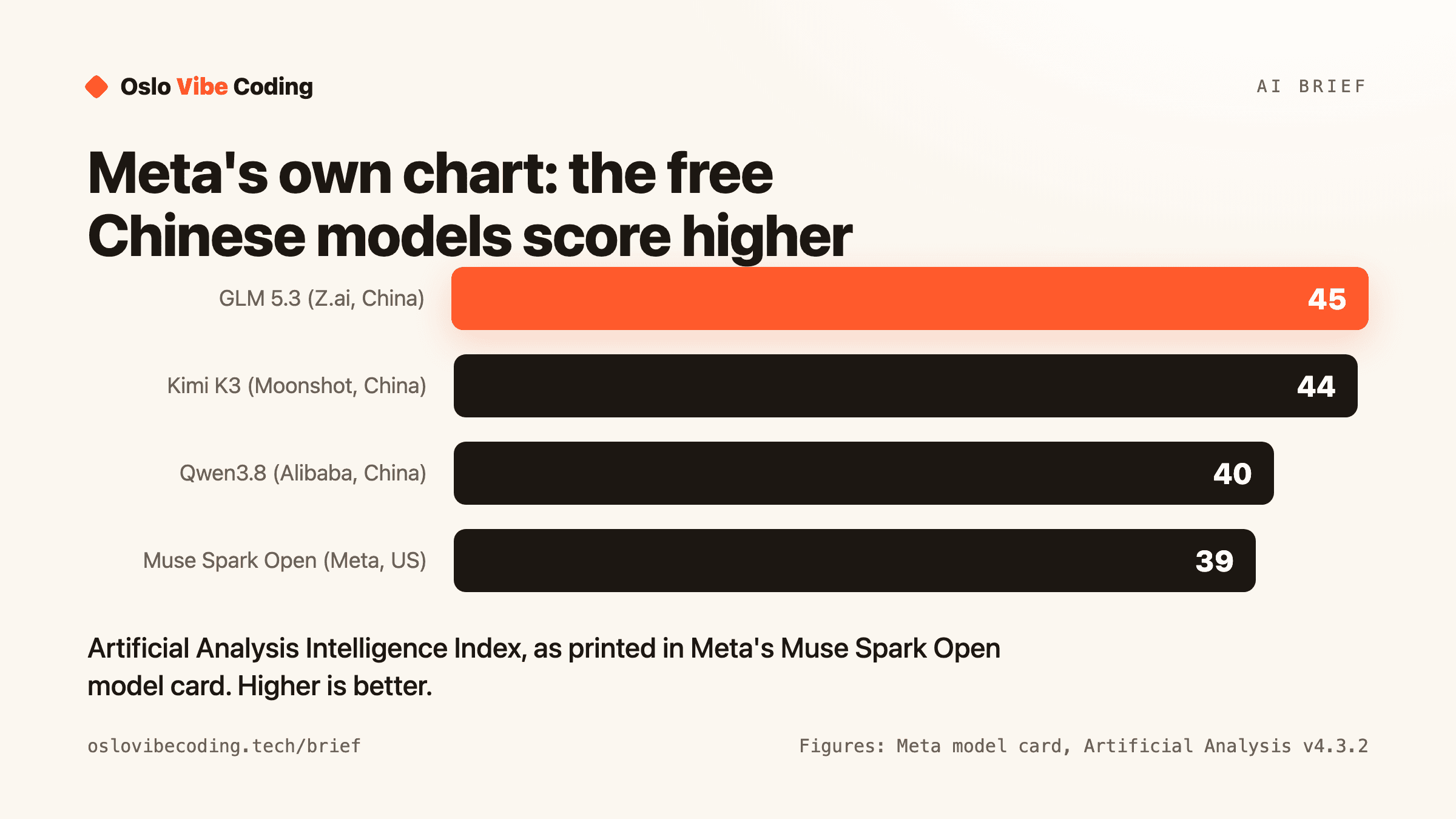
On Thursday 15 October 2026 Meta released Muse Spark Open, an open-weight model (its trained numbers are published, so anyone can download, run and modify it) with 816 billion parameters, 42 billion active per token, a one-million-token context and text, image, audio and video input. Meta says it is the first model in its class to run on a desktop, on two Apple M5 Ultra Mac Studios with 512 GB of memory each, a setup likely to cost more than $20,000. The licence allows commercial use with two conditions: show 'Built with Muse Spark Open', and sign an agreement with Meta if you sell access to the model and pass $20 million in revenue in a year. Meta calls it 'the most capable US open-weight model to date'; on Meta's own benchmark table, GLM 5.3 (45), Kimi K3 (44) and Qwen3.8 (40) from China outscore it (39) on the independent Artificial Analysis Intelligence Index, and it trails them on the Terminal-Bench coding test, while leading on tool use and some reasoning rows.
What happened
On Thursday 15 October 2026 Meta released Muse Spark Open, an open-weight AI model (one whose trained numbers, the weights, are published so anyone can download, run and modify it). It is a big one: 816 billion parameters in total, of which 42 billion are used for any given word. That design is called a mixture of experts: the model is split into 256 specialist sub-networks and only eight are consulted per token, which keeps it fast despite its size. It takes text, images, audio and video as input, writes text, and can hold a million tokens (roughly 750,000 words) in its working memory at once.
The timing is the interesting part. On Monday Meta launched Muse Wonder, its first frontier-class model, as a paid product only; we covered it that day. Thursday's release is the open sibling, pitched at coding and 'agentic' work, where the model carries out multi-step tasks on its own. Meta's announcement calls it "the most capable US open-weight model to date" and says "We're sharing this work because we want everyone to have access to the best models." It topped Hacker News, the developer news site, with nearly 800 points.
The party trick: Meta says it is "the first model in its class to run on your desktop using two Apple M5 Ultra Mac Studios", linked by a Thunderbolt 5 cable and using Apple's MLX software. Each machine carries 512 GB of unified memory (memory shared between the main processor and the graphics processor), so the pair holds a compressed version of the model, about a terabyte, entirely in memory. Meta demonstrated it fixing bugs in an open-source iPhone app and editing video in DaVinci Resolve, driven from its Muse Code terminal tool.
The facts
The scoreboard, from Meta's own model card. It compares Muse Spark Open with seven other open-weight models, four of them Chinese. On the Artificial Analysis Intelligence Index (a composite score run by an independent testing firm) Muse Spark Open gets 39; Z.ai's GLM 5.3 scores 45, Moonshot's Kimi K3 44 and Alibaba's Qwen3.8 40. On Terminal-Bench 2.1, a test of command-line software tasks, it scores 76.4 against 85.0 for Kimi K3, 83.9 for GLM 5.3 and 82.0 for Qwen3.8. Meta's model leads on other rows: MCP-Atlas, a tool-use test, at 89.2; Humanity's Last Exam without tools at 26.1; and JobBench at 61.8, a hair ahead of GLM 5.3. The 'US' in Meta's claim is doing real work: the American open models on the same table, Nvidia's Nemotron 3 Ultra (23) and Inkling (26), are far behind.
Artificial Analysis itself lists Muse Spark Open at 39 on index version 4.3.2, tenth of 119 models tested, priced at $1.25 per million input tokens and $4.25 per million output tokens on hosted services, running at about 102 tokens per second. Its top three open-weights models are MiMo-V2.6-Pro (46), GLM-5.3 (45) and Step 5 Preview (44), all Chinese. For price contrast, DeepSeek V4.1 Flash, the Chinese model that topped Hacker News last week, is listed on the OpenRouter marketplace at about 4 cents in and 68 cents out per million tokens.
The licence. The weights come under the 'Muse Model License', which is not an open-source licence in the formal sense. Anyone can use, fine-tune and ship the model commercially, with two conditions: products must display 'Built with Muse Spark Open', and anyone selling access to the model as a service whose gross revenue passes $20 million in a 12-month period must notify Meta and sign a separate agreement. The old Llama licence's cap of 700 million monthly users is gone. Using the model inside your own product, or for research, is unrestricted. One Hacker News commenter's verdict: "Not exactly fully open, but not that harsh." Meta also says the model had extra safety training because it is open, and that a full evaluation report is coming.
The hardware bill. Apple's M5 Ultra Mac Studio starts at $5,499 with 96 GB of memory; the 256 GB configuration is $9,499 to $10,799; the 512 GB option Meta's demo uses is due later this month and Apple has not published a price, which MacRumors expects to start well above $10,000. Two of them is comfortably a $20,000-plus desktop. Meta lists alternatives: four Nvidia Blackwell Ultra GPUs, eight H200s, or a heavily compressed 2-bit version that needs about 300 GB of memory. Or skip the hardware: the model is hosted on Baseten, Fireworks, Groq, Together, Nebius, Modal and OpenRouter, and in the Amazon, Google and Microsoft clouds.
"There's a reason they put the 'US' in 'the most capable US open weight model'." A Hacker News commenter, on Thursday
The everyday version
Think of Meta as a car maker with two launches this week. Monday's car is the flagship, sold only through dealers, on a subscription. Thursday's is the mid-range model, and Meta has published its full blueprints: anyone with a big enough garage can build it, tune it, and even sell cars based on it, as long as the badge says 'Built with Muse' and they call Meta before the business gets large.
The garage is the catch: the one that fits this car costs more than $20,000. And a few rival makers in China have published blueprints for slightly faster cars that fit in the same garage. What Meta is betting on is that mechanics prefer an American blueprint with a familiar toolchain, and that enough of them tinker with the mid-range model to keep the flagship's dealers busy.
Is this actually new?
For Meta, it is a return. From 2023 to April 2025 Meta's Llama models were the default free download in the West. Llama 4 landed badly, the team was rebuilt around Alexandr Wang, and for 18 months the company shipped nothing big and free. In that gap Chinese labs took over the open-weight world: by March 2026 their models had been downloaded 1.15 billion times on Hugging Face against 723 million for American ones, as we covered last week. Hugging Face's own summer review noted that in five of seven months this year no US lab released an open model above 130 billion parameters. An 816-billion-parameter American model changes that count overnight.
For the industry, the pattern is familiar: give away the second tier, sell the top. OpenAI did it in August 2025 with gpt-oss while keeping GPT-5 closed; Google does it with Gemma next to Gemini. Meta used to be the exception that gave away its best. Now it does what everyone else does. The 'runs on a desktop' claim is also less new than it sounds: enthusiasts have been running large Chinese models on multi-Mac setups for a year. What is new is a Western lab designing and testing for that configuration and saying so in the launch post.
What it means
For a developer or a small company, this is the first large American open model you can run on hardware you own, with a licence that does not care how many users you have. That matters for data that cannot leave the building: a law firm, a clinic or a bank can run a strong assistant on a desk-sized machine with no cloud account and no per-token bill, for the price of a used car. The Chinese models could already do that; some buyers will pay for the American badge.
For the race, Meta's own table is the honest headline: on the index the industry quotes most, three Chinese open models are ahead and a fourth is level. 'Best US open model' is true, and it is a smaller claim than 'best open model'. The number to watch is whether Artificial Analysis and others move the score once they test Meta's top effort setting against GLM 5.3 and Kimi K3 at theirs, and whether the promised evaluation report arrives.
The larger point is strategic. Meta now has a paid flagship and a free runner-up, like OpenAI and Google. The free one exists to make the paid one's ecosystem bigger, not out of generosity, and Meta's own announcement is candid that the point is to bring people onto its 'personal superintelligence' platform. Disclosure: we use AI tools from several companies mentioned or compared here, including Meta's rivals, to help produce this brief. The benchmark figures are Meta's unless attributed to Artificial Analysis.
'Best US open model' is true, and it is a smaller claim than 'best open model'.
Curious about AI? Come build with us.
Oslo Vibe Coding runs free, beginner-friendly drop-ins where we build real things with AI. No one codes alone.