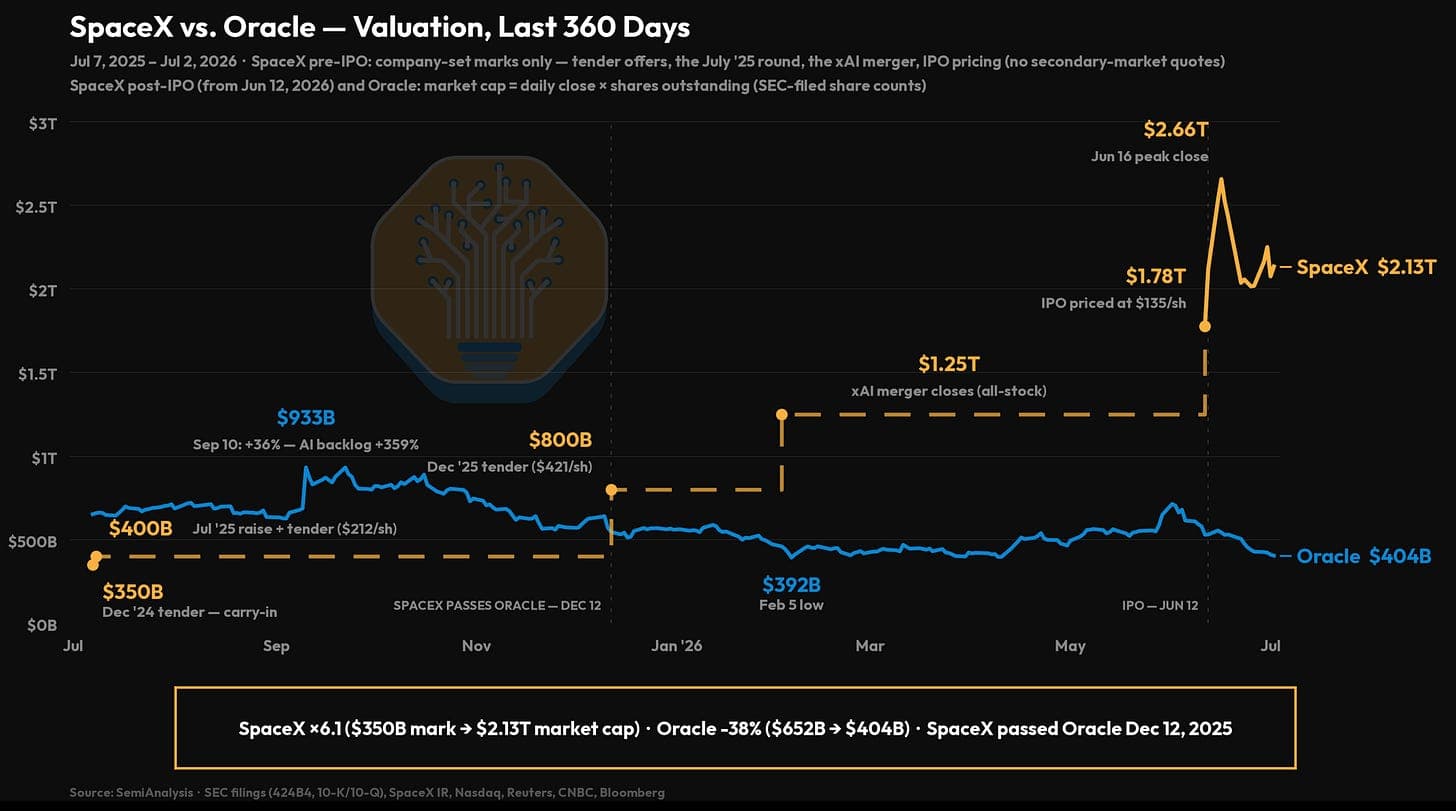
SemiAnalysis tracked the valuations of SpaceX and Oracle from July 2025 to July 2026. SpaceX rose 6.1 times, from a $350 billion private mark to a $2.13 trillion market value after its June listing. Oracle fell 38%, from $652 billion to $404 billion, even though its AI backlog grew by hundreds of billions. SemiAnalysis's point is that for both companies, gigawatts of AI computing capacity are now a large and growing part of what investors are pricing. Oracle's quarterly results on Thursday 10 September show what that looks like from the inside: revenue up 30%, cloud infrastructure up 121%, a $664 billion order book of which roughly half is OpenAI, $28.5 billion of capital spending in three months, free cash flow of minus $5.4 billion, $125 billion of debt and a $20 billion share sale to fund the next round. SpaceX sells the same kind of capacity on short, flexible contracts at three to four times the price, and its investors value it as a growth company. Oracle sells long, fixed contracts, mostly to one customer, and borrows to build. Same product, opposite business models, and the market has priced them accordingly.
The chart
In July, SemiAnalysis, the research firm whose work this series draws on, published a single chart showing the market value of two companies over the previous 360 days. One line is SpaceX, Elon Musk's rocket and satellite company, which merged with his AI company xAI in early 2026 and listed on the stock market on 12 June. The other is Oracle, the fifty-year-old database company that has become the main builder of OpenAI's datacentres.
The SpaceX line goes up in steps, because until June it was private and each step is a price the company set itself: a $350 billion share sale to employees in December 2024, $400 billion in July 2025, $800 billion in December 2025, $1.25 trillion when the xAI merger closed, then a listing priced at $1.78 trillion. It peaked at $2.66 trillion four days after listing and sat at $2.13 trillion when the chart was drawn. Six times the starting mark.
The Oracle line goes the other way. On 10 September 2025 Oracle's shares jumped 36% in a day after it reported that its contracted future revenue had grown 359%, most of it a five-year, $300 billion deal with OpenAI. That took it to $933 billion. It then fell for five months, to a low of $392 billion in February, and was $404 billion in July. Thirty-eight percent below where it had been twelve months earlier, and 57% below the September peak. SpaceX passed Oracle on 12 December 2025 and never looked back.
SemiAnalysis's one-line reading: "For both, Gigawatts are an increasing portion of their valuation, and a large driver of that evolution within the last year." A gigawatt here means a datacentre's electrical capacity, the standard way the industry now measures how much AI computing a company controls. The claim is that investors have started to value both companies substantially as owners of AI capacity, the way you might value a power company by its plants. The interesting part is that the same yardstick produced opposite results.
For both, gigawatts are an increasing portion of their valuation.
What Oracle reported on Thursday
Oracle's first quarter of its 2027 fiscal year, reported after the market closed on Thursday 10 September, is the clearest picture yet of what being a compute landlord costs. Revenue was $19.3 billion, up 30%. Cloud infrastructure revenue, the part that rents out computers, was $7.4 billion, up 121% in a year. The order book, which accountants call remaining performance obligations (contracts signed but not yet delivered), reached $664 billion, up $209 billion in a year. Roughly half of it is OpenAI.
Then the other side of the ledger. Oracle spent $28.5 billion on capital expenditure in three months, against $8.5 billion in the same quarter a year earlier. It brought 850 megawatts of new capacity online in the quarter, holding more than 300,000 GPUs (the chips that run AI), nearly three times what it added the quarter before. Its GPUs are 97.9% utilised, and capacity coming up for renewal was re-let at a 20% premium. It plans to spend $90 to $95 billion this fiscal year, having spent $55.7 billion last year against a $50 billion plan.
Free cash flow, the money left after paying for all that, was minus $5.4 billion. Total debt is $125 billion, and the interest bill rose 55% to $1.4 billion for the quarter. To keep building, Oracle is selling $20 billion of new shares into the market. Asked when cash flow turns positive, the company declined to say. Since March it has cut up to 30,000 jobs, around 18% of its staff, in what has been reported as the largest restructuring in its history, with the savings going into datacentres.
The shares fell 5.4% during Thursday's session and rose 4.3% after the results. Which is to say: the market still cannot decide what this company is.
Why the same product gets two prices
Oracle and SpaceX both rent out gigawatt-scale AI computing. The difference is the contract, and we wrote about the contracts in August. Oracle's book is dominated by long, fixed-price deals, above all the five-year OpenAI agreement. That is a stable income stream, but it means Oracle carries the cost of building first, on borrowed money, and collects later from a customer that is itself burning cash and has just postponed its own stock market listing. Half of a $664 billion order book resting on one tenant is a concentration that lenders and shareholders price.
SpaceX does the opposite. SemiAnalysis reports that its compute deals with Google and Anthropic are priced at "triple and quadruple what peers are charging" per megawatt, in exchange for flexibility: the Google deal runs three years on paper but either side can cancel with 90 days' notice, so it is effectively a three-month deal that renews. At those prices, SemiAnalysis calculates, a gigawatt of capacity earns about $50 billion a year. And SpaceX funds its building from equity investors who treat it as a growth company, so the debt that weighs on Oracle sits elsewhere.
There is a second difference that the chart understates. SpaceX is also rockets, Starlink and, since the merger, xAI's models, and the pre-listing prices on the chart were set by the company, not by a market. Some of the 6.1 times is AI capacity and some is everything else. But the direction is what matters. When Oracle's AI backlog jumped 359%, its shares rose 36% in a day and then gave all of it back and more, because investors did the arithmetic on what delivering that backlog would cost. When SpaceX signed compute deals, its price went up and stayed up, because the deals paid for the building.
SemiAnalysis's verdict on Oracle is blunt: it is "yet another piece of evidence that they could've done a much better job at monetizing all of their gigawatts of compute." The gigawatts are real. The problem is the price and the terms Oracle sold them at.
Is this actually new?
Companies being valued for their infrastructure rather than their product is not new; it is how utilities, ports and pipelines have always been priced. What is new is a software company being priced that way, and the speed of the switch. Two years ago Oracle was valued on database licences and cloud applications. Today its infrastructure arm grows at 121% while its traditional software revenue shrinks 3%, and the questions on its earnings call are about megawatts and financing, not features.
The precedent people reach for is the fibre-optic boom of 1999 and 2000, when companies like Global Crossing and Level 3 built continent-spanning networks on borrowed money, backed by long contracts from customers who turned out not to need the capacity as fast as they had signed for. The comparison is imperfect: Oracle's capacity is 97.9% used and its tenants are paying a premium to renew, which the fibre builders never had. But the financing shape, build first on debt against a concentrated order book, is the same, and it is the shape that markets learned to distrust.
The SpaceX model has a precedent too: the serviced office. Regus and WeWork discovered that tenants pay multiples of the going rent for the right to leave, and that this only works if you can fill the space when they do. SpaceX's 97.9% equivalent is the queue of AI labs that cannot build fast enough. That queue is the asset. If it ever shortens, the premium goes with it.
The everyday version
Imagine two landlords who own identical office towers in the same street. The first signs a fifteen-year lease with one tenant at a fixed rent, then borrows against that lease to build a second tower and a third, because the tenant has promised to take those too. The rent is real, the tenant is famous, and the bank keeps lending. But the landlord's fortune now depends entirely on that one tenant paying every month for fifteen years, and the tenant is a startup.
The second landlord runs the tower as serviced offices. Tenants pay triple the rent per square metre and can leave on 90 days' notice. Investors buy shares in the second landlord because the rent roll grows faster than the mortgage. They lend to the first landlord, cautiously, and ask about the tenant. Same street, same towers, very different prices. Oracle is the first landlord. SpaceX is the second.
What to take from it
If you want one sentence: the market has decided that owning AI datacentres is worth a great deal, and that how you sell the capacity matters more than how much of it you have.
For anyone watching the AI buildout from the outside, Oracle is the company to read. It publishes, every quarter, the honest cost of being the landlord: this quarter, $28.5 billion out, $5.4 billion short, $20 billion of new shares. Its shares tell you how the market weighs that against a $664 billion promise. SpaceX tells you what the same capacity is worth when the customer carries the risk.
Three things to watch. Oracle's investor day on 28 October, where it has to answer the cash flow question it declined on Thursday. Whether OpenAI, now not listing until 2027 at the earliest and openly discussing slowing down, keeps taking capacity at the contracted pace. And whether SpaceX's short contracts start to renew at lower prices, which would be the first sign that the queue is shortening.
Curious about AI? Come build with us.
Oslo Vibe Coding runs free, beginner-friendly drop-ins where we build real things with AI. No one codes alone.