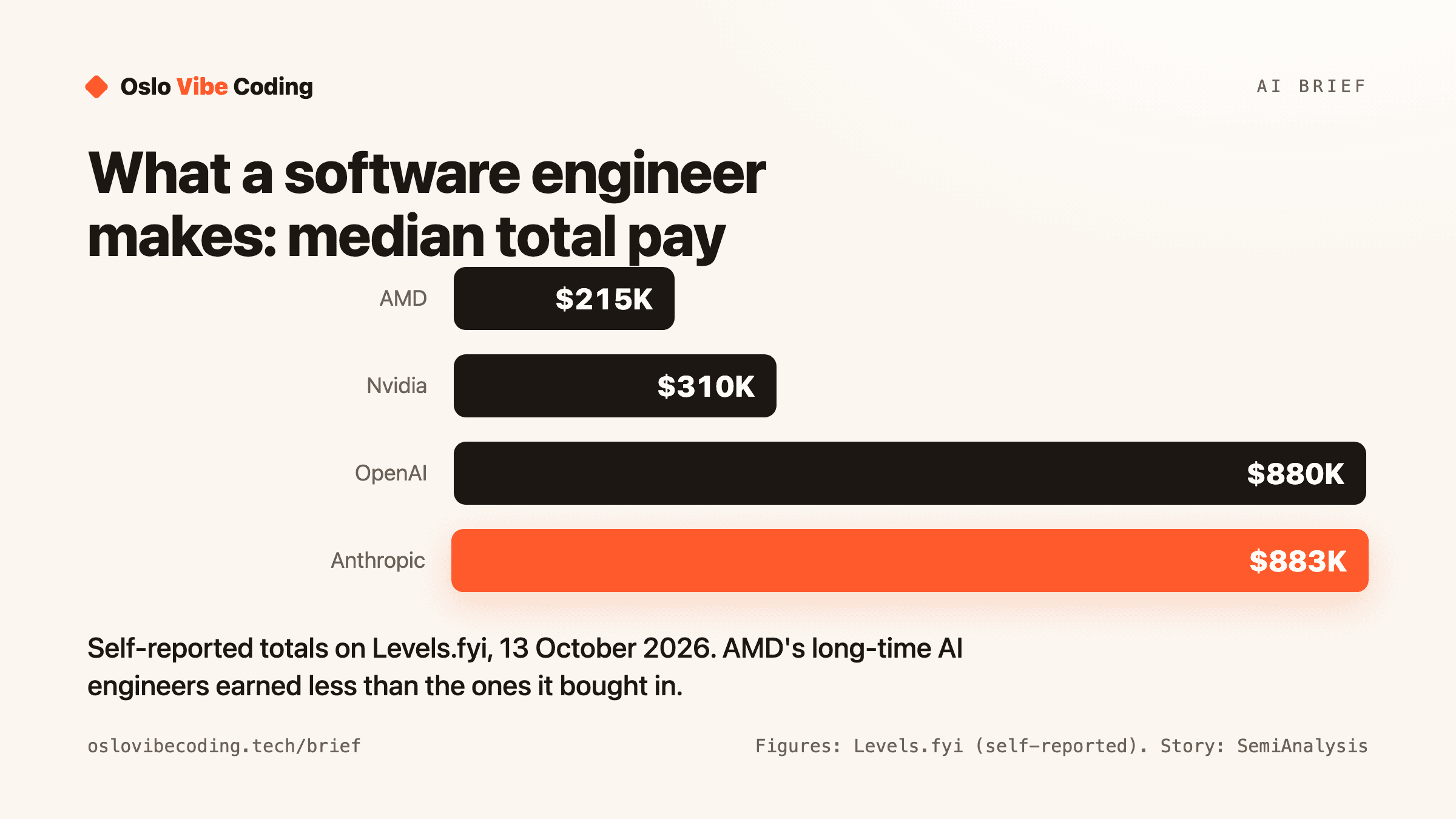
SemiAnalysis, the semiconductor research firm, reported in June 2025 that most AI engineers AMD acquired with the startup Nod.ai in 2023 were being paid significantly more than AMD's existing AI engineers, even after adjusting for experience and skill. AMD's HR department had raised the gap internally several quarters earlier; management left it as a low priority until SemiAnalysis published an April 2025 report calling AMD's engineer pay its management's 'blind spot', after which the head of HR made it a top priority. Self-reported pay data on Levels.fyi (13 October 2026) puts the median software engineer at $215,000 a year at AMD, $310,000 at Nvidia, and about $880,000 at OpenAI and Anthropic. Nvidia's latest annual report gives its staff turnover as 3.7%. AMD has made no public statement on the pay review that we could find; the account is SemiAnalysis's, and the pay figures are self-reported.
What happened
In October 2023 AMD, the chipmaker that is Nvidia's main rival in AI processors, bought a small startup called Nod.ai. The press release talked about open-source software and faster deployment on AMD chips. What it did not say was what the deal would do to AMD's own pay scales.
Twenty months later, in June 2025, SemiAnalysis (the semiconductor research firm whose work we draw on most weeks) reported the result in a long piece on AMD's annual product event. Its words: "most of the AI engineers that were bought in from NodAI, an acquisition from two years ago, are receiving significantly higher compensation than existing AMD engineers, even when equalizing for experience and skillset." The acquired engineers were paid at startup-era AI rates; the people who had been at AMD for years, doing comparable work, were not.
The firm added two details that make this a management story rather than a payroll quirk. First, AMD's own HR department "already raised this issue a few quarters ago and recognized this pay disparity", but management "has yet to elevate this beyond a low priority issue." Second, the thing that changed that was publicity. After SemiAnalysis published an earlier report saying AMD paid its AI engineers well below market, "AMD's Head of HR immediately elevated this matter to be a top priority", with a process under way to address what the firm called "massive pay discrepancies". Implementation, it said, remained work in progress.
The facts
The pay gap AMD was being told about is not small, if self-reported data is any guide. Levels.fyi, a site where tech workers submit their offer letters and pay slips, gives these US medians for total yearly pay (salary plus stock plus bonus) for software engineers, as of 13 October 2026: AMD $215,000; Nvidia $310,000; OpenAI about $880,000; Anthropic about $883,000. At the top of the ladder the gap widens: Levels.fyi's highest listed AMD level tops out around $495,000, while Nvidia's goes to about $1.08 million. These are self-reported figures with uneven sample sizes, not company disclosures, so treat them as a rough map rather than a survey.
The reason the top end matters is stock. SemiAnalysis's December 2024 report, the one that started the argument, said AMD "has largely failed to attract collective library talent due to less attractive compensation", while at Nvidia "it is not uncommon to see engineers make greater than a million dollars per year thanks to appreciation in the value of RSUs." RSUs are restricted stock units: shares an employer promises you, which turn into real shares over several years if you stay. When the share price goes up fivefold, so does the value of the promise. Nvidia's latest annual report says its staff turnover in the year to January 2026 was 3.7%, and that over 40% of its new hires came through employee referrals. It employs about 42,000 people, 31,000 of them in research and development. AMD, for comparison, had about 31,000 employees in total at the end of 2025.
SemiAnalysis's diagnosis, in its April 2025 report titled "AMD 2.0: New Sense of Urgency", was that AMD was measuring itself against the wrong companies. It wrote that AMD's internal pay benchmarking "appears to cherry pick comparable companies": networking and chip firms like Juniper, Cisco and Arm, "that aren't known for great software". Measured against them, AMD looked fine. Measured against Nvidia, Google's TPU team, OpenAI's chip team or the AI labs, the people AMD actually competes with for a PyTorch or networking-library engineer, "the gap in pay becomes glaringly apparent." The firm's recommendation was specific: keep base salaries stable, raise stock grants substantially, and tie engineers' pay to AMD's own success. It noted AMD had over $5 billion in cash to do it with.
The June 2025 piece reported that AMD had started "a new work in progress initiative to raise AMD engineering pay to be more competitive with market rate and to more closely align compensation with the success of AMD", with the timing of any announcement to engineers unknown. We looked for a public AMD statement on this and found none; AMD does not discuss individual pay programmes in its filings. SemiAnalysis's most recent long report on AMD, in July 2026, does not mention pay at all. It says the chief complaint from AMD engineers is now a "persistent lack of stable GPU clusters" to develop on, and that "most of AMD's best 10x engineers are in Shanghai." Whether that silence means the pay gap was closed, or that the firm stopped pushing, we cannot tell.
"Most of the AI engineers that were bought in from NodAI ... are receiving significantly higher compensation than existing AMD engineers, even when equalizing for experience and skillset." SemiAnalysis, June 2025
The everyday version
Think of a football club that has spent years developing its own academy players. One summer it buys a striker from a rival league, and because that is what strikers cost on the open market now, the newcomer is paid three times what the academy graduates earn. Nothing about the academy players changed. The market changed, and the transfer made the change visible inside one dressing room.
That is what an acquisition does to a pay scale. AMD did not decide to underpay its own engineers; it decided, years ago, which companies it would compare itself to, and that decision quietly set every salary. Buying Nod.ai imported the AI market's prices into the building, and the people already there could suddenly see the difference. The HR department saw it first. Management acted when it became public.
Is this actually new?
The mechanism is old. HR people call it pay inversion: new hires or acquired staff earning more than longer-serving colleagues in the same job, because the market moved and internal scales did not. It happens in every boom. What is new is the size of the AI premium and how fast it arrived. In 2025 Meta offered individual researchers packages worth tens or hundreds of millions of dollars; we wrote about what that bought in "Meta paid sports-superstar money for single AI researchers." The AMD story is the same pressure one rung down: not the star researchers, but the engineers who write the software that makes a chip usable.
The other thing that is not new is why it matters for AMD specifically. Nvidia's lead in AI is often described as a software moat called CUDA, the layer that lets code run fast on its chips. A moat like that is built and maintained by people. SemiAnalysis's April report put it bluntly: "if AMD does not significantly increase their AI Software Engineer pay, AMD will continue losing to Nvidia." It also quoted engineers who turned AMD down because the work "feels like working on porting features that NVIDIA engineers developed two years earlier." Pay and purpose, in other words, pull in the same direction.
What it means
The measured take. One acquisition exposing a pay gap is not a scandal, and SemiAnalysis did not frame it as one; the firm has been a consistent, sometimes harsh, outside voice urging AMD to compete harder, and AMD's chief executive Lisa Su publicly thanked it for the feedback after the first report. The story matters because it shows where the AI race is actually fought. Chips get the headlines, but the scarce input is a few thousand people who can write the software underneath, and those people now have a market price that a traditional chip company's pay scales were never built for.
For anyone outside the industry, two lessons travel well. First, when an employer benchmarks pay, the choice of comparison companies is the whole decision; ask which list you are on. Second, pay gaps inside a company rarely get fixed because HR notices them. They get fixed when they become visible, to the people affected or to the public. The engineers from Nod.ai did not make AMD's long-time staff underpaid. They made it impossible not to see.
What to watch: Levels.fyi's AMD numbers over the next year, and the stock-based compensation line in AMD's quarterly filings, which is where a real change in RSU grants would show up. One disclosure: we use AI tools from several of the companies named here, including Anthropic's, to help produce this brief. The pay figures are self-reported; the account of what happened inside AMD is SemiAnalysis's, and AMD has not commented on it publicly.
Chips get the headlines. The scarce input is a few thousand people who write the software underneath.
Curious about AI? Come build with us.
Oslo Vibe Coding runs free, beginner-friendly drop-ins where we build real things with AI. No one codes alone.