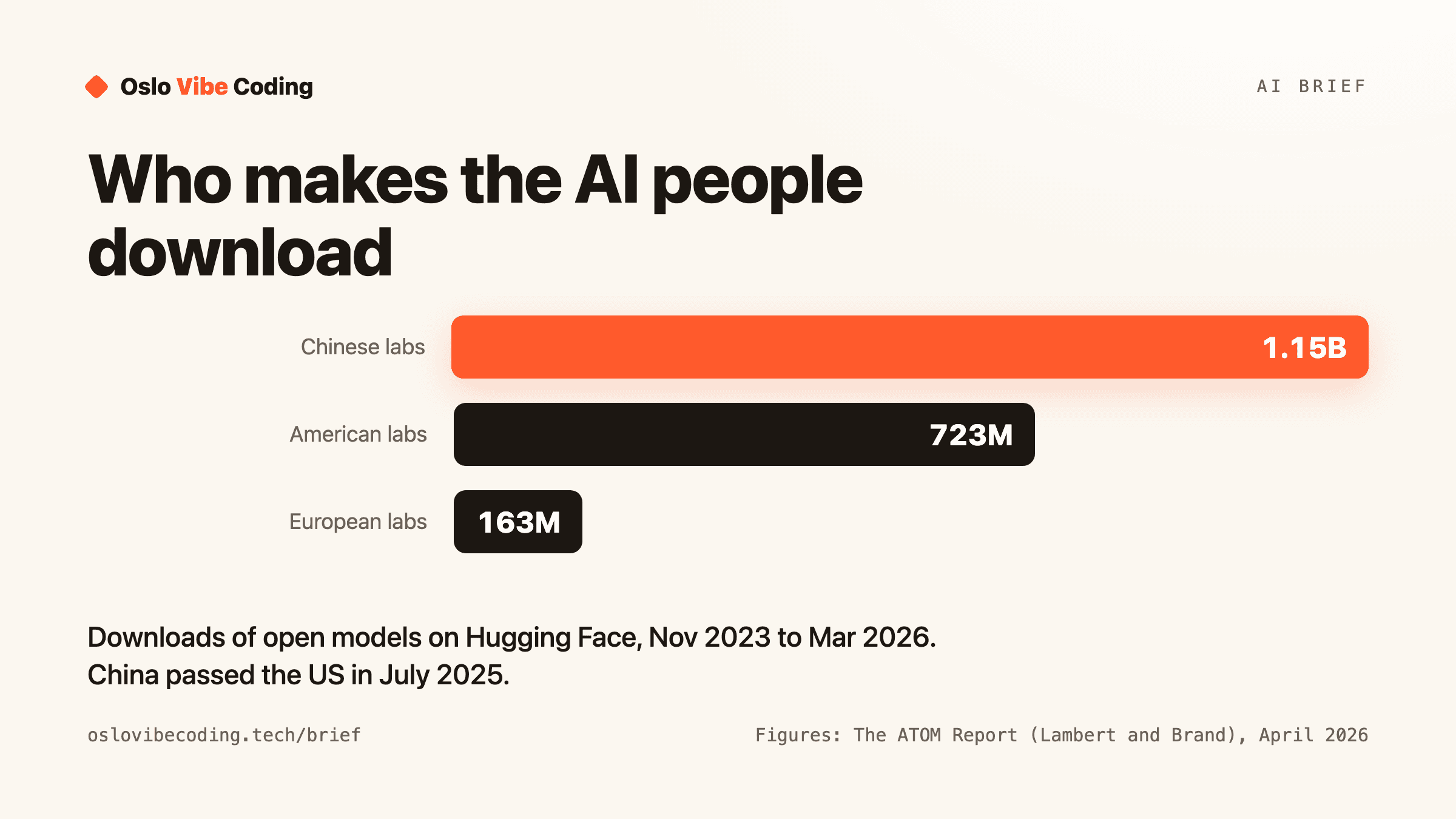
Two independent counts of the open-weight world (models whose trained numbers are published so anyone can download and run them) tell the same story. The ATOM Report (Nathan Lambert and Florian Brand, April 2026) found that by March 2026 models from Chinese labs had been downloaded 1.15 billion times on Hugging Face, the main sharing site for AI models, against 723 million for American labs and 163 million for European ones. China passed the United States in late July 2025 and the gap has widened since. Alibaba's Qwen passed Meta's Llama in September 2025 and reached 942 million cumulative downloads. Hugging Face's own August 2026 review adds that China's largest monthly release ran from 754 billion to 2.78 trillion parameters while American releases stayed under 130 billion in five of seven months, and that 81% of large Chinese releases this year used the two most permissive licences against 29% for American ones. The catches: the biggest models are too large to run at home, licences are tightening at the top (Moonshot's Kimi K3 needs a separate deal once a hosting business passes $20 million in revenue), and on the hardest tests the closed models from Anthropic and OpenAI still lead, even by DeepSeek's own numbers.
What happened
If you use AI, you probably use it through a website or an app: ChatGPT, Claude, Gemini. The model lives on the company's servers, you send it a question, it sends back an answer, and you never touch the thing itself. There is a second way. Some labs publish the model's weights (the billions of numbers that make up a trained model) as files anyone can download, run on their own hardware, modify and build into their own products, usually for free. This is called an open-weight model, and the main place people get them is Hugging Face, a website that works like an app store for AI models.
This year two careful measurements of that world appeared. In April, Nathan Lambert and Florian Brand published the ATOM Report, which tracked about 1,500 open language models and their downloads from November 2023 to March 2026. In August, Hugging Face itself published a review of the first seven months of 2026 on its platform. Together they show that the free side of AI has changed hands. It used to be led by Meta's Llama from the United States. It is now led, by a wide and widening margin, by Chinese labs.
The facts
The headline count comes from the ATOM Report. By March 2026, models from Chinese labs had been downloaded 1.15 billion times, American ones 723 million, and European ones 163 million. A year earlier the order was the other way round: China 97 million, the United States 177 million. China overtook the US in late July 2025, with a gap of 23 million downloads in August; by March the gap was 428 million.
One company carries most of it. Alibaba's Qwen family passed Meta's Llama in September 2025 (325 million downloads against 324 million) and stood at 942 million by March, against 476 million for Llama. In February 2026 alone Qwen was downloaded 154 million times, more than twice the 71 million of the next eight labs combined. Qwen is also what people build on: about 69% of new fine-tuned variants on Hugging Face in February started from a Qwen model, up from 1% in January 2024. Meta's share fell from a 44% peak to 11%.
The rest of the cast, with the figures from Hugging Face's own counters this week. DeepSeek, whose R1 model shook the stock market in January 2025, released V4 in April and V4.1 Flash on 10 September under the MIT licence (one of the two most permissive software licences); it is 552 billion parameters and was downloaded 1.3 million times in the past month. Moonshot's Kimi K3 is 2.8 trillion parameters and weighs 1.56 terabytes on disk, a release we covered in July. Z.ai's GLM 5.3 is about 750 billion parameters and was downloaded 1.6 million times in the past month. MiniMax's M3 is about 430 billion. On the American side, OpenAI's gpt-oss (its first open-weight release since 2019, August 2025, Apache 2.0 licence) is still pulled about 4 million times a month, and Google's Gemma, Meta's Llama and Nvidia's Nemotron carry on. In Europe, Mistral put Large 3 out under Apache 2.0 in December and has promised the weights of its new trillion-parameter Large 4 by the end of this month.
Size is where the two sides differ most. Hugging Face found that China's largest open release each month ran from 754 billion to 2.78 trillion parameters, and in almost every month beat the largest American one. American releases stayed under 130 billion in five of the seven months, with two exceptions: Nvidia's Nemotron 3 Ultra at 561 billion and Thinking Machines' Inkling at 952 billion. Licences differ too. Of 178 Chinese releases above 20 billion parameters this year, 59% used Apache 2.0 and 22% MIT. American labs in the same size band: 29% Apache or MIT, 41% custom terms, 30% no declared licence at all. Meta's Llama 4, for example, comes with its own licence that requires "Built with Llama" on your product and a separate permission if your service has more than 700 million monthly users.
How good are they? Take DeepSeek's own comparison table for V4.1 Flash, remembering that these are the vendor's numbers. Against Anthropic's Claude Opus 5.0 and OpenAI's GPT-5.6 Sol it comes out ahead on two coding tests (Terminal-Bench 2.1: 90.6 against 89.1 and 88.8; DeepSWE: 74.2 against 74.0 and 73.0) and well behind on the hardest general test, Humanity's Last Exam (36.8 against 56.3 and 44.5), and on the newest coding test, Terminal-Bench 4.0 (31.2 against 51.8 and 39.9). On Wednesday a developer's blog post titled "Why isn't the industry freaking out about DeepSeek 4.1 Flash?" topped Hacker News with over a thousand votes; the author says that after a month of daily use he cannot tell it apart from Claude Opus for ordinary work, and that a small task costs him about a third of a cent against about a dollar on a frontier model. That is one person's experience, not a benchmark.
One more number that corrects the picture. Downloads are concentrated in tiny models, not giants. Hugging Face reports that models under one billion parameters take 83% of all-time downloads and models over 100 billion take 1%; 85.6% of all models on the site have fewer than 200 downloads ever. In the file format people use to run models on a laptop, Qwen is downloaded 39.6 million times a month, Google's Gemma 20.8 million, Llama 7.5 million.
The everyday version
Think of a closed model as a restaurant. You eat there, you pay per meal, and the kitchen is off limits. An open-weight model is the bakery handing you the finished cake. You can slice it, put your own frosting on it, serve it in your own café under your own name, and nobody charges you per slice. What you do not get is the recipe: the training data and the exact method. Only a few projects publish those, which is why Moonshot carefully calls Kimi K3 "open weight" rather than "open source".
Why would a lab give the cake away? MIT Technology Review asked Chinese researchers that question in February. The answers: after ChatGPT, open release was the fastest way for a lab nobody had heard of to win developers, reputation and a seat at the table, and the Chinese programmer community came to see it as a point of pride. Tiezhen Wang of Hugging Face put it plainly: "Right now, the focus is on making the cake bigger." The money comes later, from selling access to the same model by the hour, from cloud deals, and increasingly from licence terms that kick in once a customer gets big.
Is this actually new?
Free models are not new. Meta's Llama 2 in July 2023 started the modern wave, and Llama 3 gave Meta a clear lead through 2024. Mistral in Paris was Europe's champion. DeepSeek's R1 in January 2025 was the moment the wider world noticed a Chinese lab could match the leaders for far less, and we wrote about Kimi K3's record-size release and about China giving away a top-three model this summer.
What is new is that the lead has changed hands and keeps moving. Meta's share of traffic on OpenRouter (a marketplace that routes developers' requests to whichever model they pick) peaked at 37% in January 2025 and fell to zero within a year, while Chinese models went from under 3% to about 73%. Also new are the cracks in "free". Kimi K3's licence requires a separate agreement with Moonshot once a company offering the model as a service passes $20 million in yearly revenue, a step away from the plain MIT terms of its predecessor. Qwen's 2.4-trillion-parameter flagship ships under its own licence too. The biggest models are free in the sense that a container ship is free if you can collect it.
What it means
For a non-engineer, the practical point is that you do not need to download anything to be affected. The apps and startups you use increasingly run on these models under the hood, and the price pressure they create is one reason AI features keep getting cheaper. For a Norwegian company, open weights are the only way to run a strong model on your own servers, which matters when the data is not allowed to leave the building or the country.
For Europe, the numbers are uncomfortable. The EU's share of cumulative downloads is about 8%, and its share of new fine-tuned models fell from a 58% peak in January 2024 to 4%. Mistral's Large 4 weights, due by the end of October, are the main thing to watch.
Two cautions. Hugging Face itself says downloads measure neither quality nor market share: they exclude everything served through the labs' own APIs, which is where ChatGPT and Claude live. And on the hardest tests the closed models still lead, as DeepSeek's own table admits. A fair disclosure: we use AI tools from several labs, open and closed, to help produce these briefs.
Curious about AI? Come build with us.
Oslo Vibe Coding runs free, beginner-friendly drop-ins where we build real things with AI. No one codes alone.