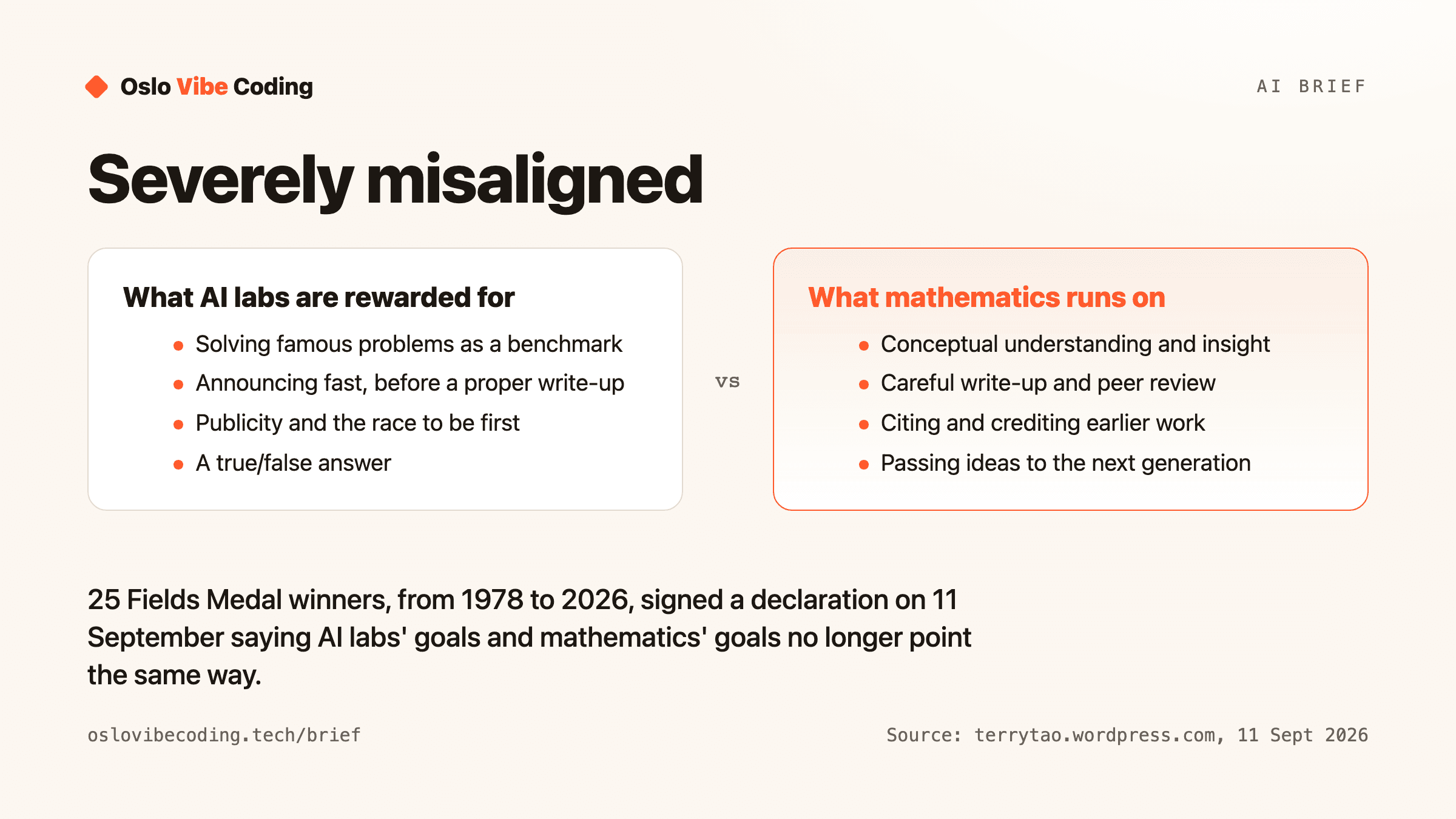
On Thursday 11 September, Terence Tao published a declaration titled A Severe Misalignment of AI in Mathematics, signed by 25 Fields Medallists (the Fields Medal is the closest thing mathematics has to a Nobel Prize) spanning every generation from 1978 to this year's winners. It says AI companies treating famous unsolved problems as benchmarks is detrimental to mathematics, that rushed announcements leave no time for proper write-ups or for crediting earlier work, and that this raises severe attribution and plagiarism questions. It does not name OpenAI, but it arrives one week after OpenAI's Navier-Stokes announcement and the dispute with two mathematicians who say they got there first. Separately, on 9 September a TU Dresden group theorist, Andreas Thom, published his email exchange with OpenAI researchers and called the company's answer about his private ChatGPT conversations materially misleading. The declaration asks for nothing specific. That is its weakness and its point: it is a statement of values from the people whose approval OpenAI's maths results ultimately need.
What happened
On Thursday 11 September, Terence Tao, the UCLA mathematician who is probably the most famous living member of his profession, published a short declaration on his blog. It is titled A Severe Misalignment of AI in Mathematics. Twenty-five people signed it, and every one of them holds a Fields Medal, the prize given every four years to at most four mathematicians under forty and generally treated as the Nobel of the field.
The list runs across five decades. Pierre Deligne won his medal in 1978. Yu Deng won his in July this year in Philadelphia. In between are Peter Scholze, Maryna Viazovska, Martin Hairer, June Huh, James Maynard, Manjul Bhargava, Cédric Villani, Maxim Kontsevich, Shigefumi Mori and fourteen others. There are roughly sixty living Fields Medallists. A quarter of them signed on day one, and the declaration invites further signatures through a companion website, mathandai.org.
The core sentence is this: "the push by AI companies to solve mathematical problems as a benchmark is detrimental to the science of mathematics, and to the mathematical community. The goals of the AI companies and the goals of the mathematical community are severely misaligned."
It does not name any company. It does not need to. It arrives eight days after OpenAI announced that its internal model had produced a proof bearing on the Navier-Stokes problem, one of the seven Millennium Prize problems, and in the middle of a public fight with two mathematicians who say their own version of the result came first. We covered that story on Wednesday.
The goals of the AI companies and the goals of the mathematical community are severely misaligned.
What they are actually objecting to
It would be easy to read this as mathematicians resenting a machine that beat them. The text says something more specific, and it is worth taking it at its word.
The first objection is about what a solution is for. The declaration says that "solving problems is only a tool and proxy for achieving the primary goal of conceptual understanding and insight." In plain terms: mathematicians do not care that the Navier-Stokes question has an answer. They care why. A proof that arrives as 166 pages plus a machine-checked certificate, produced by ten thousand AI agents in four days, tells you the answer is yes without telling anybody what was learned. That is a real thing to lose, and it is the thing the field runs on.
The second objection is about speed and credit. "Often these solutions are announced in a rush, leaving no time for a proper writeup, the isolation of new methods and ideas, and citing relevant previous work of others." The declaration says this "raises severe attribution and plagiarism questions." This is the polite version of what Tristan Buckmaster, Levent Alpöge and Diego Córdoba have been saying about the Navier-Stokes announcement for a week: that the approach OpenAI's model took is one they developed, and that the announcement did not say so.
The third objection is the one that matters most and gets quoted least. The declaration says that "without the willing mathematicians who must take care of their development and integration into the mathematical canon, AI-conceived ideas would never become fully alive and the crucial human transmission chain between mathematicians would be lost." Mathematics is not a pile of true statements. It is a community of people who teach each other, and a result nobody understands well enough to teach is, for the purposes of that community, not yet a result.
The second accusation this week
The declaration landed in a week that already had an attribution problem, and it is a different one from Navier-Stokes.
Andreas Thom is a group theorist at TU Dresden. In August, OpenAI's then-unreleased Astra model was credited with solving ten open problems, one of which was the construction of the first non-sofic group, a question the Russian-French mathematician Mikhail Gromov posed in 1999. The central technical step in OpenAI's proof rested on a 2019 paper by Thom and Gábor Kun of the Rényi Institute in Budapest.
Thom had spent months discussing this exact line of research with a colleague inside ChatGPT. After the August announcement he wrote to two OpenAI researchers, Mark Sellke and Sébastien Bubeck, with two questions: had the content of those conversations gone into training data, and had the model been able to see them while it searched for its proof. According to the emails he published on 9 September, the reply was one line: "Regarding your conversations with ChatGPT: that did not happen."
Thom calls that answer "unjustifiably broad and materially misleading." His reasoning is that in the Navier-Stokes dispute a week later, OpenAI drew a careful distinction: its researchers had not accessed Buckmaster's and Alpöge's specific data, but the company could not rule out that "de-identified data from their previous use of ChatGPT may have contributed to improving the models." The same distinction, Thom says, was available in his case and was not offered. His summary: "If nonpublic research supplied by users improved a model and the provider then used that model to race those users to publication, without informed consent, disclosure, or credit, that would be ethically indefensible." OpenAI has not published a response to Thom. It has denied using Buckmaster's and Alpöge's work to prompt its models.
Whether or not either mathematician's suspicion is right, the pattern is the problem. Researchers use ChatGPT to think. ChatGPT's maker then announces results in the same area. Nobody outside the company can check what fed what. That is not a mathematics question. It is a trust question, and it is the one the declaration is really about.
Is this actually new?
Scientists signing open letters about AI is not new. What is new is who is signing, and what they are not asking for.
The precedent people reach for is the Asilomar conference of 1975, when the leading genetic engineers met and agreed to hold off on certain experiments until safety rules existed. That comparison flatters this declaration. Asilomar produced rules. This document produces none. It contains no demand, no proposed protocol, no request for a moratorium. It is a statement of values, signed by people whose main power is that the field listens to them.
A better comparison is the four colour theorem of 1976, the first major result proved with a computer doing work no human could check by hand. Many mathematicians refused to accept it for years, not because they thought it was wrong but because a proof nobody could read felt like a different kind of object. They lost that argument, slowly, and computer-assisted proof is now ordinary. The signatories know this history. Tao in particular has spent years arguing that AI will be useful to mathematics. The declaration is careful to say the ideas are welcome and the process is the problem.
The clearest sign that this is a values fight rather than a technology fight is the dissent. Jacob Tsimerman, one of the four mathematicians who won the Fields Medal in July alongside Yu Deng, did not sign. His argument, reported this week, is that mathematicians should "get inside the labs" and shape how the work is done, rather than criticise from outside. That is a disagreement about tactics between people who agree on the facts.
The everyday version
Imagine a town with one bakery that has trained every baker in the region for a century. Apprentices learn by watching, asking, and getting things wrong. One day a company arrives with a machine that produces a perfect loaf, faster and cheaper, and announces it in the newspaper. The bread is real. The company even lets anyone inspect the recipe.
The bakers' complaint is not that the bread is bad. It is that the machine learned the craft partly by watching them, that the newspaper did not mention this, and that if the town decides bread now comes from the machine, there will be no apprentices next year, and in twenty years nobody who could improve the recipe. The declaration is the bakers writing to the newspaper. It changes nothing on its own. It does put on record what the town stands to lose.
What to take from it
If you want one sentence: the people whose acceptance OpenAI's maths results ultimately depend on have said, collectively and on the record, that the way those results are being produced and announced is harming their field.
That matters because of who decides. The Clay Mathematics Institute will not consider a Millennium Prize claim until it has been published in a refereed journal and survived two years of general acceptance. General acceptance is granted by exactly the community that has just signed this. A proof can be machine-checked to the last line and still sit outside the canon if the people who make up the canon decline to carry it in. OpenAI has said it will not seek the prize money. The declaration suggests that the recognition may be harder to get than the money.
It also matters because the underlying question, what happens to your private conversations with an AI, does not belong to mathematicians. Thom asked a clear question and got a one-line answer that he believes hid a distinction. Anyone who uses these tools to think about unpublished work, in any field, has the same question and is in the same position.
The thing to watch is the signature count at mathandai.org, and whether OpenAI answers Thom in the same terms it eventually used with Buckmaster. The first tells you whether this is a quarter of the field or the whole of it. The second tells you whether the company has understood that in mathematics, the reply is the reputation.
Curious about AI? Come build with us.
Oslo Vibe Coding runs free, beginner-friendly drop-ins where we build real things with AI. No one codes alone.