A plain summary, so you can get the gist here without leaving.
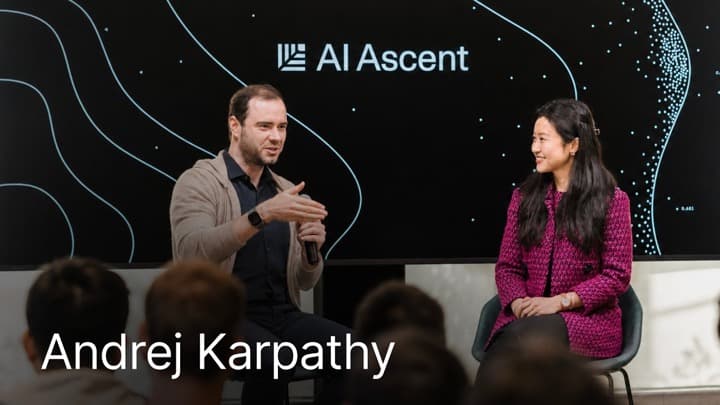
In this conversation with Sequoia and Stephanie Zhan, Andrej Karpathy describes how building software with AI is growing up. The playful, improvisational style he once called vibe coding is giving way to something more deliberate, where a person directs capable agents and stays responsible for the result.
What changes from vibe coding to agentic engineering
Vibe coding is the loose, fast mode many people first meet: you describe what you want, the model writes code, and you keep nudging it until something works. It is wonderful for sketching ideas and learning, and it lowered the barrier to making things in a way that felt almost magical.
Agentic engineering is the more grown-up cousin. The AI is no longer a clever autocomplete but an agent that can take on real chunks of work. The human shifts from typing every line to directing the effort: framing the task, setting boundaries, and deciding what good looks like. The skill being asked for is less about syntax and more about clear thinking and good judgment.
Humans in the loop, and the cost of being wrong
A central theme is that the person does not step away. Karpathy is wary of handing over too much at once, because an agent that runs unsupervised can produce a large amount of plausible work that is subtly wrong, and now you have to untangle all of it. Keeping a human in the loop means working in smaller pieces you can actually follow.
This is a matter of trust calibrated to the situation. Some tasks are safe to let an agent run with, while others touch things that are expensive or dangerous to get wrong, and those deserve a closer hand on the wheel. The judgment of where to draw that line is part of the new craft.
Verification as the real discipline
The discipline Karpathy keeps returning to is verification. It is easy to generate code; the hard and valuable part is confirming it does what you intended. That means reading what the agent produced, testing it, and building tight feedback loops so mistakes surface quickly instead of piling up unnoticed.
For anyone building with AI, this reframes the whole job in a hopeful way. The bottleneck is no longer how fast you can write code. It is how well you can describe what you want and how carefully you can check what comes back. Those are learnable habits, and they reward patience and clarity over raw speed.
- Vibe coding is the fast, improvisational way to build with AI; agentic engineering is the disciplined version where you direct capable agents.
- The human role shifts from writing every line to framing tasks, setting limits, and judging quality.
- Keeping a person in the loop and working in small pieces prevents large amounts of plausible but wrong output.
- How much autonomy to grant should match the risk of the task, not a fixed rule.
- Verification, reading and testing what the agent produces, is becoming the core skill rather than typing speed.
Andrej Karpathy
New to this? Come build with us.
Reading is good. Building with people is better. Our drop-ins are free and open to total beginners.