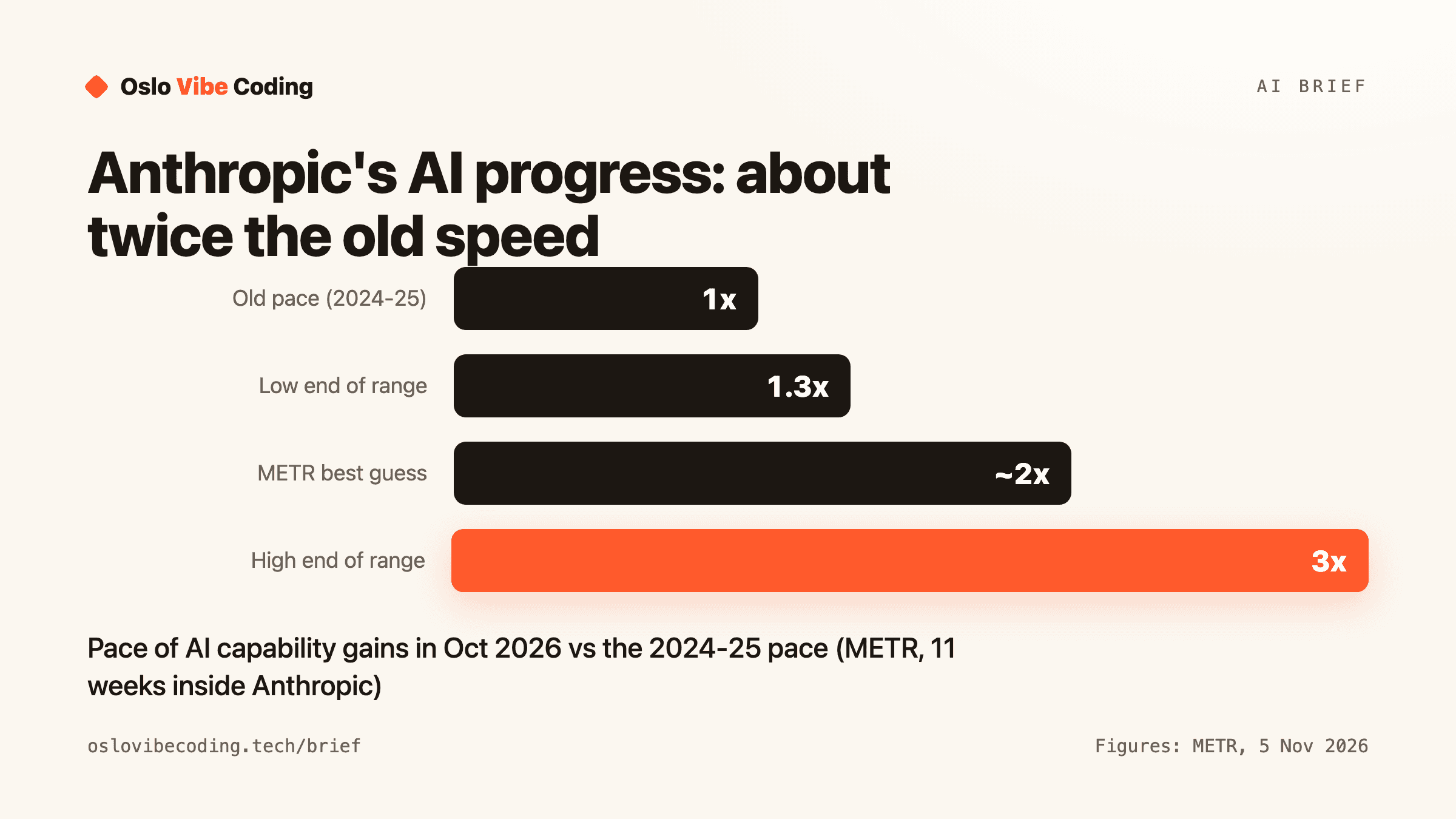
On 2 November 2026 Anthropic filed an amended IPO prospectus (S-1/A) adding a new risk factor: 'our internal estimates and our expectations regarding future models, rather than our current models, indicate that we may imminently meet our Responsible Scaling Policy's definition of "dramatically accelerated progress attributable to AI."' It says no current model has been designated as crossing that line, that it has in the past failed to spot a significant acceleration until after it happened, and that it is considering policy changes 'to keep humans in control of frontier model development'. The original 26 October filing did not contain this sentence. On 5 November METR published an independent assessment based on 11 weeks (12 August to 29 October) of privileged access to Anthropic's internal data and about 15 staff interviews. Its conclusions: as of October 2026 Anthropic is likely improving its models on well-specified tasks at about twice the rate of March 2024 to October 2025 (plausible range 1.3x to 3x); a benchmark index rose 1.9 times faster after October 2025 (95% interval 1.5x to 2.8x); METR guesses roughly 80% of today's acceleration is due to Anthropic's use of AI; it found no clear bottleneck that would stop further speed-up in the next 12 months; and the acceleration was not caused by faster growth in training compute. METR also reports that Anthropic redacted 'a majority of the evidence we found most informative', and that Anthropic dropped a planned check of how its compute is split between capabilities and safety. Oslo Vibe Coding uses Claude in its own work.
What happened
Recursive self-improvement, usually shortened to RSI, is the idea that an AI becomes good enough at AI research to speed up the building of its own successor, which is then even better at it, and so on. For years it was a thought experiment. In the first week of November it showed up in two documents with numbers attached.
On Monday 2 November Anthropic, the maker of Claude, filed an updated version of its stock-market prospectus (the S-1, the document a company must publish before selling shares to the public). TechCrunch spotted a new paragraph in the risk section. Anthropic wrote that its 'internal estimates and our expectations regarding future models, rather than our current models, indicate that we may imminently meet' its own safety policy's definition of 'dramatically accelerated progress attributable to AI'. That sentence was not in the first filing a week earlier.
On Thursday 5 November METR, a non-profit that evaluates AI systems, published what it found after eleven weeks with unusual access to Anthropic's internal data. The Verge ran it under the headline that the report is 'alarming researchers'. On Hacker News one commenter called it the most important report of the year and complained it was 'barely a whisper'; another called it 'an empty shell' timed to flatter an IPO. Both reactions are worth keeping in mind.
The facts
What Anthropic told investors. The amended filing says Anthropic has not designated any current model as crossing the threshold and is still assessing the data. It also admits: 'we have in the past not identified, and may in the future not identify, a significant acceleration in our rate of development until after it has occurred.' Elsewhere it says it does 'not anticipate being able to safely use Claude to fully autonomously design and build successive generations of frontier models without meaningful human supervision or understanding', and that it is considering updates to its Responsible Scaling Policy (its public rulebook for when to add safety measures) 'to keep humans in control'. The same filing calls this loop of each Claude helping build the next 'closing the loop' and pitches it to investors as 'one of the most significant structural advantages in frontier AI'.
The supporting numbers in the filing, all Anthropic's own: in September 2026 over 90% of contributions to its codebase were written by Claude; code contributed per engineer per day was over 45 times the 2024 level; Claude's success rate on hard, loosely specified engineering problems reached about 90%, up about 50 percentage points in nine months; and the list-price value of Anthropic's internal Claude use grew more than 250-fold from January to September and in April overtook its monthly payroll (excluding stock pay).
What METR measured. From 12 August to 29 October, METR staff worked on Anthropic laptops with access to internal benchmark scores, training metrics, unreleased models' results, staff surveys and about 15 interviews. Its main conclusion: as of October 2026 Anthropic is 'likely improving the capabilities of their models on well-specified tasks at around twice the rate' it managed between March 2024 and October 2025. It 'would not be surprised' if the true figure were 1.3 times or 3 times. The hardest number behind that is a benchmark index (AECI, Anthropic's version of a public capabilities index from the research group Epoch AI) that has risen 1.9 times faster since October 2025, which METR translates as roughly two years of the old progress in one year. Other reasonable ways of cutting the data give anything from 1.1x to 2.9x.
Why METR blames the AI. It says it is confident the speed-up is not explained by faster growth in training compute (the raw chips and electricity). Its rough guess is that about 80% of today's acceleration comes from Anthropic's use of AI in its own research, mostly as an assistant to human researchers rather than working alone, though staff described 'signs of life' of more autonomous contributions. Anthropic staff, polled in Slack, reported personal speed-ups as high as 12 times by October; METR calls this 'only very loose evidence'. Most worrying, it found no clear bottleneck in algorithms, compute or data that would stop things speeding up further over the next 12 months, while warning that its view of those bottlenecks 'changed several times'.
What we were not allowed to see. METR says Anthropic redacted 'a majority of the evidence we found most informative', describing the cuts as aimed at not helping rival labs, and that the public therefore 'has to rely on METR's judgment much more than would be ideal'. Anthropic also tightened its redaction rules in the final week and dropped a part of the contract that would have checked how much of its computing goes to capabilities versus safety; Anthropic said it wanted to revisit that later. METR says it took no payment from Anthropic.
METR's best guess: Anthropic's models are improving about twice as fast as they did in 2024 and 2025, and most of that extra speed comes from Claude itself.
The everyday version
Think of a blacksmith. For years she forges tools with the same hammer, and her output grows steadily as she gets more skilled and buys more iron. Then she starts using her best tools to forge better tools, including a better hammer. Next year she makes two years' worth of improvements, and the new hammer is waiting to help with the next round.
METR has been allowed to watch the forge for eleven weeks. It says the blacksmith is now working about twice as fast, mostly thanks to the new tools, and that it cannot see an obvious shortage of iron or coal that would stop her speeding up again. The catch is that the blacksmith decided which parts of the workshop the visitor could describe to everyone else.
Is this actually new?
Tools that help build better tools are as old as industry. Computers have helped design faster computer chips for decades, and programming languages are routinely used to write improved versions of themselves. What made AI researchers nervous about RSI was always the speed: a loop where the improver is also the thing being improved could compound faster than people can check it.
Anthropic has been building towards this disclosure in public. In September its chief executive Dario Amodei asked the industry to slow down, partly because AI was already helping build the next AI, and promised to let outside evaluators in. Six days later Anthropic's policy institute said Claude 'leads' about a quarter of the work on its next models. What is new this month is an independent group putting a measured rate on the speed-up using internal data, and the company telling investors, in a legal document where misstatements carry real liability, that it may be close to its own red line.
The measured caution cuts both ways. An S-1 is both a disclosure and a sales document, and 'our AI builds our AI faster than anyone else's' is also an attractive pitch to buyers of shares. METR itself lists reasons it could be overestimating (benchmarks favour neat, checkable tasks; Anthropic's earlier pace may have been unusually slow) and reasons it could be underestimating (growth may still be speeding up; automation could arrive suddenly).
What it means
For people using AI at work, the practical meaning is that the gap between model generations may keep shrinking. If Anthropic really is making two years of progress per year, tools that feel cutting-edge today will be overtaken faster than the last wave was, and plans built on 'the AI can't do that yet' age quickly.
For governments, this is the scenario safety rules were written for. Anthropic's own policy treats dramatically accelerated, AI-driven progress as a trigger for extra safeguards, and METR's work is the first serious outside attempt to measure it. The uncomfortable part is the process: the company chose what the outside reviewer could publish, and dropped the check on how much computing goes to safety. If regulators are going to lean on numbers like these, they will want reviewers who can show their evidence, not just their conclusions.
The honest bottom line: no one is saying an AI is building itself unsupervised today, and Anthropic says it intends to keep humans in charge. What two independent-ish signals now say is that the loop has started turning faster, and that the people closest to it cannot yet see what would slow it down. Disclosure: Oslo Vibe Coding uses Claude in its own work.
Nobody says the AI is building itself unsupervised. The news is that the loop is turning faster, and nobody can yet see what slows it down.
Curious about AI? Come build with us.
Oslo Vibe Coding runs free, beginner-friendly drop-ins where we build real things with AI. No one codes alone.