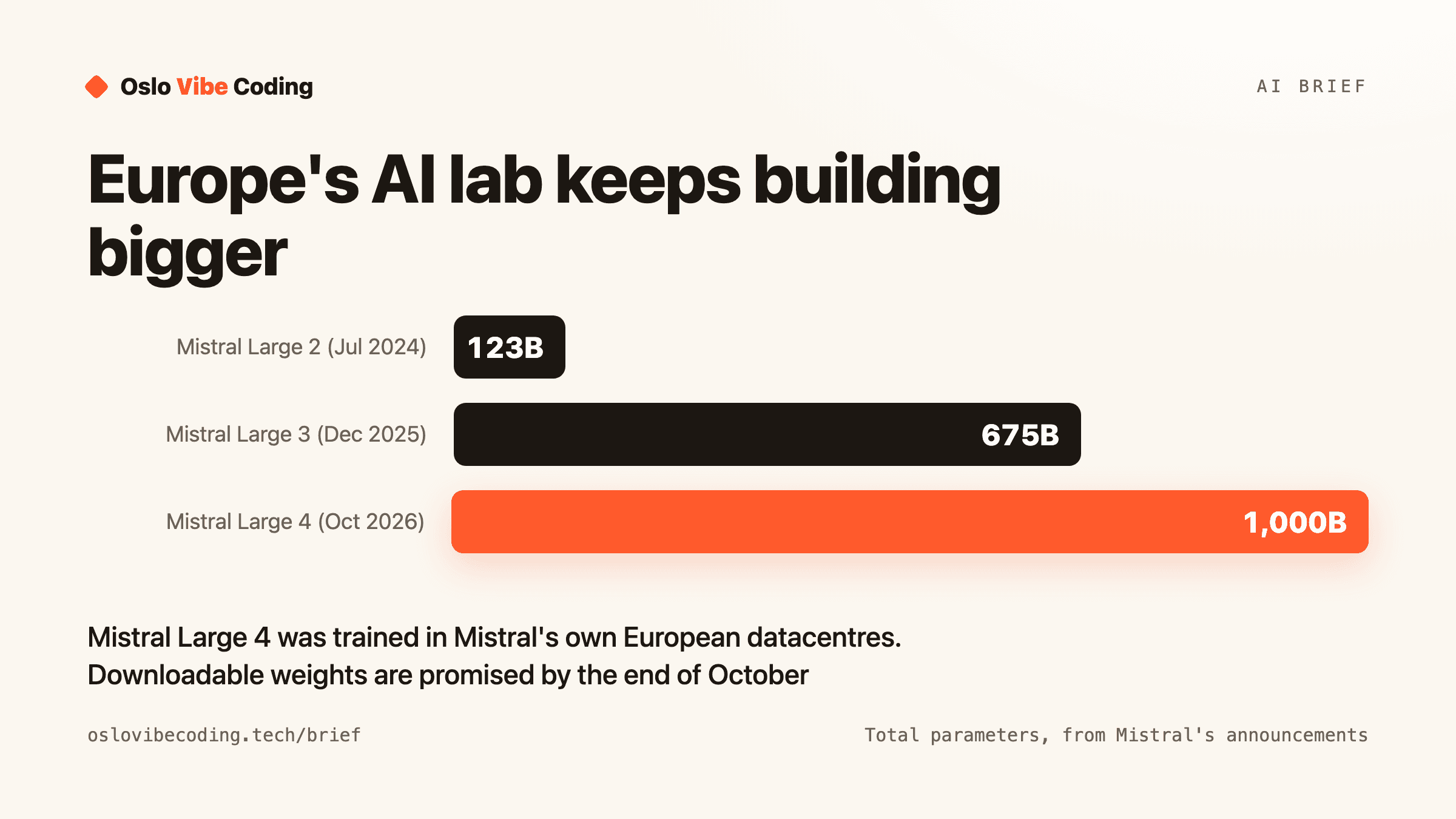
On 6 October 2026 Mistral, the Paris-based AI company, released a public preview of Mistral Large 4, nicknamed "le Chonk". It has 1 trillion parameters (the adjustable numbers a model learns during training), of which 49 billion are used for any single word, a design called mixture-of-experts. Mistral says it trained the model from scratch on 3,800 Nvidia Grace Blackwell chips in its own datacentres in Europe, and that it will publish the weights (the full trained model, free to download and run yourself) by the end of October. For now only a paid preview API is open, at $1.36 per million input tokens and $4.18 per million output tokens. Mistral claims the model beats every open-weight model made in the US or Europe and ranks in the global top five on an independent cybersecurity index, but most benchmark numbers are Mistral's own and not yet checked by outsiders. Mistral itself names Chinese open models such as DeepSeek and Kimi as the competition, and its own human test still ranked Anthropic's Claude Opus 5 clearly ahead. The real story is sovereignty: a top-tier model that European companies and governments can run on their own machines under European law.
What happened
Yesterday Mistral, the Paris company that has become Europe's flagship AI lab, opened a public preview of Mistral Large 4. Officially it is ML4. Unofficially, in Mistral's own words, it is "le Chonk". Anyone with a developer account can try it through Mistral's paid API today, and the company says it will release the full model for anyone to download by the end of this month.
The headline number is size. Large 4 has 1 trillion parameters, the adjustable numbers inside a model that get tuned during training, and roughly what people mean when they call one model "bigger" than another. It is Mistral's largest model by a wide margin, and it understands images as well as text from the ground up ("natively multimodal").
The facts so far
Large 4 is a mixture-of-experts model. Instead of one giant brain that wakes up fully for every word, it is a team of specialists, and only the relevant ones are called in each time. So although it holds 1 trillion parameters, only 49 billion do work on any given word. That keeps it far cheaper to run than its size suggests: the preview costs $1.36 per million tokens (chunks of text, roughly three quarters of a word each) going in and $4.18 per million coming out.
Mistral says it trained the model from scratch on 3,800 Nvidia Grace Blackwell chips in its own datacentres in Europe, and serves the preview from the same machines. More than 160 languages went into the training data, including every official language of the European Union.
Now the claims, which come from Mistral and have not yet been checked by outsiders. Mistral says Large 4 beats every open-weight model built in the US or Europe, scores 61.7% on a hard coding test called DeepSWE, and edges out OpenAI's GPT-6 Astra on one test of pointing to objects in busy images (42% against 41%). It names Chinese open models such as DeepSeek V4 Pro and Moonshot's Kimi K3 as the ones to beat, which tells you where the open-model race really is. And it is honest about the top: in its own blind human test of coding quality, Large 4 came second, clearly behind Anthropic's Claude Opus 5 (3.74 against 4.22 on a five-point scale).
"Forged in Europe. Built for AI sovereignty." (Mistral)
The cybersecurity twist
The most striking claim is in cybersecurity. On the Artificial Analysis Cyber Index, an independent ranking of how well AI finds and fixes security flaws, Mistral says Large 4 sits in the global top five. On one test, reproducing a real software flaw and then patching it, Mistral reports 82%, the best of any model, while leading closed models such as Claude Opus 5.5 and GPT-6 Astra score near zero because they refuse to do it.
That cuts both ways, and it is worth saying plainly. Defenders often have to prove a flaw is real before they can fix it, and a model that refuses gets in their way. But a model that will do this work, and whose weights anyone can download, will also do it for attackers. Mistral says it is testing the model with security firms and state authorities before the weights go out. Watch what safeguards, if any, ship with the download.
The everyday version
Think of the difference between renting a car and owning one. Using ChatGPT or Claude is renting: it is excellent, but the company sets the rules, can change the price, and can take the keys back. An open-weight model is a car in your own garage. It may be a little slower than the best rental on the market, but nobody can switch it off, read your logbook or tell you where you may drive. For a hospital, a bank or a government, that difference can matter more than the last few points on a benchmark.
Is this actually new?
The direction is not new. In December 2025 Mistral released Large 3 with 675 billion parameters (41 billion active) under the Apache 2.0 licence, which lets anyone use it, even commercially. In September we covered Mistral raising around €3 billion and repositioning itself as Europe's AI infrastructure company. Large 4 is that plan arriving: bigger model, own datacentres, European law.
What is new is the scale and the honesty about the gap. A year ago the open-model frontier belonged almost entirely to Chinese labs. Large 4 is the first sign of a European model competing at their level, though by Mistral's own figures it is still behind the best closed American models. Two things are not yet known: the exact licence, and whether independent testers confirm the numbers once the weights are out.
What it means
For European organisations, and for Norway, which follows EU digital rules through the EEA, the practical question has been: if we want top-tier AI without sending our data to American or Chinese companies, what can we use? Until now the honest answer was "something noticeably weaker". If Large 4 holds up, the answer becomes "something close to the best, that you can run yourself".
The sober version: this is a preview, the benchmarks are the maker's own, and the weights are a promise for the end of the month. Check back in November. If the download arrives on time and outside testers agree with Mistral, this will be remembered as the moment Europe got a seat at the top table of AI.
Curious about AI? Come build with us.
Oslo Vibe Coding runs free, beginner-friendly drop-ins where we build real things with AI. No one codes alone.