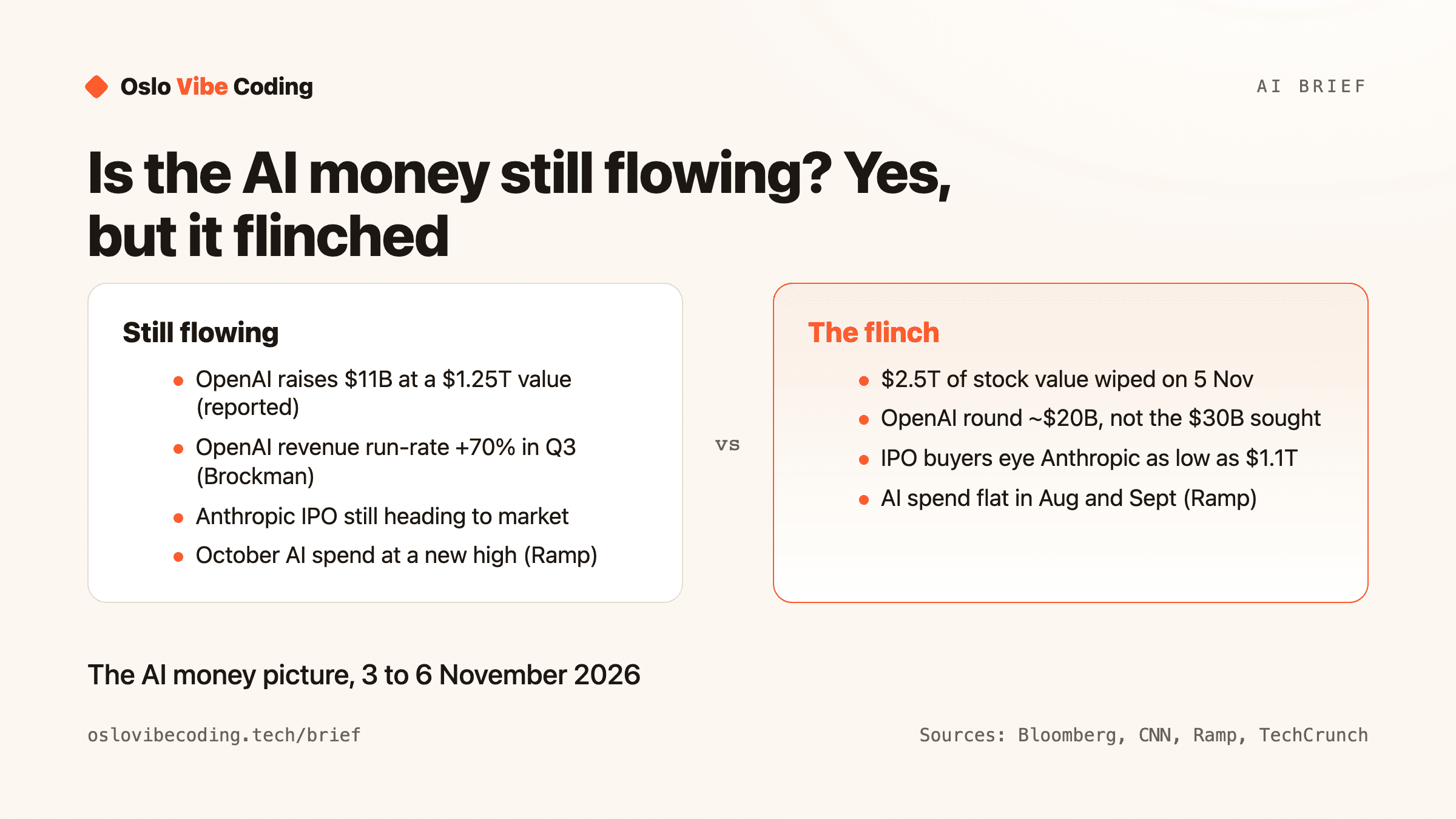
On Thursday 5 November 2026 the Nasdaq fell 5.52%, its worst day since April 2025, wiping roughly $2.5 trillion of market value on fears that Democratic midterm wins, especially in Texas, will slow AI datacentre construction (CNN). Nvidia fell 9.3% and a chipmaker index 12.3%; markets partly rebounded on Friday. On 6 November Bloomberg reported that OpenAI has raised $11 billion of a new round at a $1.25 trillion valuation, with the round expected to total about $20 billion, short of the $30 billion at $1.4 trillion it reportedly targeted in September. A day earlier OpenAI president Greg Brockman said the company could be ready to go public in 2027 and that its annualised revenue grew 70% in the third quarter, with business customers now the majority. Bloomberg, the Wall Street Journal and CNBC reported on 6 November that some potential buyers of Anthropic's IPO shares see a valuation as low as $1.1 trillion, against roughly $2 trillion discussed a month earlier. Ramp, a US corporate card company, reported that business AI token spending barely grew in August and September (1.5% across the two months) even as volumes rose, which its lead economist blames mainly on price cuts; spend reached a new high in October. Nikkei Asia reported on 3 November that US tech giants' off-balance-sheet AI obligations, such as long-term datacentre leases and power contracts, have nearly doubled in six months to about $3.2 trillion. These are reported figures and analyst views, not investment advice.
What happened
Four pieces of news landed within four days, and together they answer a question people keep asking: is the money behind AI still flowing? The short answer is yes, but for the first time in a while it hesitated.
On Tuesday 3 November, American voters punished datacentres at the ballot box (we covered that in today's other brief). On Thursday 5 November investors reacted. The Nasdaq, the US stock index full of tech companies, fell 5.52%, its worst day since April 2025, and about $2.5 trillion of share value disappeared in a day, according to CNN. The next day, Bloomberg reported that OpenAI's newest fundraising round is coming in smaller than planned, and that buyers lining up for Anthropic's stock market listing want to pay less than hoped. Meanwhile Ramp, a US company that issues business credit cards and publishes what those cards are spent on, showed that companies' AI bills have stopped growing even though they are using more AI than ever.
The facts
The sell-off. CNN reported that Thursday's fall was driven by fear that Democratic wins, above all Texas governor-elect Gina Hinojosa's promised pause on datacentre approvals, could slow the AI buildout. Nvidia, the leading AI chipmaker, fell 9.3%, erasing its gains for the year. An index of chipmakers fell 12.3%, its worst day in about six and a half years. CoreWeave and Nebius, two 'neoclouds' (companies that rent out AI chips), fell about 10% and 15%. South Korea's main index dropped almost 9% at Friday's open, triggering a 20-minute trading halt. Prices partly recovered on Friday, though Reuters noted the Nasdaq still posted its fourth weekly loss in a row.
OpenAI. On 6 November Bloomberg reported, citing people familiar with the matter, that OpenAI has raised $11 billion of a new round valuing it at $1.25 trillion, and that the round may total about $20 billion when it closes in the coming weeks. In late September Bloomberg had reported OpenAI was aiming for $30 billion at $1.4 trillion. OpenAI did not comment to TechCrunch. The day before, at a Wall Street Journal conference, OpenAI president Greg Brockman was asked whether the company would be ready to go public next year and answered: 'I think so. Yes.' He said annualised revenue grew 70% in the third quarter and that business customers now bring in the majority of revenue, up from about 30%. He also admitted the first half of 2026 was 'pretty rough' and that OpenAI 'wasn't even in the conversation' in AI coding, where Anthropic's Claude Code had taken the lead.
Anthropic. Bloomberg, the Wall Street Journal and CNBC all reported on 6 November that big investors are pushing back on Anthropic's hoped-for price. According to Bloomberg, some potential buyers think the valuation could be as low as $1.1 trillion, compared with roughly $2 trillion that investors were said to expect a month ago. Reuters reported on 5 November that the AI backlash could even affect the IPO's timing. No price or trading date has been confirmed. For balance: Anthropic's filing, which we covered on 29 October, shows revenue growing more than tenfold in a year. Disclosure: we use Claude, Anthropic's AI, in our work.
Ramp's spending data. Ramp's lead economist Ara Kharazian reported that business spending on AI tokens (the units AI companies charge by, roughly a word fragment each) grew only 1.5% across August and September combined, after rising 42% in July alone, according to TechCrunch. Token volumes kept rising. The biggest spenders, the top 1% of firms, paid $9,568 per employee per month in September, 3.1% below their July high, and Ramp says about 80% of spending on OpenAI and Anthropic comes from that 1%. The median company spends just $12 to $15 per employee per month. Kharazian's explanation is a price war: OpenAI halved API prices for GPT-6 Sol and Luna in September, Anthropic cut prices too (TechCrunch says Anthropic's filing puts the cost at about $600 million of revenue growth), and customers have learned to send simple jobs to cheaper models. October brought a rebound: spend rose 8.9% and hit a new high.
The hidden obligations. Nikkei Asia reported on 3 November that the off-balance-sheet AI obligations of US tech giants, promises such as long-term datacentre leases and power contracts that do not show up as ordinary debt, have nearly doubled in six months to about $3.2 trillion, and that commitments and obligations at Google, Meta and others now reach about 80% of their assets. On Hacker News, several commenters pushed back that these are contracts for future spending stretched over decades, not borrowed money, and that a datacentre lease keeps some value even if AI demand disappoints.
Companies are using more AI than ever. They are not paying more for it.
The everyday version
Think of a new restaurant district. The diners keep coming, more every month, so the landlords sign longer leases and the banks lend for more kitchens. Then a price war breaks out: every restaurant cuts its menu prices in half to win customers. The district is busier than ever, but the tills are not filling faster. That is when the landlords and lenders start asking whether next year's rent can really be paid, and new investors ask for a cheaper price to buy in.
That is roughly where AI is. Demand is real and growing. What has changed is that falling prices and political risk are making investors check the arithmetic before they write the next cheque.
Is this actually new?
Wobbles like this are normal in a boom. In January 2025, when China's DeepSeek showed a cheap, capable model, Nvidia lost about $600 billion of value in one day and the AI buildout carried on. The 2000 dot-com bust is the gloomier comparison: internet use kept growing through the crash, but many companies that had borrowed and built ahead of demand did not survive. Our October brief on AI borrowing overtaking America's car loans and our brief on Uber burning a year's AI budget in four months covered the two sides of that question.
What is new this week is that the doubts arrived together, from three different directions: voters (who decide where datacentres can be built), customers (who decide how much they pay per token) and investors (who decide the price of the two biggest AI listings ever planned). There is also a sharper critique on the table. In a widely shared op-ed for Tech Policy Press on 2 November, lawyer Matt Scherer argued that the US Securities and Exchange Commission should block Anthropic's IPO, warning that retail investors and retirees could be 'left holding the bag' if its spending commitments come due. That is one writer's argument, not a regulatory step, but it shows how quickly the mood around AI money has become a public debate.
What it means
For people who use AI at work, this week is mostly good news. A price war means the same AI costs less, and Ramp's data says buyers now have the upper hand in negotiations: the long contracts AI companies offer usually come with discounts rather than lock-in. If your company's AI bill has stayed flat while usage has grown, you are seeing the same thing in miniature.
For the AI companies, the pressure points are price and patience. Selling more tokens for less money only works if volume keeps growing faster than prices fall, and building datacentres only pays if the buildings can be finished on time. The coming weeks will show how much the market will pay for Anthropic, and whether OpenAI's round closes near $20 billion.
The honest caveats: the OpenAI and Anthropic valuation figures come from anonymous sources reported by Bloomberg, the WSJ and CNBC; Ramp's data covers only its own business customers, mostly American, and Ramp says its top-1% numbers are volatile; and Nikkei's $3.2 trillion counts commitments that stretch over many years. Markets also bounced back on Friday. This is a flinch, not a crash. Nothing here is investment advice.
Voters, customers and investors all asked harder questions in the same week. That is the real news.
Curious about AI? Come build with us.
Oslo Vibe Coding runs free, beginner-friendly drop-ins where we build real things with AI. No one codes alone.